India has grown a lot in digital payments. Apps like PhonePe, Google Pay, and Paytm have made it super easy to send and receive money in just seconds — all thanks to UPI (Unified Payments Interface).
But as digital payments grew, so did online scams.
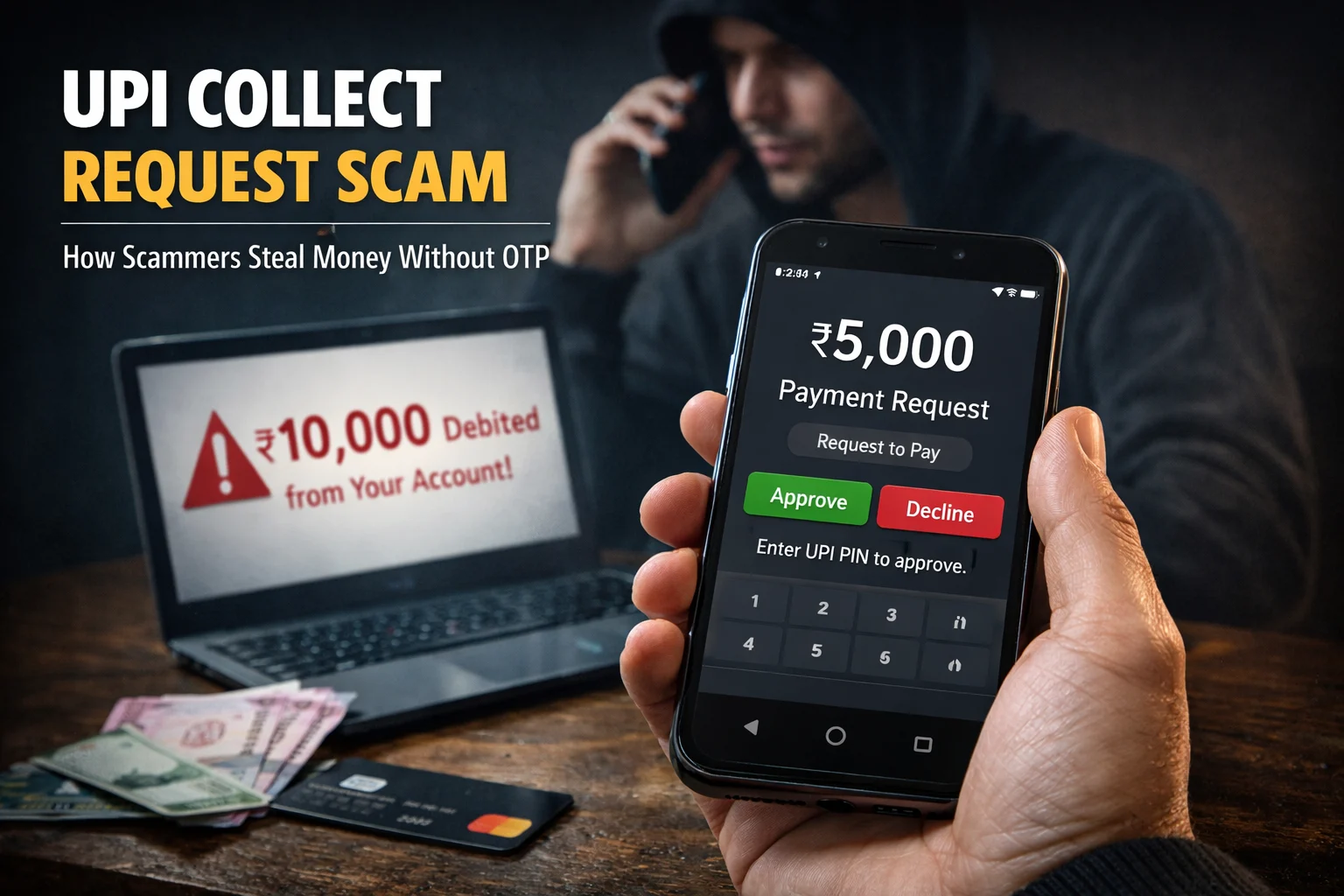
Cybercriminals have found a smart way to steal money from UPI users — it’s called the UPI Collect Request Scam. In this scam, fraudsters trick you into approving a payment request. The moment you approve it, money gets deducted from your bank account — without any OTP.
Yes, you read that right. No OTP needed. Just approving the request + entering your UPI PIN is enough for the money to leave your account. Most people don’t know this, and that’s exactly what scammers take advantage of.
In this article, we’ll explain:
- How this scam works
- How fraudsters trick you
- How to check if a UPI ID or QR code is safe
- How to protect yourself from UPI scams in India
What Is a UPI Collect Request?
A UPI Collect Request (also called a Payment Request) is a simple feature where someone can ask you to send them money — directly through your UPI app.
Instead of you going and sending money yourself, the other person sends you a request. You just see a notification pop up in your app.
You get two options:
- ✅ Approve — money gets sent
- ❌ Decline — nothing happens
If you tap Approve and enter your UPI PIN, the money is instantly transferred to the other person’s account.
This is a totally normal and useful feature. People use it every day for things like:
- Paying a shopkeeper
- Splitting a bill with friends
- Paying a freelancer for work
- Subscribing to online services
So what’s the problem?
The problem is — scammers misuse this exact same feature to steal money from innocent people. And because it looks just like a normal request, most users don’t even realize they’re being scammed.
Also Read: What Is a Digital Arrest Scam And How to Protect Yourself
How the UPI Collect Request Scam Works
The scam usually follows a simple but effective process.
Step 1: The Scammer Contacts You
The fraudster reaches out to you through apps and platforms like:
- WhatsApp or Telegram
- Phone calls
- OLX or Facebook Marketplace
- Fake customer support messages
They pretend to be someone you’d trust, like:
- A buyer interested in your product
- A bank or app customer care agent
- A delivery agent
- A company representative
Step 2: Victim Receives a Payment Request
Instead of sending money, the scammer sends a collect request to the victim’s UPI app.
The notification may look like:
“₹5,000 Payment Request Received”
The scammer claims this request is required to receive money.
This is the trick.
In reality, approving the request sends money instead of receiving it.
Step 3: You Approve and Lose Money
If you:
- Tap Approve
- Enter your UPI PIN
The payment goes through instantly. The money lands in the scammer’s account within seconds.
And since you authorized the transaction yourself using your own UPI PIN, banks usually treat it as a valid payment — making it very hard to get your money back.
Real-Life Example of This Scam
A common scenario happens on online marketplaces.
For example:
Someone lists a phone for sale on an online marketplace. A buyer contacts them and agrees to purchase the item.
The buyer then says:
“I am sending payment through UPI. Please approve the request to receive money.”
Soon, the seller receives a UPI Collect Request for ₹10,000.
Thinking it is required to receive payment, the seller approves the request and enters the UPI PIN.
Instead of receiving money, ₹10,000 is deducted from the seller’s account.
This scam has affected thousands of online sellers across India.
Warning Signs of a UPI Collect Request Scam You Should Never Ignore
Before approving any UPI request, watch out for these red flags:
1. Someone Asks You to “Approve to Receive Money”
This is the biggest red flag.
Receiving money on UPI never requires your approval or PIN. If someone sends you money, it just arrives automatically in your account.
Only sending money requires your UPI PIN.
So if anyone tells you “approve this request to receive your payment” — it’s a scam. Period.
2. They’re Pressuring You to Approve Quickly
Scammers don’t give you time to think. They’ll say things like:
- “Payment is pending, approve fast”
- “Transaction will fail if you don’t approve now”
- “Hurry up, it’s about to expire”
Urgency is a classic fraud trick. Any time someone is rushing you to approve a payment — stop, pause, and think.
3. The Request is From an Unknown UPI ID
If a collect request comes from a UPI ID you don’t recognize — do not approve it. Always verify who is sending the request before doing anything.
4. It Says “Payment Request” — Not “Payment Received”
Always read the notification carefully. There’s a big difference between:
- Payment received
- Payment request
These two look similar but are completely opposite. One small word can cost you thousands of rupees.
How to Check a Suspicious UPI ID or QR Code on ScamDekho
If you receive a suspicious payment request, you can verify the UPI ID before taking action.
Follow these steps:
Step 1: Open the website ScamDekho.
Step 2: Go to the UPI ID/QR code Check tool.
Step 3: Enter the suspicious UPI ID such as: example@upi
Step 4: Click Check UPI ID.
Step 5: The tool will show if the UPI ID or Qr code is scam or safe.
If multiple complaints appear, avoid interacting with that account.
This step helps users identify potential scammers quickly.
What to Do If You Get a Suspicious Collect Request
If you receive an unexpected UPI collect request, don’t panic — just follow these simple steps:
1. Do Not Approve It
This is the most important step. If you don’t recognize the request — decline it immediately. Never approve a collect request from an unknown or unexpected source.
2. Verify Who Sent It
Before doing anything, confirm who actually sent the request. Call or message the person directly through a trusted contact number — not through the same WhatsApp chat where the request came from.
Scammers can easily fake conversations. Always verify through a separate, trusted channel.
3. Never Share Your UPI PIN
Your UPI PIN is like the key to your bank account. Never share it with anyone — not with friends, not with strangers, and not even with someone claiming to be bank staff or customer support.
No legitimate bank or app will ever ask for your UPI PIN.
4. Never Install Remote Access Apps
Some scammers will ask you to install apps like AnyDesk or TeamViewer, claiming they need to “help you” with a payment issue.
Do not install these apps. Once you give someone remote access to your phone, they can see everything — including your UPI apps, bank details, and PIN.
If anyone asks you to install such an app, cut the call immediately.
How to Report UPI Fraud in India
If you become a victim of a UPI scam, act immediately.
Step 1: Call Cybercrime Helpline
Dial 1930, the official cybercrime helpline in India.
This helpline is operated under the Indian Cyber Crime Coordination Centre (I4C) under the Ministry of Home Affairs.
Quick reporting increases the chances of freezing the fraudster’s account.
Step 2: Report Online
Visit the official portal: https://cybercrime.gov.in
Submit a complaint with:
- Transaction ID
- Bank details
- Screenshots
- Phone number used by scammer
Step 3: Inform Your Bank
Contact your bank immediately and report the unauthorized transaction.
Banks may attempt to freeze the destination account if reported quickly.
Quick Safety Tips to Remember
Stay safe from UPI scams by keeping these simple rules in mind:
- Only enter your UPI PIN when you are sending money
- Always decline collect requests from unknown sources
- Never trust a stranger who asks you to approve a UPI request
- Always verify a UPI ID before making any transaction
- Never scan a QR code sent by someone you don’t know
The Golden Rule
Scammers survive on confusion and urgency. Whenever you feel rushed or confused — stop, think, then act.
One extra second of verification can save you thousands of rupees.
Conclusion
The UPI Collect Request Scam is one of the most common online frauds in India right now. Scammers target people who don’t fully understand how UPI payment requests work — and trick them into sending money without even realizing it.
But the good news? Awareness is your strongest weapon.
The one thing you must always remember:
You NEVER need to enter your UPI PIN to receive money. Ever.
If anyone tells you otherwise — it’s a scam.