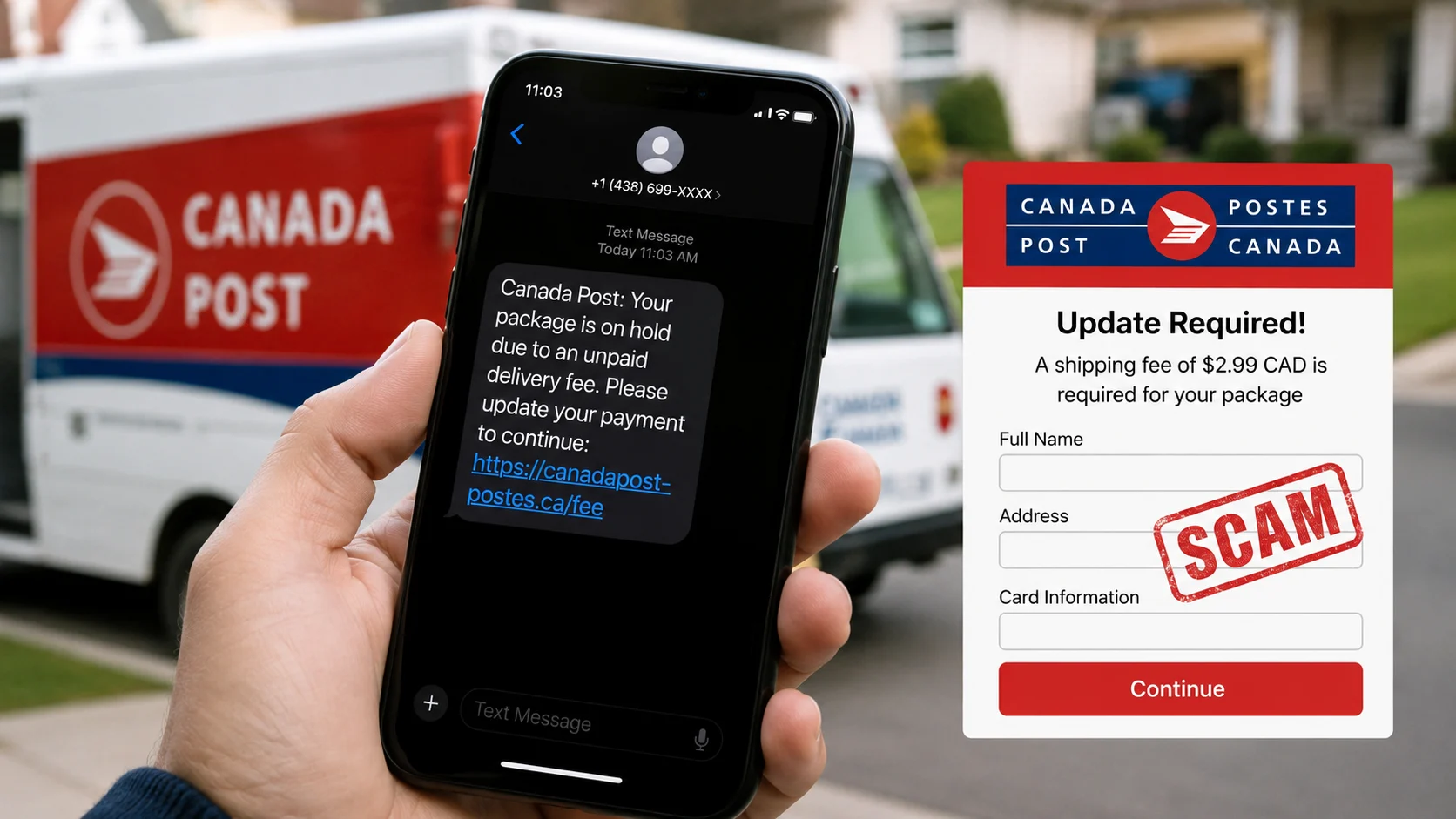
A Canada Post text scam often claims that a package cannot be delivered until you update your address or pay a small fee. The amount is deliberately low so the request feels routine. The linked page may collect card details, identity information or account credentials.
Semrush Canada data shows useful demand with relatively low keyword difficulty. Before opening anything, paste the wording into ScamDekho’s scam message checker. Copy the link without visiting it and inspect the destination with the website scam checker. Neither tool replaces confirmation through Canada Post’s official tracking service.
Quick answer: how do you check a Canada Post text scam?
Do not use the message link. Open the official Canada Post website or app independently and enter the tracking number from the retailer or shipping receipt. Compare the status there. If the text asks for an address correction, card payment or personal information that does not appear in your official tracking record, do not proceed.
Common fake Canada Post message types
Incomplete address text
The message says a street number, postal code or unit is missing and asks you to update the details through a link. The page is built to look like a delivery form.
Small redelivery fee
A charge of a few dollars appears reasonable, but the real objective may be to capture full card details and billing information.
Missed delivery or final attempt
The sender creates urgency by saying the parcel will be returned or destroyed if you do not act immediately.
Customs or import charge
The message claims an international parcel is waiting for a tax or customs payment. Verify through the actual carrier and order record.
Fake delivery survey or prize
The text offers a reward for completing a short survey, then asks for shipping payment or personal details.
10 warning signs of a fake parcel text
1. You were not expecting a package
Scammers send parcel messages in bulk because many recipients are waiting for something. An unexpected message deserves extra checking, but even an expected parcel can be used as bait.
2. The message has no valid tracking context
A generic “your package” notice with no order, retailer or usable tracking detail is difficult to verify. Do not treat a random number in the message as proof.
3. The link uses an unrelated domain
Read the registered domain carefully. A web address can contain “Canada”, “post”, “parcel” or “delivery” without being official. Shortened links also hide the destination.
4. The text demands action within hours
Urgency reduces the chance that you will check the retailer, carrier or official tracking page.
5. A tiny fee requires full card details
The page may use a small charge to collect card number, expiry, security code, address and phone number. The value of the information can be much greater than the advertised fee.
6. The page asks for a banking login or one-time code
Do not provide online-banking credentials, OTPs or device-approval codes to resolve a parcel delivery.
7. The sender number is unfamiliar
Phone numbers can be spoofed or rotated. An apparently local number is not proof that Canada Post sent the message.
8. The message moves to WhatsApp or a phone call
A follow-up agent may claim to help with payment or address verification. Use contact details from the official website instead.
9. The design is convincing but the details do not match
Logos and layouts are easy to copy. Check the order, tracking status, recipient name and domain rather than relying on visual appearance.
10. The sender asks you to install an app
Do not install an APK, browser extension or remote-access tool from a parcel text.
How to verify a Canada Post delivery safely
- Do not tap the text link.
- Open the retailer’s order page separately.
- Copy the tracking number from your genuine order or receipt.
- Type the official Canada Post website address yourself.
- Check the tracking status there.
- Contact the retailer or carrier through independently found details.
- Ignore payment instructions that exist only in the text.
How to inspect the URL
Press and hold the link on mobile or hover over it on desktop to see the destination. Focus on the registered domain, not familiar words in the path. Paste it into the ScamDekho URL checker without visiting the page. A new domain, mismatched identity and limited reputation can support a cautious decision.
HTTPS and a padlock do not prove that the delivery page is genuine.
What to do if you entered card information
Contact the card issuer or bank immediately using its official app or the number on the card. Explain that the details were entered on a suspected phishing page and follow the provider’s current security instructions. Review recent transactions and preserve the text, URL and screenshots.
What to do if you entered a password
Change the password through the real service, especially if it was reused elsewhere. Enable available multi-factor security and review account sessions. Do not approve unexpected login prompts or codes.
How to report the message in Canada
Report the text through the carrier or platform’s current official channel and keep the evidence. The Canadian Anti-Fraud Centre publishes current national guidance at Report fraud and cybercrime. If money or card data is involved, contact the financial provider promptly.
Canada Post text scam checklist
- Expected parcel does not make the text automatically genuine.
- Verify tracking from the retailer or original receipt.
- Open Canada Post independently.
- Do not pay a delivery fee through an unsolicited link.
- Never share an OTP or banking password.
- Save the sender, message, URL and payment record.
- Report the message through official channels.
Frequently asked questions
Does Canada Post send text messages?
Delivery communication options can change. Do not decide from this question alone; verify the specific parcel through the official website or app and your genuine tracking information.
Can a fake message include a real tracking number?
Yes. A number may be copied or unrelated. Check whether it matches your order and official tracking record.
Is a $1 or $2 redelivery fee harmless?
No. A small charge can be used to collect complete card and identity details.
Can ScamDekho confirm a Canada Post message?
No. It provides message and link risk signals. The official carrier and retailer confirm the actual delivery.
Final takeaway
A Canada Post text scam relies on a familiar delivery problem and a low-friction link. Verify the parcel from your genuine order record, not the text. Use this Canada Post text scam checklist before updating an address or entering card information.