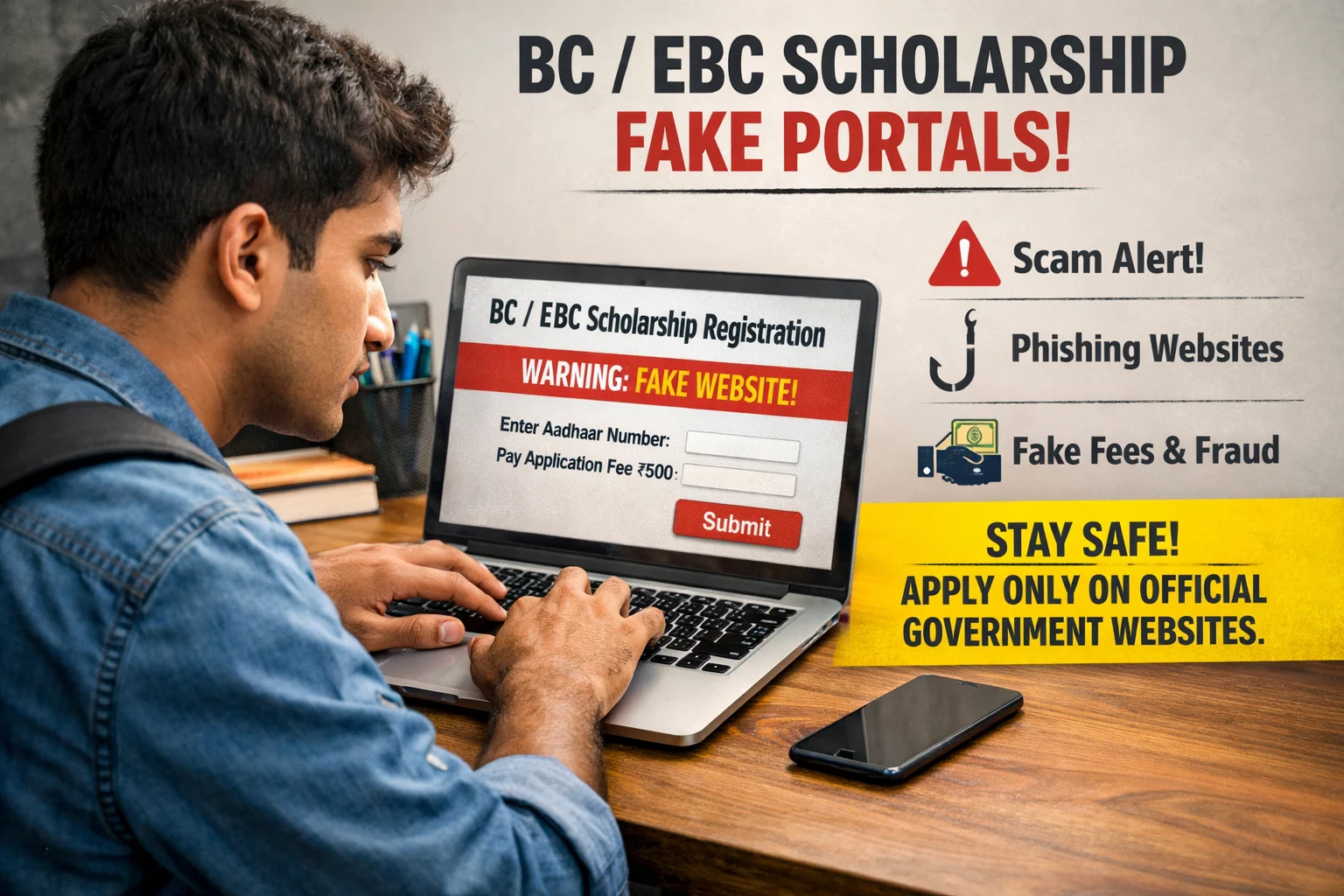
Scholarships for Backward Class (BC) and Economically Backward Class (EBC) students are intended to encourage educational pursuits and avoid financial difficulties. Various government portals, such as the National Scholarship Portal (NSP) and state government social welfare department portals, offer scholarships to students.
But the popularity of these scholarship schemes has also led scammers to target these schemes. Scammers are developing fake scholarship portals, links, and phishing websites that mimic government portals. The motive of these scammers is to obtain personal information, money, and bank account details from students and their parents.
Over the last few years, several scholarship fraud cases and fake scholarship portals have been reported in India.
This article will guide you on how scholarship scams are conducted, how they are identified, and how you can avoid them.
What Are BC / EBC Scholarship Fake Portals?
A fake scholarship portal is a fraudulent website or application that pretends to be an official government scholarship platform.
These fake portals often:
- Use names similar to government schemes
- Copy the design of real scholarship portals
- Ask students to submit personal documents
- Demand registration or processing fees
The objective is usually to collect sensitive information like:
- Aadhaar numbers
- Bank account details
- Student documents
- OTPs for financial transactions
Scammers may later use this information for identity theft, financial fraud, or illegal transactions.
Why Scholarship Scams Are Increasing
Scholarship scams are on the rise due to the growing use of online government schemes. Students use Google, social media, or messaging apps to search for scholarships. Therefore, they become victims of scholarship scams.
According to reports, scholarship scams trick students with the promise of a scholarship or guaranteed approval, asking them to pay fees or share their bank details.
During the scholarship season, which is from February to June, scholarship scams promise quick “scholarships” from fake portals or agents.
Authorities have found cases of massive scholarship scams involving fake educational institutions and fake students claiming their scholarships.
Real Scholarship Scam Cases in India
Scholarship scams have been reported in various states in India. These cases demonstrate the severity of the problem.
1. ₹144 Crore Minority Scholarship Scam
The Central Bureau of Investigation (CBI) has registered a case regarding the benefits received by 830 fake institutions under the minority scholarship scheme, resulting in a loss of more than ₹144 crore for the government.
2. Fake Applicants in Scholarship Schemes
During an investigation, it was discovered that there were over 6.7 lakh fake applicants in the minority scholarship scheme. This is an example of how fake identities are misused for fraudulent purposes.
3. Fake Educational Institutions
In some cases, the scammers even opened fake colleges and uploaded documents to receive scholarships for the students.
4. Scholarship Phone and QR Code Fraud
Parents of the students have been tricked by the scammers, who claimed to be education officials asking them to scan the QR codes to receive the scholarship amount, leading to bank withdrawals.
The above cases are examples of how scholarship schemes are frequently targeted by cybercriminals.
Check: Fake Offer Letter Check Online Free in India – Step-by-Step Verification Guide (2026)
How Fake BC / EBC Scholarship Portals Work
Most scholarship scams follow a similar pattern.
Step 1: Creating Fake Websites
Scammers create websites with names similar to official portals, such as:
- scholarship-india-apply.com
- bc-scholarship-portal.xyz
- nsp-registration-online.info
These sites often look professional and include fake government logos.
Step 2: Promoting the Portal
Fraudsters promote these portals through:
- WhatsApp groups
- Telegram channels
- Instagram reels
- Fake YouTube videos
The posts usually claim:
- “₹50,000 scholarship for all students”
- “Apply before the last date today”
- “100% guaranteed approval”
Step 3: Collecting Data or Fees
Once students visit the site, they are asked to:
- Upload Aadhaar card
- Enter bank account details
- Pay a small “processing fee”
Some websites also request OTP verification, which scammers use to access bank accounts.
Signs That a Scholarship Portal Is Fake
Students should watch for these red flags when applying online.
1. Suspicious Domain Names
Government scholarship portals usually end with:
- .gov.in
- .nic.in
If the website uses domains like .xyz, .online, or .info, it may be fraudulent.
2. Asking for Application Fees
Most government scholarships are completely free to apply.
If a website asks for a processing fee or registration charge, it may be a scam.
Experts warn students to avoid platforms asking for upfront payments for scholarship approvals.
3. “Guaranteed Scholarship” Claims
No government scholarship guarantees approval.
Fake portals often promise:
- Guaranteed selection
- Instant approval
- Scholarship without eligibility checks
4. Contact Only Through WhatsApp
Fake portals often provide only:
- WhatsApp numbers
- Gmail addresses
Official portals usually have government emails and helpline numbers.
5. Urgent Deadlines
Scammers create pressure using messages like:
- “Apply today or lose the opportunity”
- “Limited seats left”
This is designed to make students submit information quickly.
Official Scholarship Portals Students Should Use
To avoid fraud, students should apply only through official government portals.
Some trusted platforms include:
- National Scholarship Portal (NSP) – scholarships.gov.in
- State government scholarship portals
- Welfare department websites
For example, Bihar students applying for BC/EBC scholarships use the official Post-Matric Scholarship portal managed by the government.
These portals handle applications and payments through Direct Benefit Transfer (DBT), which sends scholarship money directly to the student’s bank account.
How Students Can Stay Safe from Scholarship Scams
Follow these safety tips before applying for any scholarship online.
1. Verify the Website
Always check the URL carefully. Official government portals will usually have secure domains ending in .gov.in.
2. Avoid Unknown Links
Never click scholarship links shared through:
- WhatsApp forwards
- Telegram channels
- Random social media posts
3. Do Not Pay Registration Fees
Government scholarships generally do not charge application fees.
If someone asks for payment to “process” a scholarship, it is likely a scam.
4. Protect Personal Documents
Do not upload documents like:
- Aadhaar card
- Bank passbook
- PAN card
Unless you are certain the website is legitimate.
5. Verify Through College or Government Sources
Students can confirm scholarship information through:
- College administration offices
- Official government websites
- Education department announcements
Also Read: Fake UPI Payment Screenshot Scam — How Shopkeepers Are Getting Fooled
What To Do If You Find a Fake Scholarship Portal
If you encounter a suspicious scholarship website:
- Do not enter any personal information
- Take screenshots of the website
- Report it to the Cyber Crime Portal (cybercrime.gov.in)
- Call the cybercrime helpline 1930
- Warn other students and classmates
Reporting these scams helps authorities shut down fake websites faster.
Conclusion
BC and EBC scholarships are providing financial assistance to millions of students across India. However, scammers are misusing these schemes by creating fake portals, phishing sites, and even by making fake calls.
In recent times, investigations have revealed fake institutions, fake documents, and crores of rupees spent on scholarship scams. This shows the gravity of the problem.
Students should be careful while filling up forms online.
Remember these simple rules:
- Apply through official government sites only
- Do not pay any fees for scholarship forms
- Do not click on unknown links on social media
- Keep your personal and banking info secure
Awareness and verification are the best ways to avoid scholarship scams.
Leave a Reply