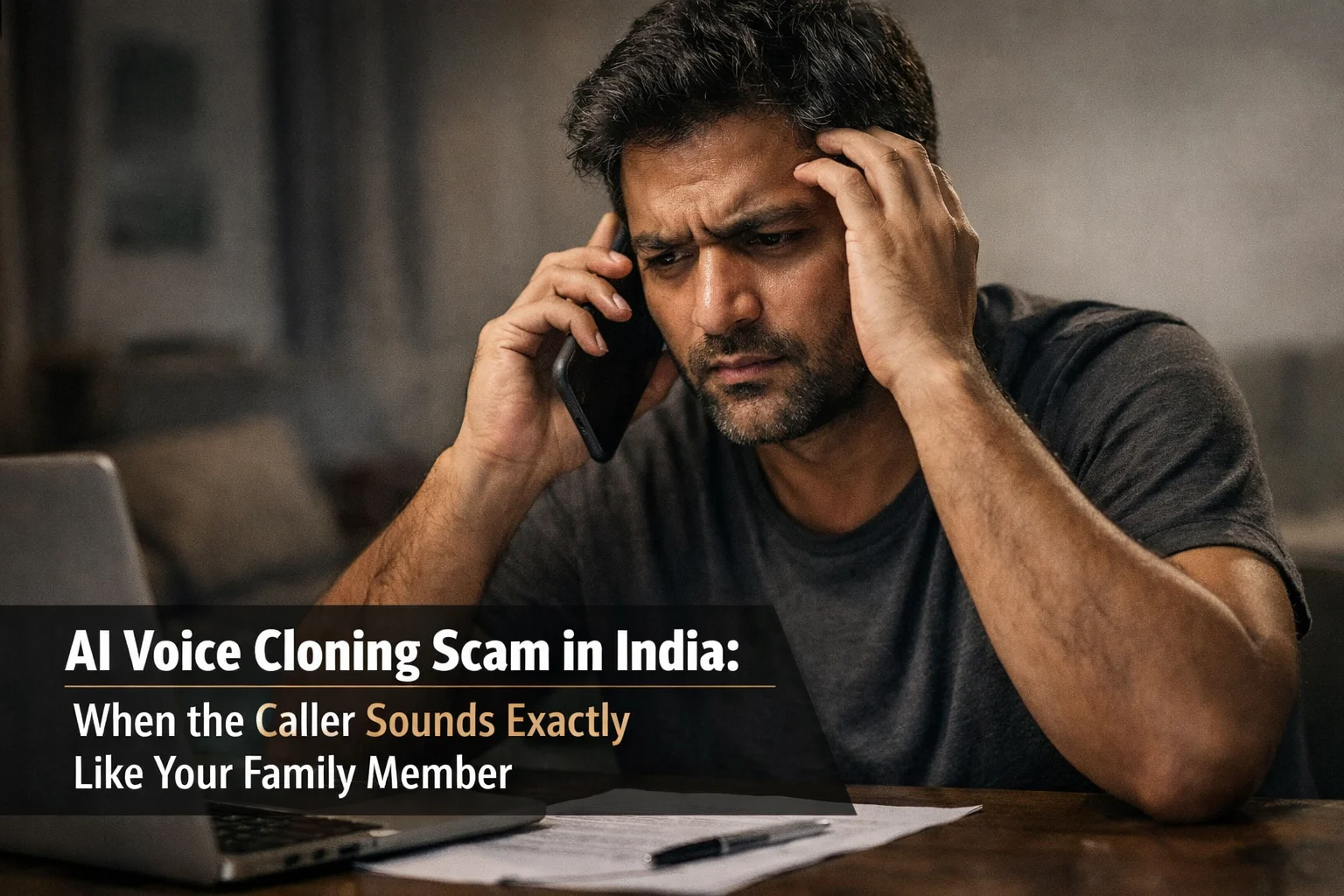
Your phone rings. You answer. It is your son’s voice — panicked, crying: “Papa, I have been in an accident. I am in the hospital. Please send money immediately. Do not tell anyone.”
The voice is perfect. The fear is real. You transfer ₹50,000 within minutes.
Then your son calls from his actual number — safe at home, having no idea what just happened.
This is the AI voice cloning scam. And in 2026, scammers need just 3 seconds of your family member’s voice — taken from an Instagram Reel, a WhatsApp voice note, or a YouTube video — to clone it so accurately that even you cannot tell the difference.
In this guide, we explain exactly how this scam works, how scammers steal your voice without you knowing, real cases from India, and the one protection method that no AI can defeat.
How Serious Is This Threat in India?
- 3 seconds of audio is all a scammer needs to clone any voice in 2026 — down from 20 minutes just three years ago
- 47% of Indian adults have personally experienced an AI voice cloning scam or know someone who has — nearly double the global average
- 77% of voice cloning victims globally lost money as a result of the scam
- ₹2.3 crore was lost by a Mumbai company when a CFO authorised a wire transfer after receiving a call from a cloned CEO voice in early 2026
- Global losses from deepfake and voice cloning fraud exceeded $200 million in just Q1 of 2025 — and India accounts for 8% of all cases
- 70% of people worldwide say they are not confident they could tell the difference between a cloned voice and the real thing
The technology is advancing faster than human detection. And scammers in India are already using it daily.
How Does AI Voice Cloning Work?
You do not need to understand the technology in detail — but understanding the basics helps you realise how serious this threat is.
Step 1: Scammer Finds Your Voice
Scammers havest voice samples from publicly available sources. They do not need to hack your phone or intercept your calls. They look for:
- Instagram Reels and Stories where you speak
- YouTube videos — even short ones
- WhatsApp Status videos with voice
- Facebook videos and Live sessions
- Podcasts, interviews, or news clips
- Voice notes that were accidentally made public
Step 2: AI Clones the Voice in Minutes
Using freely available AI tools, the scammer uploads the 3-second audio clip. The AI extracts a “voice fingerprint” — capturing the exact tone, pitch, rhythm, and emotional quality of the person’s voice. Within minutes, the scammer can type any text and the AI will speak it in that person’s voice — complete with emotion, urgency, and natural breathing patterns.
Step 3: The Call Is Made
The scammer calls a family member — usually a parent, spouse, or sibling. The call appears to come from an unknown number, and the cloned voice immediately creates panic. The script almost always includes:
- A sudden emergency — accident, arrest, hospital, or robbery
- A request to send money immediately via UPI
- A demand not to tell anyone or call back on the regular number
- Extreme urgency — “There is no time, please send now”
The emotional shock of hearing a loved one’s voice in distress bypasses rational thinking. Most victims transfer money before even considering whether the call might be fake.
Types of AI Voice Cloning Scams in India
1. Family Emergency Scam
The most common variant. A parent receives a call from a cloned child’s voice claiming to be in a hospital, jail, or accident. They are asked to immediately transfer money — and told not to call back on the regular number because “the phone is damaged” or “I am in police custody.”
2. Virtual Kidnapping Scam
Scammers clone a child’s voice screaming or crying and call parents claiming they have kidnapped the child. They demand a ransom — ₹50,000 to ₹5 lakh — to be transferred immediately. Meanwhile, the child is perfectly safe somewhere with their phone on silent or unavailable. Scammers time these calls carefully.
3. CEO and Boss Fraud
A company employee receives a call from what sounds exactly like the CEO or MD — asking them to urgently transfer funds to a specific account. The voice is cloned from public videos, conference recordings, or media appearances. A Mumbai CFO lost ₹2.3 crore in exactly this scenario in early 2026.
4. Friend in Need Scam
A cloned voice of a close friend calls claiming to be stranded — abroad, in another city, or in a difficult situation — and asks for an urgent UPI transfer. “I will explain everything later, just please help me now.”
5. Government Officer Impersonation With Voice
Combined with digital arrest scams, scammers now use AI-cloned voices of judges, police officials, or government officers to make fake arrest or legal threat calls sound more convincing and authoritative.
Real Cases
Case 1 — Mumbai, Maharashtra — ₹2.3 Crore Lost
A CFO at a Mumbai company received a phone call from a voice that sounded exactly like the company’s CEO — asking for an urgent wire transfer for a critical business payment. The voice passed every mental credibility check. The CFO authorised ₹2.3 crore. The CEO was in a meeting the entire time and had made no such call. The voice was AI-generated using publicly available recordings of the CEO from company events.
Case 2 — Lucknow, Uttar Pradesh — ₹47,000 Lost
A retired teacher from Lucknow received a call from a voice that sounded exactly like her son. He was “in an accident on the highway” and needed ₹47,000 urgently for hospital admission. She transferred the money immediately. When she called her son’s regular number, he picked up — he was at the office and had no idea. By the time she realised what happened, the UPI transfer was already processed.
Case 3 — Bengaluru, Karnataka — ₹1.2 Lakh Lost
A software professional received a call from what sounded like his close friend — claiming to be stranded in Delhi after a robbery and needing ₹1.2 lakh for a flight back. His friend’s voice, his friend’s manner of speaking, even his friend’s nickname for him were replicated accurately. The scammer had harvested audio from the friend’s Instagram Reels and used additional personal details found on social media.
Case 4 — Hyderabad, Telangana — Virtual Kidnapping
Parents of a college student received a call with their daughter’s voice screaming and crying — saying she had been kidnapped and kidnappers were on the line. The parents were told to transfer ₹3 lakh immediately and not call the police. They were about to transfer when a neighbour suggested they try calling their daughter’s phone from a different number. She picked up — completely safe in her college hostel. The entire call was fabricated using 4 seconds of audio from her Instagram Story.
How Scammers Steal Your Voice Without You Knowing
You do not have to do anything wrong for your voice to be stolen. Scammers harvest voice data from:
- Public Instagram Reels and Stories — the most common source. Even a 5-second clip of you speaking is enough
- YouTube videos — any video where you appear speaking
- WhatsApp Status videos — if your privacy is set to “My Contacts” or “Everyone”
- Facebook videos and Lives — especially older videos that were made public
- Podcasts and webinars — professional appearances are prime targets
- News interviews and college recordings — any publicly available audio
If you have ever spoken in a video posted publicly online — your voice can be cloned today. This is not a future threat. It is happening right now.
How to Detect an AI Cloned Voice Call
Current AI voice cloning is 95% accurate — but not perfect. Here is what to listen for:
- Unnatural rhythm: AI voices often have a perfectly uniform pace — too even, too smooth. Real distressed voices crack, speed up, and slow down irregularly
- Unusual background: Real emergency calls have chaotic background noise — traffic, hospital sounds, voices. Cloned audio is often suspiciously clean or has a faint digital hiss
- Avoids specific questions: Ask something only the real person would know — a pet’s name, a family joke, a recent private conversation. AI cannot answer from a voice clone alone
- Refuses video call: If the caller refuses to switch to video or FaceTime, that is a major red flag
- Extreme urgency: Scammers use urgency to prevent you from thinking clearly. Real emergencies allow time to verify
The One Protection That No AI Can Defeat — Family Code Word
This is the single most effective protection against AI voice cloning scams. Set up a family safe word right now — today, before you finish reading this article.
How to Set It Up
- Choose a random word that has no obvious connection to your family — not a pet’s name, not a hometown, not a favourite food. Something unexpected like “mango tree” or “blue kite” or “seven stairs”
- Share this word privately with all immediate family members — in person or on an encrypted message that you then delete
- Make a family rule: anyone claiming to be a family member in an emergency must say the code word before any money is sent
- If the caller cannot provide the code word — hang up immediately and call the family member directly on their regular number
- Change the code word every few months
No AI voice clone can say your family’s secret code word because it does not exist in any audio or public data. This one simple step defeats even the most advanced voice cloning technology available today.
7 Things to Do Right Now to Protect Yourself
- Set a family code word today — share it with all immediate family members privately
- Review your social media privacy settings — make old videos private or friends-only on Instagram and Facebook
- Never send money based on a voice call alone — always verify by calling back on the person’s regular number
- Tell your parents and elderly relatives about this scam — they are the most likely targets of family emergency variants
- If you receive such a call — hang up and call back on the saved number. Do not use any number the caller gives you
- Never trust urgency — “send money right now or it will be too late” is always a manipulation tactic, not a real emergency
- Report suspicious calls on Sanchar Saathi at sancharsaathi.gov.in and file at cybercrime.gov.in
What to Do If You Already Sent Money
1. Call 1930 Immediately
India’s National Cybercrime Helpline is available 24×7. Call as soon as you realise the fraud. Cyber cells can attempt to freeze the beneficiary UPI account before funds are moved further. Every minute matters.
2. File at cybercrime.gov.in
File a complaint under “Online Financial Fraud.” Include the caller’s number, UPI ID you sent money to, transaction UTR number, and approximate time of the call.
3. Contact Your Bank
Call your bank’s fraud helpline immediately. Provide the UTR number of the fraudulent transaction and request an emergency freeze on the beneficiary account.
4. Report the Number on Sanchar Saathi
Go to sancharsaathi.gov.in → Chakshu → report the phone number used by the scammer. This helps authorities trace and block serial fraud numbers.
5. File an FIR
Visit your nearest cyber police station with all evidence — the caller’s number, UPI transaction receipt, and a written account of what happened. File under Section 318(4) of BNS 2023 and Section 66D of the IT Act.
Check: How to Report a Cyber Crime in India: Complete Step-by-Step Guide (2026)
Key Takeaways
- AI voice cloning needs just 3 seconds of audio — available from any public video or Reel
- 47% of Indian adults have experienced or know someone who faced this scam
- Scammers create family emergencies, virtual kidnappings, and boss fraud calls using cloned voices
- 77% of people who received a voice clone call lost money as a result
- Set a family code word today — it is the only protection AI cannot defeat
- Never send money based on a voice call alone — always call back on the saved number
- If scammed, call 1930 immediately — every minute matters for fund recovery
Conclusion
The most terrifying thing about AI voice cloning scams is not the technology — it is how it exploits the most human of instincts. When you hear someone you love in distress, you do not think. You act. You help. That is exactly what scammers count on.
But now you know. You know how they steal the voice. You know how the call is made. You know what to listen for. And most importantly — you know about the family code word, the one protection that no AI tool in the world can defeat.
Set it up today. Right now. Call your parents, your spouse, your children — and agree on a word. It takes five minutes and could save lakhs.
Share this article with everyone in your family. The elderly are most vulnerable to family emergency variants. Young people are most likely to have their voices harvested from social media. Everyone needs to know about this scam.
And if you ever receive a suspicious link, a fake website, or an unknown UPI ID as part of any scam — check it for free on ScamDekho before clicking or paying.
Set the code word. Verify before you pay. Share this with your family today.
Frequently Asked Questions
1. Can AI really clone a voice from just 3 seconds of audio?
Yes. In 2026, AI tools like Microsoft’s VALL-E 2 and similar models can generate a convincing voice clone from as little as 3 seconds of clean audio. The AI extracts a voice fingerprint — capturing tone, pitch, rhythm, and emotional quality — and can then speak any text in that person’s voice. This technology is now freely available online.
2. How do I know if the call I received was AI-generated?
Listen for unnaturally smooth rhythm, suspiciously clean background noise, and evasiveness when asked specific personal questions. But the most reliable method is not to try to detect it — just always verify by calling back on the regular saved number of the person, regardless of how real the voice sounds.
3. My social media is set to friends only. Am I safe?
Safer — but not completely safe. Voice notes sent on WhatsApp, old public posts, group recordings, and content shared by mutual contacts can still be accessed. The safest approach is to assume your voice is accessible and focus on verification protocols rather than trying to completely prevent voice harvesting.
4. Is the family code word really effective?
Yes — it is the single most effective protection available. An AI voice clone can replicate how someone sounds but cannot know a privately shared secret word. As long as the code word is kept private and never mentioned in any public recording, no voice cloning technology can defeat it.
5. Can companies protect themselves from CEO voice cloning fraud?
Yes. Companies should implement multi-person authorisation for any financial transfer above a set amount, require written confirmation via official email for all fund transfers regardless of verbal instructions, and train finance teams to always verify unusual payment requests through a known secondary contact — never using contact details provided in the suspicious call itself.