You just realised you have been scammed. Money is gone. You are panicking. You do not know what to do first.
Take a breath. Then read this.
Every minute matters after a cyber fraud. The faster you report, the better your chances of getting your money back. India has a proper system for this — most people just do not know how to use it.
This guide gives you the exact steps to follow, the exact things to say to your bank, and the exact portals to file your complaint — all in one place, in simple language.
How Serious Is Cyber Fraud in India Right Now?
Before we get into the steps, here is why acting fast is so important:
- ₹22,845 crore was lost to cyber fraud in India in 2024 — a 206% increase from 2023
- 22.68 lakh complaints were filed on cybercrime.gov.in in 2024 — up from 10.29 lakh in 2022
- National recovery rate improved from 10% in 2024 to 24% in 2025 — because more people are reporting faster
- ₹4,386 crore has been saved so far through the 1930 helpline system by freezing fraudulent accounts in time
- Only 1 in 10 cyber fraud victims in India actually report the crime
The system works — but only if you use it fast enough.
The Golden Rule: Report Within 24 Hours
When you transfer money via UPI, NEFT, or any digital method — scammers move it through multiple accounts within minutes. The 1930 helpline system is directly connected to banks and can request an emergency freeze on the beneficiary account. But this only works if funds have not yet been moved or withdrawn.
- 0 to 4 hours: Best chance of recovery — account freeze is very likely
- 4 to 24 hours: Still possible — partial recovery realistic
- 24 to 72 hours: Difficult — money has usually moved through multiple accounts
- After 72 hours: Recovery is rare — but filing a complaint is still essential for legal record and bank dispute
Do not wait. Do not feel ashamed. Do not think the amount is too small. Report immediately.
What You Need Before You Start
Keep all of this ready before making any call or filing any complaint. This will speed up the process significantly:
Transaction Details
- Exact amount lost and date and time of transaction
- UTR number or Transaction ID (found in your UPI app or bank statement)
- UPI ID, account number, or phone number you sent money to
- Your bank name and account number
Evidence Screenshots
- All WhatsApp, Telegram, or SMS conversations with the scammer
- Screenshots of any website, app, or link used in the scam
- Screenshot of UPI payment confirmation from PhonePe, GPay, or your banking app
- Any offer letter, job posting, or fake website shared by the scammer
- Email communications if any
Personal Documents
- Your Aadhaar card, Voter ID, or any government ID (soft copy in .jpg or .png, under 5MB)
- Your mobile number linked to the bank account
Important: Do not delete any chats, messages, or screenshots. Even if you blocked the scammer — the evidence in those screenshots is what investigators will use. Store everything in a folder on your phone or email it to yourself before anything is accidentally deleted.
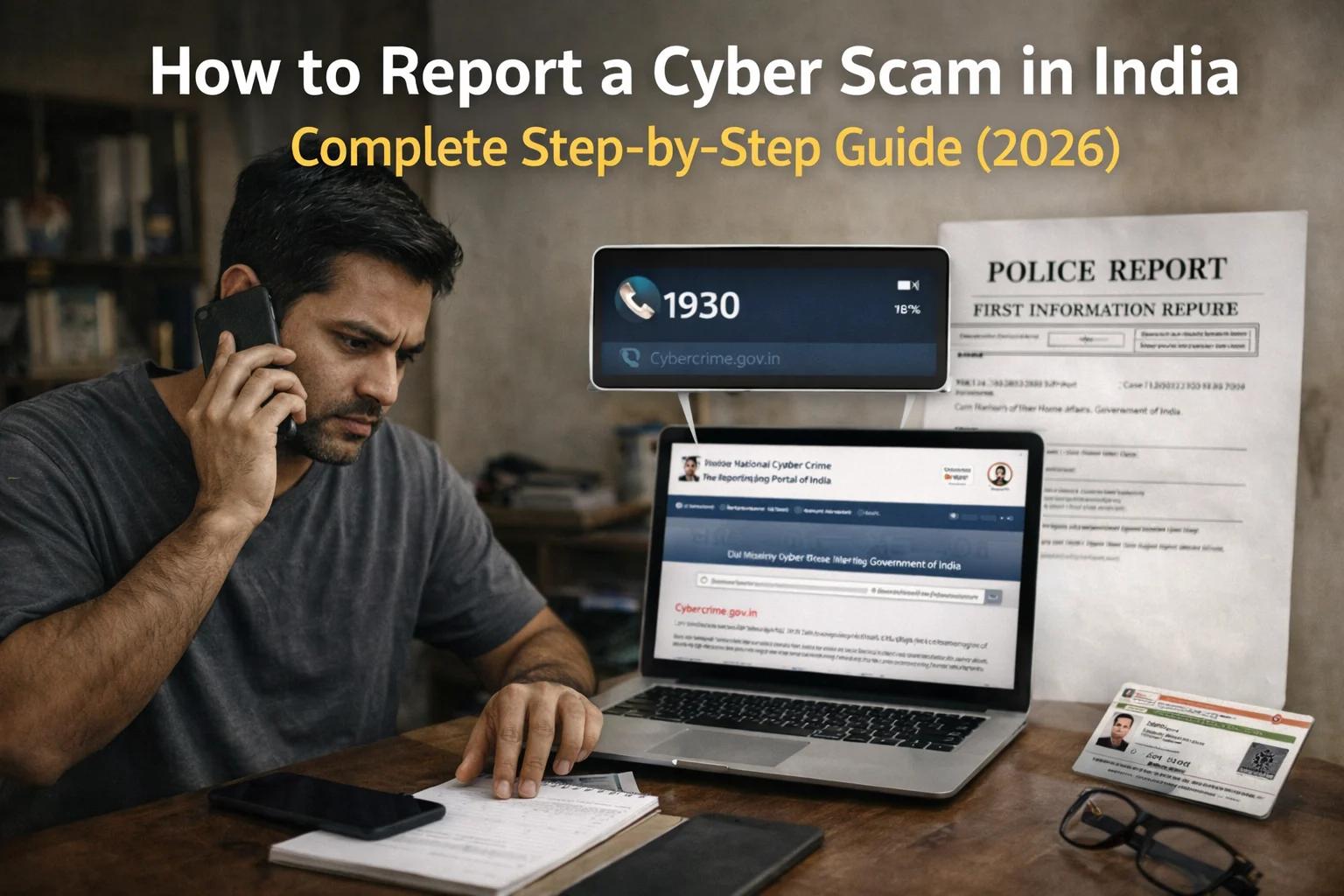
Step 1 — Call 1930 Immediately (Do This First)
Before filing any written complaint, call 1930 right now.
This is India’s National Cybercrime Financial Fraud Helpline, available 24 hours a day, 7 days a week. It is completely free.
Here is exactly what happens when you call:
- The operator takes your details — transaction amount, UTR number, bank name, and the fraudster’s account details
- Your complaint is instantly forwarded through a centralised system connected to all major banks and payment gateways
- Authorities attempt to place a transaction hold or fund freeze request on the suspicious account
- You receive an SMS with an acknowledgement number — save this, you will need it
After the call, you must log in to cybercrime.gov.in within 24 hours to complete the formal written complaint using your acknowledgement number. The call alone is not sufficient — it must be followed up with the online complaint.
What to Say When You Call 1930
“I am a victim of cyber fraud. On [date] at [time], I was deceived into transferring ₹[amount] to UPI ID [UPI ID] / bank account [account number]. My bank is [bank name]. The UTR number of the transaction is [UTR number]. I request an immediate freeze on the beneficiary account.”
Speak clearly and slowly. Give exact numbers. The operator will guide you through the rest.
Step 2 — File Your Complaint on cybercrime.gov.in
This is India’s official National Cyber Crime Reporting Portal, run by the Ministry of Home Affairs. Filing here creates a legal record of your complaint and triggers action by state cyber cells.
How to File — Exact Steps
- Go to cybercrime.gov.in on your browser
- Click “File a Complaint”
- Click “Report Other Cyber Crime” for financial fraud, job scam, fake website, or investment fraud
- Fill in your personal details — name, state, district, PIN code
- In the complaint form, select the category — choose “Online Financial Fraud” for most scams
- Select the sub-category — UPI Fraud, Fake Job Scam, Investment Fraud, etc.
- Enter the incident date, time, and platform (WhatsApp, Telegram, website, etc.)
- In the description box — write a clear, factual account of what happened. Minimum 200 characters. Do not use special characters like #, $, @, ^
- Enter the bank name, account number, and UTR transaction number
- Upload your evidence screenshots and a copy of your ID
- Submit — you will receive a complaint reference number. Save this immediately. Your complaint is automatically routed to your State or UT cyber cell for action.
Tips for Writing Your Complaint Description
- Write in simple, factual language — what happened, when, how, how much
- Include the exact scammer UPI ID or account number
- Mention the platform — WhatsApp, Telegram, Instagram, job portal, etc.
- Do not exaggerate or include unnecessary emotional content — stick to facts
- A good description example: “On 18 March 2026, I received a WhatsApp message from +91-XXXXXXXXXX offering a part-time job for liking YouTube videos. After completing three tasks for which I was paid ₹450 via UPI, I was asked to deposit ₹5,000 to a ‘VIP task group’ UPI ID: fraud@ybl to earn ₹12,000. After payment, the contact disappeared. Total loss: ₹5,000. UTR: XXXXXXXXXX.”
Step 3 — Contact Your Bank Immediately
Parallel to calling 1930, call your bank’s fraud helpline. Do not wait for cybercrime.gov.in complaint first — do this at the same time.
What to Say to Your Bank
“I am a victim of a cyber fraud. On [date], I was deceived into transferring ₹[amount] to UPI ID [UPI ID] / account number [number]. I request you to immediately flag this transaction and send an emergency hold request to the beneficiary bank under RBI cybercrime guidelines. My 1930 acknowledgement number is [number] and my cybercrime.gov.in complaint reference is [number]. Please treat this as urgent.”
Major Bank Fraud Helpline Numbers
- SBI: 1800-111-109 or 1800-425-3800
- HDFC Bank: 1800-202-6161
- ICICI Bank: 1800-102-4242
- Axis Bank: 1800-209-5577
- Kotak Mahindra: 1860-266-0811
- Bank of Baroda: 1800-102-4455
- Punjab National Bank: 1800-180-2222
- Paytm: 0120-4456-456
- PhonePe: 080-68727374
- Google Pay: 1800-419-0157
Know your rights: Under RBI guidelines, if you report an unauthorised transaction within 3 working days and it was not due to your own negligence, your bank is required to refund the amount. Follow up in writing if your bank does not respond within 3 working days.
Step 4 — Report the Scammer’s Phone Number on Sanchar Saathi
Go to sancharsaathi.gov.in and click on “Chakshu” — this is the Government of India’s platform to report fraudulent phone numbers.
Report the exact number used by the scammer. The Department of Telecommunications uses these reports to trace and block fraud numbers. Complaints made within 30 days are actively investigated. Reports after 30 days still help identify patterns and block serial offenders.
This step takes under 5 minutes and helps protect thousands of other potential victims from the same number.
Step 5 — File an FIR at Your Local Cyber Police Station
An online complaint on cybercrime.gov.in is important — but for serious fraud, especially above ₹10,000, filing a physical FIR gives you a stronger legal position.
When is an FIR Mandatory?
- Loss above ₹10 lakh — under the new e-Zero FIR initiative, complaints involving losses above ₹10 lakh automatically generate a Zero FIR
- When your bank asks for an FIR copy to process your refund
- When you want to pursue legal action against the scammer
- For identity theft, data breach, or harassment cases
How to File an FIR
- Visit your nearest cyber police station or any police station
- Carry printed copies of all evidence — chats, payment receipts, screenshots, offer letters
- Carry your cybercrime.gov.in complaint reference number
- Request to file an FIR under Section 318(4) of BNS 2023 (cheating) and Section 66D of the IT Act (cheating using computer resources)
- Review the FIR carefully before signing — make sure all amounts and details are accurate
- Get a copy of the FIR with the FIR number and investigating officer’s name and contact
What If Police Refuse to File an FIR?
This still happens in some stations. If police refuse, remind them of Section 173 of BNSS 2023 (formerly Section 154 of CrPC), which legally mandates registering an FIR for cognizable offences. If they still refuse, file your complaint on cybercrime.gov.in — online complaints are monitored directly by the Ministry of Home Affairs and local police are mandated to act on them.
Step 6 — Escalate If No Action Is Taken
If you filed a complaint and received no response or action within a reasonable time, do not give up. You have escalation options.
Escalate to RBI Banking Ombudsman
If your bank refuses to acknowledge or act on your fraud complaint within 30 days, file a complaint against the bank at bankingombudsman.rbi.org.in. The RBI Ombudsman has authority to direct banks to process refunds in eligible fraud cases.
Escalate to State Cyber Cell
If local police are unresponsive, contact your state’s dedicated cyber crime cell directly. Most states now have a separate cyber crime division with dedicated officers for financial fraud cases.
Escalate to National Consumer Helpline
For e-commerce fraud, fake delivery scams, or online shopping fraud, file a complaint at consumerhelpline.gov.in or call 1800-11-4000.
You can also use ScamDekho to verify any website link, UPI ID, or QR code before clicking or paying — completely free, no login required.
Types of Cyber Scams You Can Report
The cybercrime.gov.in portal accepts complaints for all of these:
- UPI fraud and digital payment scams
- Fake job offer and work-from-home scams
- Online investment and trading scams
- Fake loan app fraud
- Digital arrest scam
- Phishing — fake bank, UIDAI, or government websites
- Online shopping fraud — fake products, no delivery
- Fake donation and NGO scams
- Identity theft and Aadhaar misuse
- Social media hacking and impersonation
- Sextortion and online blackmail
- Fake customer care number fraud
- SIM swap fraud
- Ransomware and hacking
Also Read: Fake Scheme Portals Are Defrauding Users-How to Spot Scams on Government Sites
Quick Reference — All Important Links and Numbers
- National Cybercrime Helpline: 1930 (24×7, free)
- Online Complaint Portal: cybercrime.gov.in
- Report Fraud Phone Numbers: sancharsaathi.gov.in (Chakshu)
- RBI Banking Ombudsman: bankingombudsman.rbi.org.in
- National Consumer Helpline: consumerhelpline.gov.in or 1800-11-4000
- Check Suspicious Links and UPI IDs: scamdekho.in
- PM CARES Fund (official): pmcares.gov.in
- NGO Verification: ngodarpan.gov.in
Key Takeaways
- Call 1930 immediately after any cyber fraud — this is the most time-sensitive step
- File a written complaint on cybercrime.gov.in within 24 hours of calling 1930
- Contact your bank simultaneously — use the exact script provided above
- Report the scammer’s number on Sanchar Saathi at sancharsaathi.gov.in
- File a physical FIR for losses above ₹10,000 — especially if your bank needs it
- Escalate to RBI Ombudsman if your bank does not respond within 30 days
- Check any suspicious link or UPI ID on ScamDekho before clicking or paying
- Never pay any fee to anyone who offers to help you recover your scammed money — that is a second scam
Conclusion
Getting scammed is not your fault. These are professional criminal networks that have spent years perfecting their techniques to deceive even the most careful people.
But now you know exactly what to do. You have the helpline number. You have the portal link. You have the bank script. You have the escalation path.
The most important thing is speed. Every hour you wait reduces your chance of recovery. So do not wait, do not feel ashamed, and do not think your case is too small to report. Even small amounts, when reported, help authorities track and shut down the networks behind these scams.
And before your next online transaction — if you ever receive a suspicious link, a UPI ID from an unknown source, or a website that feels off — check it for free on ScamDekho before you click or pay. That one check could save you from needing this guide in the first place.
Bookmark this page and share it with your family. The person who needs it most might not know this guide exists until it is too late.
Report fast. Recover faster.