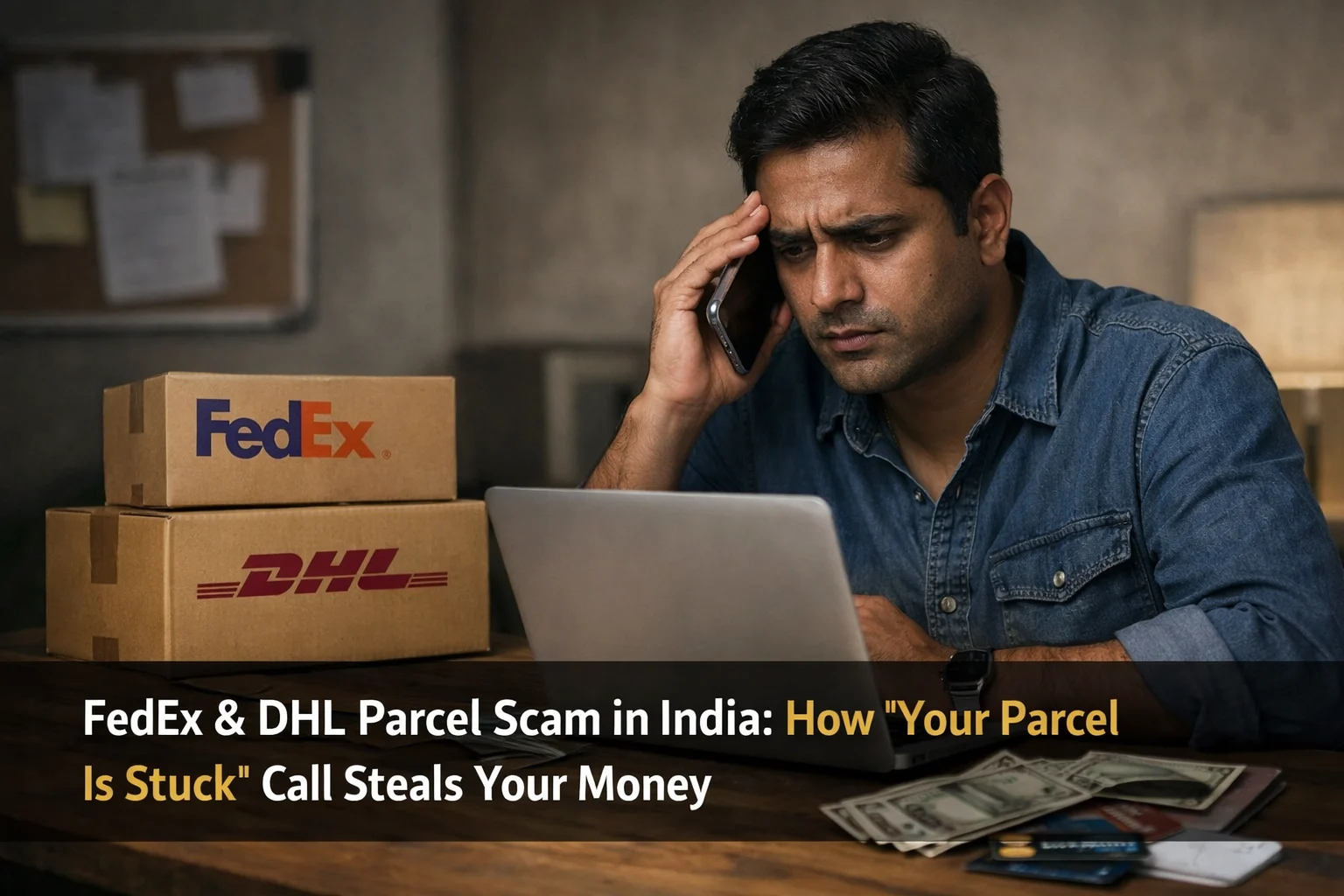
Imagine this. You are in the middle of a normal workday and your phone rings. A robotic voice says, “Your FedEx package has been blocked, press 1 to speak to an officer.” You press 1 out of curiosity. A person on the other end tells you that a parcel booked in your name is stuck at Mumbai customs, and it contains narcotics, fake passports, and illegal SIM cards. Before you can process what is happening, the call is transferred to a man in police uniform on Skype who says you are now under “digital arrest” and must transfer money to prove your innocence.
This is not a movie plot. This is the FedEx and DHL parcel customs scam, and it has already stolen over ₹1,806 crore from Indians in just one year, according to Bengaluru City Police data. The scary part is how real it feels, because the caller already knows your Aadhaar number. This guide explains exactly how the scam works, the red flags to catch in the first 30 seconds, and what to do if you or a family member has already picked up the call.
What Is the FedEx / DHL Parcel Customs Scam?
The FedEx parcel scam is a phone-based impersonation fraud where criminals pretend to be courier company employees and accuse you of sending or receiving an illegal international parcel.
Once they have your attention, the call is transferred to a fake police officer, NCB agent, or customs official who demands a “security deposit” or “verification payment” to clear your name.
This scam is also known as:
- “Your parcel is stuck at customs” fraud
- Fake courier call scam
- Digital arrest parcel scam
- Narcotics parcel scam
How Big Is the Problem? (Data You Should Know)
The parcel scam is not a fringe crime. It is one of the fastest-growing cyber frauds in India.
| Region | Cases Reported | Losses / Status | Source |
|---|---|---|---|
| Bengaluru | 1,417 cases in 2024 (up 251% from 2023) | Part of ₹1,806 crore total cyber losses in 2024 | Bengaluru City Police |
| Telangana | 645 cases in 2023 vs 64 in 2022 | ₹18.24 crore lost; ₹4.77 crore recovered | Telangana State Cyber Security Bureau |
| Krishnagiri (TN) | 337 cases in 2024 | Zero cases in 2023 | The New Indian Express |
| All India | 7.4 lakh+ cyber complaints in 2024 | ₹11,333 crore+ lost overall | I4C, Ministry of Home Affairs |
What makes this scam especially dangerous is the psychology behind it. Over 70% of victims in reported cases have said they initially sensed something was off. But the moment the scammer correctly recited their Aadhaar number, their doubt collapsed. This is the real weapon of the scam: leaked personal data combined with fear.
How the Scam Actually Works Step by Step
Here is the exact playbook scammers follow, reconstructed from FIRs, FedEx’s official advisory, and verified news reports.
Step 1: The IVR Call
You receive an automated call in English or Hindi saying:
“Your FedEx package has been blocked. Press 1 to speak to customer care.”
The moment you press 1, you are connected to a live “agent”.
Step 2: The Hook
The “agent” claims a parcel booked in your name is stuck at Mumbai or Delhi airport and contains one or more of the following:
- MDMA or other narcotics
- Fake passports
- Illegal SIM cards
- Foreign currency
- Expired credit cards
They quote your full name and Aadhaar number, obtained from data leaks, to appear legitimate.
Step 3: The Transfer to “Police”
The call is transferred to a fake officer from the “Mumbai Cyber Cell” or “Narcotics Control Bureau”. They instruct you to download Skype, Zoom, or a custom app for a “digital statement”.
Step 4: The Digital Arrest
On video, you see a man in police uniform, often with a fake police station backdrop. He tells you:
- You are under “digital arrest” and cannot contact anyone
- Your Aadhaar is linked to a money-laundering case
- You must transfer money to a “verification account” for clearance
Step 5: The Drain
Victims are kept on the call for hours or even days, sometimes forced to check into hotel rooms to isolate them. Money is transferred in multiple tranches to mule accounts, from where it moves through UPI chains to Dubai, Cambodia, or Myanmar.
Real Case Studies
Case 1: Bengaluru Journalist (2023) A 70-year-old journalist received a WhatsApp call from someone claiming to be FedEx Mumbai. The caller alleged her parcel contained 240 grams of MDMA. After being transferred to a fake NCB officer on Skype, she transferred ₹1,20,36,246 to four different accounts. Source: The News Minute.
Case 2: Hyderabad IT Employee (2023) A 36-year-old software engineer, Yashaswi, lost ₹8,74,998, her entire savings including a recurring deposit, after being told her FedEx parcel to Taiwan was flagged for “identity theft”. Source: The Hindu / Hyderabad Cyber Crime.
Case 3: Retired Delhi Couple (2025) A retired doctor couple in Greater Kailash lost nearly ₹15 crore after being held on a two-week “digital arrest” video call by fraudsters pretending to be TRAI and Mumbai Police officials. Source: Times of India.
9 Red Flags to Identify a FedEx / DHL Parcel Scam Call
If any ONE of these appears, it is a scam:
- The call starts with a recorded (IVR) message asking you to “press 1”
- The caller claims your parcel contains drugs, passports, or SIM cards
- They know your Aadhaar number but still ask you to “confirm” it
- You are asked to download Skype, Zoom, or any “official police app”
- A police officer in uniform appears on video call
- You are told you are under “digital arrest” and cannot inform anyone
- They ask for money transfer to a “RBI verification account” or “government account”
- The urgency is extreme, you must pay within minutes or hours
- Caller ID shows +92, +84, +855, +1, or an unusual +91 prefix
Important: Indian law does not recognise any concept of “digital arrest”. The Ministry of Home Affairs and PIB have officially confirmed this is a complete fabrication used only by scammers. (Source: PIB Fact Check.)
How Scammers Get Your Aadhaar & Personal Details
This is the part most articles skip. Scammers get your data from:
- Data leaks from telecom operators, e-commerce sites, and loan apps
- Cyber cafés and photocopy shops that store Aadhaar copies
- Resold CRM databases sold on Telegram for ₹500 to ₹5,000 per 10,000 records
- Phishing links sent through SMS and fake job portals
If you have ever uploaded your Aadhaar to an unverified job site or loan app, your data is already on a list somewhere. A safer habit is to run any suspicious link through our free URL Checker tool before clicking. It instantly flags known phishing and scam domains.
What to Do If You Receive Such a Call (Step by Step)
Within 0 to 5 minutes
- Disconnect the call immediately. Do not say anything, do not press any number.
- Do not download any app they recommend (Skype, AnyDesk, TeamViewer, or custom apps).
- Block the number on WhatsApp and your dialler.
Within 30 minutes
- Call your family and tell them. Isolation is the scammer’s main weapon.
- Verify the parcel claim by visiting the official FedEx, DHL, or Blue Dart tracking websites. Never use any link the caller sent.
- Take screenshots of the call log, WhatsApp chat, and any SMS received.
If You Have Already Transferred Money
- Call 1930, the National Cyber Helpline, within the Golden Hour (first 60 minutes). This is the window during which banks can freeze the receiving mule account.
- File a complaint at cybercrime.gov.in
- Visit your bank branch and file a written dispute for the specific transaction IDs.
- File an FIR at your local police station under IT Act Sections 66C, 66D, and IPC Section 420. For a full walkthrough, read our step-by-step money recovery guide.
FedEx, DHL & Blue Dart: What the Companies Officially Say
According to the official FedEx India advisory (fedex.com/en-in/trust-center/report-fraud.html):
- FedEx never solicits personal information through unsolicited calls, email, or SMS.
- FedEx has no affiliation with any law enforcement agency.
- FedEx will never ask you to transfer money for “parcel clearance” or “fines”.
DHL and Blue Dart have issued identical advisories on their official websites. If you are unsure whether a message from any courier is genuine, you can paste the suspicious text into our scam message checker. It analyses wording, sender patterns, and known fraud templates instantly.
FedEx Parcel Scam vs Genuine Courier Call: Quick Comparison
| Factor | Scam Call | Genuine Courier Call |
|---|---|---|
| Source | Random mobile/VoIP number, +92/+84 codes | Registered landline of courier branch |
| Language | IVR + hostile “police” tone | Normal customer-care tone |
| Asks for money | Yes, immediately | No. Payments only at delivery or on official portal |
| Mentions narcotics / Aadhaar / NCB | Yes | Never |
| Asks you to install apps | Yes. Skype, AnyDesk, custom apps | No |
| Tracking | No valid AWB number visible on official website | Always matches official courier website |
Who Is Most at Risk?
Based on case data, the highest-risk groups are:
- Senior citizens (60+), emotionally vulnerable and less familiar with digital tools
- NRIs and families of NRIs, international parcels sound plausible
- Students and job seekers, often share Aadhaar with fake recruiters (see our detailed guide on spotting fake job offers)
- Small business owners using international logistics
If your parents or elderly relatives use smartphones, keep two of our free tools bookmarked on their phones for quick safety checks.
Internal Safety Checklist (Print or Save This)
- Never press “1” on unknown IVR calls claiming to be a courier
- Never share Aadhaar, PAN, or OTP on phone/video calls
- Never download Skype, AnyDesk, or “police apps” on someone’s instruction
- Never transfer money to verify innocence. That concept does not exist in Indian law
- Always verify courier claims on the official company website
- Always report scams within the 60-minute Golden Hour
- Always tell an elderly family member this scam exists. Prevention is 10x better than recovery
Final Word
The FedEx and DHL parcel customs scam works because it attacks three human instincts at once: fear of law, trust in brands, and urgency under pressure. The moment you understand the pattern, the scam loses all power.
If you ever get that “your parcel is stuck at customs” call, remember one sentence: no genuine courier company, police officer, or customs agent will ever demand money over a phone or video call. Hang up, check the official website, and report it.
Share this guide with at least one senior citizen in your family today. That single forward can save someone ₹1 crore.
FAQs: People Also Ask
It is 100% fake. FedEx India has officially confirmed it does not make such calls or accept money for “parcel clearance”. Any call claiming your parcel contains drugs or illegal items is a scam. Real customs enforcement in India does not happen over phone calls or Skype.
Digital arrest is not a legal concept in Indian law. The Ministry of Home Affairs and PIB Fact Check have repeatedly confirmed that no Indian police, CBI, NCB, or court ever conducts “arrests” over video calls. Anyone claiming this is a fraudster.
Recovery depends on speed. If you report within the 60-minute Golden Hour on 1930 or at cybercrime.gov.in, banks can sometimes freeze the mule account before the money moves further. Telangana’s TSCSB, for example, recovered ₹4.77 crore out of ₹18.24 crore lost. After 24 hours, recovery chances drop significantly.
Most parcel scammers buy data in bulk from leaks, telecom breaches, loan app leaks, e-commerce data dumps, and Telegram database sellers. Them knowing your Aadhaar does not mean the call is real.
Avoid answering calls starting with +92, +84, +855, +1, or any unusual international code unless you are expecting one. TRAI has officially advised citizens to disconnect and report such calls through the Sanchar Saathi portal (sancharsaathi.gov.in).
No. The companies are not liable because the scammers only impersonate them and are not their employees. Your only legal route is reporting to cybercrime authorities and your bank.
This article is for educational and awareness purposes only. It does not constitute legal or financial advice. If you are a scam victim, please consult a qualified cybercrime lawyer and your bank immediately.