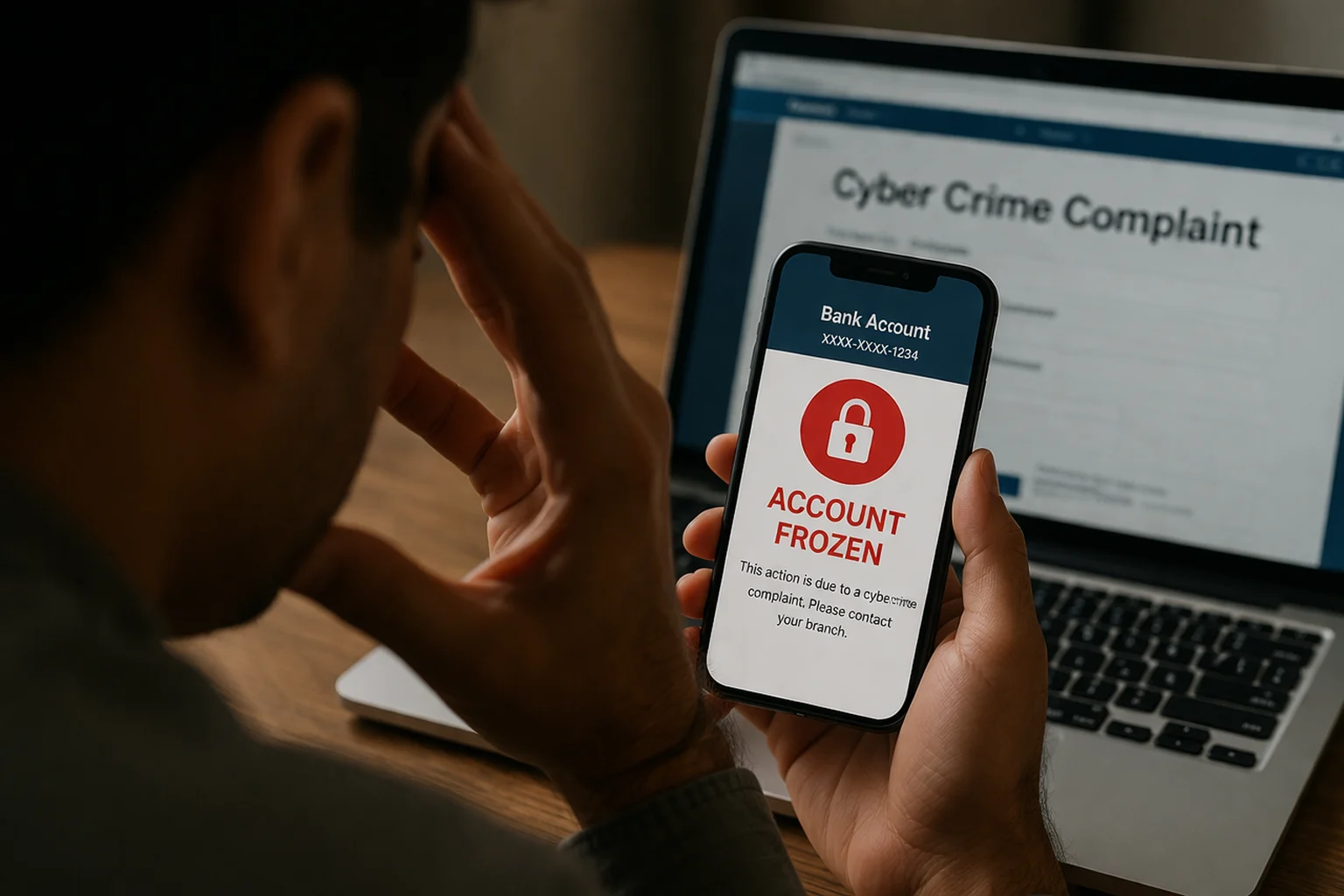
Your UPI stops working. Bank app shows “Debit Freeze Applied.” No warning. No reason. Money stuck. EMIs failing.
You are not alone. Thousands of Indians are facing this right now — and most of them have done nothing wrong.
This guide tells you exactly what to do, step by step.
Why Was Your Account Frozen?
When someone reports a cyber fraud, police trace the money. Every account in that chain gets frozen — including accounts of innocent people.
Common reasons your account got caught:
You sold something on OLX and the buyer’s money turned out to be fraud money.
You did a P2P crypto trade (like selling USDT on Binance) and the buyer used stolen funds.
Someone asked you to receive and forward money for commission — that money was stolen. You became a money mule without knowing.
A scammer routed a small amount through your UPI to confuse the money trail.
Important: The freeze is an investigative measure, not a punishment. But it can continue until the investigating authority lifts it or a court orders otherwise. It will not go away on its own — you have to act.
What Happens When Your Bank Account Is Frozen in India?
Debit Freeze (most common):
- You cannot send money, withdraw cash, or use your debit card
- But salary and other credits can still come in
- You just cannot touch any of it
Complete Freeze (rare):
- Nothing goes in, nothing comes out
- Even salary stops
Your bank will not tell you the full reason. They will just say “law enforcement direction.” You need to dig deeper yourself.
Step 1: Visit Bank Branch to Check Why Your Account Was Frozen
Do not waste time calling the helpline. Go to the branch in person with your Aadhaar and PAN.
Ask for these details in writing:
- Why was the account frozen?
- Which police station or cyber cell ordered the freeze?
- What is the FIR or complaint number?
- Is it a debit freeze or complete freeze?
Do not leave without this information. Banks may share basic details like the freezing authority and complaint number, but full details may be limited due to investigation confidentiality. Push for whatever they can share.
Step 2: Contact the Cyber Cell That Ordered the Freeze
Now that you know which police station or cyber cell froze your account, contact them.
- If the cyber cell is in your city: Visit in person. Bring your bank statements, ID proof, and any evidence that your transactions were genuine (invoices, receipts, exchange records).
- If the cyber cell is in another state: Call them. Send a written letter by speed post. Follow up by email.
What to tell them:
“My account has been frozen under complaint number [X]. I am not involved in any fraud. I am attaching my bank statements and transaction records showing that my transactions are legitimate. Please verify and issue an NOC to unfreeze my account.”
Keep it simple. Keep it polite. Keep it documented.
Step 3: Submit a Formal Written Representation
Write a letter to the Investigating Officer (IO) and the SP (Cyber Cell). Include:
- Your full name, address, and occupation
- Bank name, branch, account number, and IFSC
- The complaint/FIR number linked to the freeze
- A clear statement that you are not involved in the crime
- Supporting documents (bank statements, invoices, crypto trade records)
- A request to issue an NOC for de-freezing
Send this by registered post or speed post. Keep the receipt. This creates a paper trail.
Step 4: Get the NOC and Submit to Bank
If the IO is satisfied that you are innocent, they will issue a No Objection Certificate (NOC).
Take this NOC to your bank branch manager. After verification, your account is usually unfrozen within 3 to 7 working days.
This is the fastest route. But many IOs take time, especially in inter-state cases.
Step 5: If the IO Does Not Respond — Go to Court
If the IO ignores you or refuses the NOC, you have legal options.
Option A: File application before the Magistrate
You can file an application before the Magistrate for release or de-freezing of your account. The Magistrate can examine if the freeze was lawful and order it to be lifted.
Option B: File a Writ Petition in High Court
File under Article 226 of the Constitution. Argue that the freeze violates your right to livelihood (Article 21) and right to business (Article 19(1)(g)).
You will need a lawyer for both options. A cyber crime lawyer is ideal.
What Courts Have Said in 2026
Several High Courts in India have recently spoken up against the common practice of freezing entire bank accounts and have ruled in favour of innocent account holders.
- On freezing full accounts: courts have said that if only a small amount of disputed money passed through your account, freezing the whole balance is unfair. Only that specific amount should be held, not everything you have.
- On police powers: Multiple courts have questioned whether police can freeze accounts on their own without any order from a judge. They have stressed that proper legal process must be followed.
- On innocent account holders: Courts have made it clear that someone who is not an accused or even a suspect should not have to suffer endlessly just because fraud money moved through their account for a short time.
- What this means for you: If your full account has been frozen over a small disputed amount and no proper legal procedure was followed, you have the right to challenge it in court. Talk to a lawyer who understands these recent rulings.”
How Long Does Unfreezing Take?
| Route | Estimated Timeline |
|---|---|
| NOC from IO → Bank | 3 to 7 working days |
| Magistrate application | 2 to 6 weeks |
| High Court writ petition | 1 to 3 months (interim relief possible in days) |
These are approximate timelines. Actual duration varies depending on the case, location, and response from authorities.
The faster you act, the faster you get your money back.
Do NOT Do These Things
- Do not approach middlemen who promise to unfreeze your account for a fee. They are scammers.
- Do not ignore the freeze. It will not resolve on its own. Ever.
- Do not open a new account and try to route frozen funds through it. This creates more legal trouble.
- Do not fight with bank staff. They are following orders. Your fight is with the investigating authority.
Also Read: KYC Scam in India: Fake Bank Messages That Are Stealing Your Money
How to Prevent This from Happening
- Never receive and forward money for strangers. If someone offers you commission to let money flow through your account — say no.
- Be careful with P2P crypto trades. Verify the buyer. Avoid large trades with unknown parties.
- Do not share your bank details with anyone. No real employer needs your personal account.
- Check before you transact. Got a suspicious link, UPI ID, or QR code? Verify it on ScamDekho first. 10 seconds can save you months of trouble.
- Monitor your account. If you see any unknown credits, report to your bank and call 1930 immediately.
When Should You Hire a Lawyer?
- Account frozen for more than 2 weeks and IO not responding
- Complaint filed in a different state
- Amount involved is above ₹1 lakh
- You received a legal notice or summons
A cyber crime lawyer knows the latest court rulings and can file the right applications fast.
Conclusion
The experience of having your bank accounts frozen due to cyber crime can be frustrating and unfair, especially when you have done nothing wrong. However, the good thing is that this problem can be solved if the right process is taken. From calling your bank and cyber cell to obtaining the NOC or going to the court, all these steps are important in unfreezing your accounts.
The most important thing is to remain calm and avoid any shortcuts that might come your way. The most important thing in all this is that this experience should be taken as a lesson and that one should be careful with online transactions and P2P transactions. The experience of having your accounts frozen is just that—a hurdle that needs to be passed.
Disclaimer: This article is for informational and educational purposes only. It is not legal advice. Laws and procedures may vary by state and case. Always consult a qualified lawyer for advice specific to your situation.
Bank account frozen? Act fast. Follow these steps. Do not wait for it to fix itself.
Frequently Asked Questions
Yes. In cybercrime cases, police can freeze accounts without notifying you first. They are expected to inform the Magistrate as per legal procedure. If proper procedure was not followed, the freeze may be legally questionable.
Courts have ruled this is disproportionate and arbitrary. You have strong grounds to challenge it.
In a debit freeze — yes. Credits come in, but you cannot withdraw. In a complete freeze — nothing moves.
Go to your bank branch and ask. Banks can usually share the freezing authority’s name and complaint reference number, though they may not disclose all investigation details.
Yes. The freeze is on the specific account, not on you. But do not transfer frozen funds to the new account.
This is tricky. Contact the IO by phone and letter. If no response, consult a local lawyer who can file an application before your Magistrate or approach the High Court.