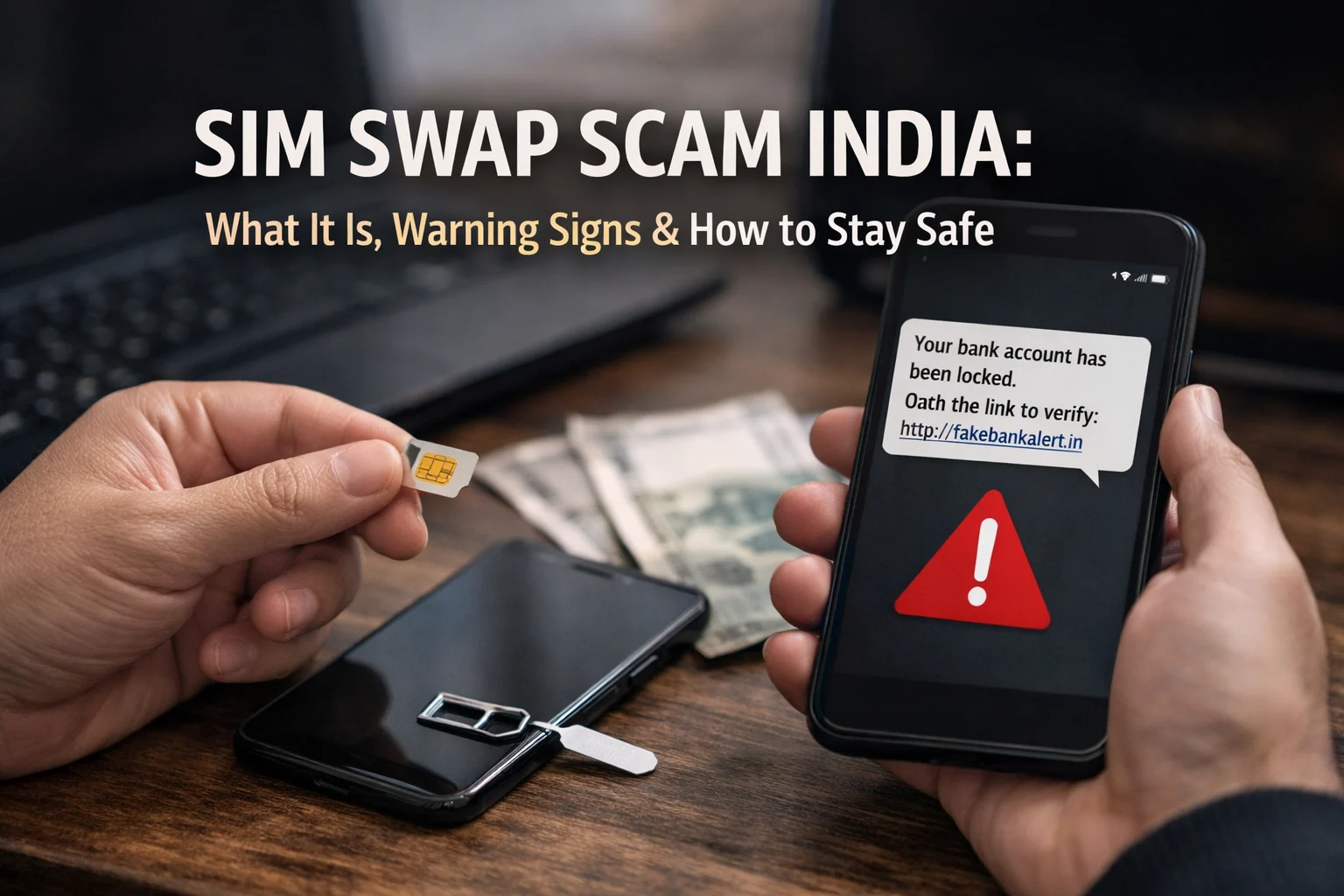
Your phone shows “No Service.”
You think — network problem. You restart your phone. Still nothing. You put it aside and plan to call the network provider later.
But here is what you do not know yet.
While you are waiting for your signal to come back, someone else is already using your phone number. They are receiving your bank OTPs. They are resetting your net banking password. They are transferring money out of your account — one transaction at a time.
By the time you figure out what is happening, your account is empty.
This is the SIM swap scam. And it is one of the most dangerous frauds in India today — because your phone does not even ring. You feel nothing until the money is already gone.
What Happened to Real People
Before anything else, read these real cases. These are not made-up stories.
1. A Mumbai businessman lost ₹7.5 crore
A Mumbai-based company owner lost ₹7.5 crore in a SIM swap fraud. Scammers got access to his company bank account by swapping his SIM card and made multiple unauthorised transactions within minutes. He called the 1930 cyber helpline immediately after realising what happened. Police managed to freeze ₹4.65 crore within four hours — but the rest was already withdrawn and gone.
2. A Tirupur businessman lost ₹19.99 lakh
A businessman from Tirupur lost ₹19.99 lakh after fraudsters obtained a duplicate SIM card without proper verification and accessed his bank account. He had no idea his SIM had been swapped until he checked his bank balance the next morning.
3. A Delhi lawyer lost lakhs — without sharing a single OTP
A Delhi lawyer lost lakhs from his account in a SIM swap scam. He never responded to any calls from the scammers and never shared his OTP or personal information — yet the fraudsters still managed to gather his details and carry out the fraud.
This last case is the most frightening one. Because it shows you do not even have to make a mistake for this scam to happen to you.
Check: AI Voice Cloning Scam in India
So What Exactly Is SIM Swap Fraud?
Let us explain this simply.
Your phone number is connected to your bank account. Every time your bank needs to confirm it is really you — when you log in, transfer money, or reset your password — it sends an OTP to your phone number.
In a SIM swap scam, fraudsters trick your mobile network provider into transferring your phone number to a SIM card that they control. Once that happens, they receive all your calls, messages, and most importantly — your OTPs. With that, they can access your bank accounts, reset your passwords, and transfer your money without you knowing.
Think of your SIM card as the key to your bank. A SIM swap scam is someone making a copy of that key — and you do not find out until they have already used it.
How Do Scammers Actually Do This?
It happens in stages. Here is the full picture in simple words.
First — they collect your personal details
The scam starts with the fraudster gathering your personal information. They get this through fake emails, fake websites, social media, or data leaks from apps you have used. They need your name, address, date of birth, and identity document details — enough to pretend to be you.
You may not even know your data was stolen. It could have happened months ago through a data breach you never heard about.
Then — they go to your telecom provider
Armed with your details, the scammer contacts your mobile network — Jio, Airtel, or Vi. They pretend to be you. They say your SIM is lost or damaged and they need a new one. The service provider verifies them using the details they have collected, deactivates your old SIM, and gives the scammer a new active SIM with your number.
In some cases, they do not even go to a store. They call customer care. In rare cases, they bribe a telecom employee to skip the verification steps.
Then — your phone goes silent
Your phone loses signal. No calls. No messages. No internet. Most people assume it is a network issue and wait.
That waiting time is exactly what the scammer needs.
Then — your money disappears
Once they control your number, the scammer requests password resets on your bank accounts. They receive your OTPs on their phone. They log into your net banking and UPI apps, reset your passwords, and transfer your money — all within minutes.
By the time your signal comes back or you contact your network provider, the transactions are already done.
The eSIM Version — Happening More
There is a newer, sneakier version of this scam that does not even require a fake visit to a telecom store.
A scammer calls you pretending to be from Jio or Airtel customer care. They say your network quality will improve if you switch to an eSIM. They sound completely professional and helpful.
They ask you to share a verification code that was sent to your current number — just to confirm the switch.
The moment you share that code, your number gets transferred to their device. Your physical SIM becomes useless. And the entire fraud plays out exactly as described above.
The rule is simple: No telecom company ever calls you to upgrade your SIM. If someone calls asking you to switch to an eSIM — hang up.
6 Warning Signs Your SIM May Have Been Swapped
Your phone will show signs. You just need to know what to look for.
Your phone suddenly shows No Service for no reason No location change. No bad weather. No network outage in your area. If your phone loses signal out of nowhere — call your telecom provider from someone else’s phone immediately. Do not wait.
Not sure if a message or link from your telecom provider is real? Check it on ScamDekho before clicking anything.
OTPs stop arriving on your phone You are trying to log into your banking app and the OTP is not coming. This is a serious sign. Someone else may already be receiving it.
You get a password reset notification you did not request Your bank or email sends a notification that your password was changed — but you did not do it. Act immediately.
Unknown transactions appear in your bank account Even small ones. Scammers sometimes test with a small amount before transferring the big amount.
You receive a call from someone claiming to be from your telecom company Telecom companies do not call you asking you to update or change your SIM card. If you receive such a call — especially from a regular 10-digit number — it is a scam. End the call immediately.
Your telecom app shows a new SIM registered that you did not do Most telecom apps let you check your account activity. Log in once a month and verify no new SIM or device has been registered under your number.
Also Read: How Fake NGOs and Charity Frauds Are Stealing From Kind-Hearted Indians
How to Protect Yourself — Simple Steps That Actually Work
You do not need to be a tech expert to protect yourself. These steps are easy and take less than 10 minutes.
Call your telecom provider and add extra verification for SIM changes
Call Jio on 198, Airtel on 121, or Vi on 199. Ask them to add an extra security step — like a PIN or a personal question — for any SIM replacement or porting request on your number. This means even if a scammer has your personal details, they cannot swap your SIM without that extra step.
Turn on email alerts for all bank transactions
Most banks let you set up email notifications in addition to SMS. Even if your SIM gets swapped and SMS stops coming, email alerts will still reach you. Enable this today.
Set a daily transaction limit on your UPI and net banking
Log into your banking app and set a daily transfer limit. This limits how much damage can happen even if someone gets into your account.
Do not share your Aadhaar or PAN on WhatsApp
Scammers gather your KYC documents through various means — fake agents, phishing messages, and data leaks. Never share your Aadhaar, PAN, or bank details over WhatsApp, SMS, or email unless you are 100% certain of who you are sending it to.
Use app-based authentication where possible
Where your bank or app gives you the option to use an authenticator app instead of SMS OTP — use it. App-based OTPs cannot be intercepted through a SIM swap.
Check your phone signal daily
It sounds simple, but it works. If your phone loses signal unexpectedly — especially during banking hours — treat it as an emergency until proven otherwise.
If You Think Your SIM Has Been Swapped — Do This Right Now
Do not panic. Act fast — that is the only thing that matters.
Step 1 — Call your telecom provider immediately from someone else’s phone. Jio: 198, Airtel: 121, Vi: 199. Tell them your SIM may have been swapped and ask them to block your number and cancel any duplicate SIM.
Step 2 — Call your bank’s 24×7 helpline and ask them to freeze all transactions linked to your mobile number.
Step 3 — Change your net banking password and UPI PIN from a different device — not your own phone.
Step 4 — Call 1930, the National Cyber Crime Helpline, and report the fraud immediately.
Step 5 — File a complaint at cybercrime.gov.in. Select “SIM Swap Fraud” as the category.
Step 6 — Save every piece of evidence — screenshots of unknown transactions, call logs, and any suspicious messages you received.
Acting fast genuinely helps. When the Mumbai businessman called the 1930 helpline immediately after the fraud, cyber police managed to freeze ₹4.65 crore out of ₹7.5 crore within just four hours. The faster you report, the better your chances of getting your money back.
Why Your SIM Card Is So Valuable to a Scammer
Most people think of their SIM as just something that makes calls work. But in 2025, your SIM card is actually the master key to your entire financial life.
Every bank account, every UPI app, every financial service in India uses your mobile number for verification. TRAI has introduced a 7-day restriction on SIM porting after a new SIM is issued — meaning your number cannot be moved to another network for 7 days after a new SIM is given. This gives you a window to detect and report the fraud.
But rules alone cannot protect you. Only awareness can.
Conclusion
The SIM swap scam does not need you to click a link. It does not need you to share an OTP. It does not even need you to answer a call. A Mumbai businessman lost ₹7.5 crore, a Tirupur businessman lost ₹19.99 lakh, and a Delhi lawyer lost lakhs — without making any obvious mistake.
The only warning is your phone going silent.
If that ever happens to you unexpectedly — do not assume it is a network problem. Call your telecom provider from another phone within minutes. That one call could be the difference between saving your money and losing everything.
Stay safe — and share this with your family and friends who use mobile banking.