Let me be honest with you. Most of us never really think about what we share online until something goes wrong. A scam call that knew your full name. A stranger who somehow had your address. A bank account drained overnight.
That moment of “how did they get this?” is what this guide is trying to prevent.
India Has a Very Specific Problem
We are not talking about hacking in the Hollywood sense. No one is sitting in a dark room cracking codes to get into your accounts.
What is actually happening is much simpler and honestly scarier. People are freely giving away information that criminals piece together like a puzzle. Your name from Instagram. Your workplace from LinkedIn. Your phone number from a WhatsApp group. Your home locality from a food delivery review you left two years ago.
Put it all together and someone has enough to impersonate you, take a loan in your name, or clean out your UPI account.
This is the reality for Indian internet users today. And most people have no idea it is happening.
Start Here Before Anything Else
Before getting into specifics, remember just one thing.
Anything you share online can end up anywhere.
Private Instagram. Closed WhatsApp group. Snapchat with disappearing messages. Does not matter. One screenshot and it lives forever. So before posting anything, ask yourself: would I be okay if this reached a complete stranger?
If the answer is no, do not post it.
So What Information Is Safe to Share Online?
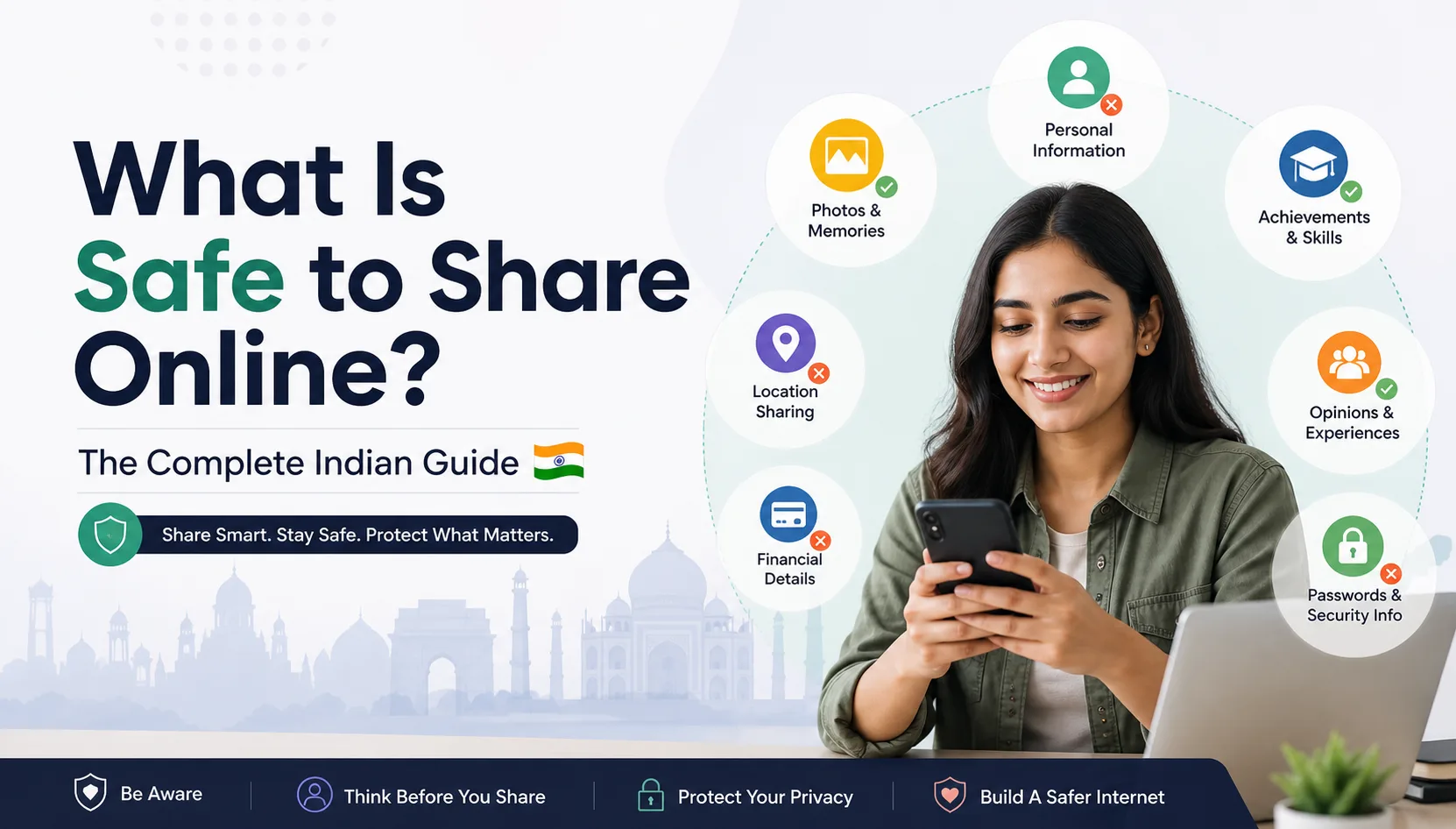
There is plenty you can put out there without any real risk. Your first name. The city you live in. Your opinions on films, cricket, food, or travel. Your professional wins on LinkedIn. Photos from a trip you already came back from. A restaurant review. A product recommendation.
None of that, on its own, can hurt you.
The problem is when you start combining things. Your first name is harmless. Your first name plus your employer plus your city plus your daily gym timing is enough for someone to find you in real life knowing exactly who you are.
So when people ask which one of these is safe to share online, the honest answer is: it depends on what else you are sharing alongside it. A single piece of information is rarely the problem. The combination is.
What Personal Information Should You Never Share Online
This is the section that actually matters. Save it. Send it to your parents. Pin it somewhere.
- Your Aadhaar number. This one gets misused more than anything else in India. With your Aadhaar, someone can get a new SIM issued in your name. With that SIM, they can reset your bank passwords and take over your accounts. You see how fast it goes.
- OTPs. Any OTP. From any service. Ever. No bank, no government office, no legitimate company will ever call you and ask for an OTP. The second someone asks for it over call or chat, you are being scammed. Hang up immediately.
- Your PAN number. Used in loan fraud and fake tax filings more than most people realize.
- Real-time location. Posting “off to Shimla for a week!” tells every person following you that your house is sitting empty. Post the holiday photos when you are back home safe.
- Your children’s details. Not their school name. Not their schedule. Not clear photos of their faces in public posts. This is non-negotiable.
- Intimate photos. Even to someone you completely trust. Relationships end. Phones get stolen. Accounts get hacked. Draw this line firmly and do not move it.
- Your full date of birth combined with your full name. Individually they seem fine. Together they are used to answer security questions and verify identity with banks and telecom providers.
- Your mother’s maiden name. This one surprises people. It is one of the most common security questions used by banks. Once someone has it, they have a key.
Is Sharing Aadhaar Card Number Online Safe?
Short answer: No. Not even close.
People share it in WhatsApp groups for housing societies, office onboarding, school admissions, and all sorts of everyday situations without thinking twice. It feels normal because everyone is doing it.
But is sharing your Aadhaar card number online safe? Absolutely not. Your 12-digit Aadhaar number is linked to your mobile number, your bank account, and your entire financial identity. In the wrong hands, it can be used to get a SIM card issued in your name, which then becomes the key to everything else.
If someone genuinely needs to verify your identity, use a masked Aadhaar instead. The UIDAI website lets you download a version that hides the first 8 digits. That is what you share, not the full card.
And if someone is asking for your Aadhaar number over WhatsApp or email for a reason that feels even slightly off, trust that feeling.
Also Read: Deepfake Scam in India: How AI Is Being Used to Cheat You
The 5 Things Indians Specifically Keep Getting Wrong
- Sending Aadhaar photos in group chats. Housing societies, office groups, school parent chats. It happens every single day and it is one of the riskiest habits on this list.
- Trusting closed groups. A Facebook group with 300 members is not a private conversation. It is a room full of people, many of whom you have never actually met. Treat it like a semi-public space.
- Filling every field in every online form. A food delivery app does not need your blood group. A loyalty card does not need your anniversary. If a field is optional, leave it blank.
- Posting travel plans before leaving. Already said it above but worth repeating because it is that common and that easy to avoid.
- Using the same photo on every platform. When your LinkedIn, Instagram, WhatsApp, and Gmail all use the same profile picture, it becomes easy to connect your identities across every platform you are on. Small change, real difference.
Platform by Platform, Quickly
- WhatsApp: Set your profile photo to contacts only. Turn off Last Seen for everyone outside your contacts. Never join groups from unknown invite links.
- Instagram: If your account has photos of your home, your kids, or your daily routine, keep it private. Avoid location tagging posts taken at or near your house.
- Facebook: Go through your friend list once a year. Remove people you would not recognize if you ran into them. Check your privacy settings every few months because they tend to reset quietly after updates.
- LinkedIn: Do not put your personal phone number on your public profile. It will be scraped by bots and sold to spammers faster than you think.
Check: WhatsApp Bans 9,400 Accounts Linked to Digital Arrest Scams: Supreme Court Told
What the Law Says, Simply Put
India’s Digital Personal Data Protection Act gives you the right to ask any company what data they hold on you and the right to ask them to delete it. Companies that leak your data now face serious penalties.
On the flip side, sharing someone else’s private information, photos, or messages without their permission is a punishable offense under the IT Act. Forwarding an intimate image of someone, even if they once sent it to you willingly, is a criminal offense under Section 67A.
Your data is protected by law. But so is your responsibility with someone else’s.
If Something Has Already Gone Wrong
First, do not panic. Then move quickly.
Delete whatever you can still delete. Change passwords on every account connected to the information that got out. If money is involved, call your bank right now and ask them to freeze transactions while you investigate.
File a complaint at cybercrime.gov.in or call 1930. That is India’s national cyber fraud helpline and it is the right first call to make.
If your Aadhaar was compromised, go to uidai.gov.in and lock your biometrics immediately. It takes two minutes and can prevent a lot of damage.
Conclusion
Being careful online does not mean being paranoid or suspicious of everyone. It just means pausing for two seconds before you share something.
Most privacy violations and scams targeting Indians do not happen through sophisticated attacks. They happen because someone shared the wrong detail with the wrong person at the wrong time, usually without even realizing it.
You now know what that looks like. That already puts you ahead of most people.
Frequently Asked Questions
Your first name, a secondary email address, general interests, professional profile, and UPI ID for receiving payments are all relatively safe. OTP, Aadhaar number, PAN card, CVV, UPI PIN, and any banking credentials should never be shared with anyone under any circumstances.
Non-sensitive details like your first name, general location (city only), hobbies, secondary email, and professional work are safe to share. What is not safe: government IDs like Aadhaar and PAN, financial details like CVV and UPI PIN, one-time passwords, and your exact home address.
Your full Aadhaar number, PAN card combined with date of birth, OTP, CVV, UPI PIN, net banking password, ATM PIN, passport scan, home address, and bank statements. No legitimate service in India will ever ask for these over a call, message, or email.
OTP, full Aadhaar number, PAN combined with date of birth, CVV, UPI PIN, bank passwords, home address, and passport scans. These individually or in combination give scammers everything they need to commit fraud in your name.
Identity theft using Aadhaar and PAN details, financial fraud through OTP and UPI PIN scams, and social engineering where scammers use your personal information to build trust before stealing from you.
No. Sharing your full 12-digit Aadhaar number can lead to identity theft and SIM swap fraud. Use UIDAI’s Masked Aadhaar or Virtual ID instead. Only share on verified government portals with HTTPS.
Never share a passport scan or photo on WhatsApp, email, or social media. Only upload it on verified visa processing or official government portals. Passport combined with date of birth is one of the most dangerous combinations for identity theft.
Yes. PAN combined with date of birth can be used to file fake tax returns, open fraudulent bank accounts, or take loans in your name. Only share PAN on verified income tax or banking portals.
By itself, a phone number is limited. But combined with other data, it enables SIM swap attacks where a scammer gets a new SIM issued on your number and then intercepts all your OTPs. Never confirm personal details to unsolicited callers.
Photos are generally fine as long as they do not reveal your home address, school or workplace name, car number plate, location tags, or any documents visible in the background. Always turn off geotagging before sharing.