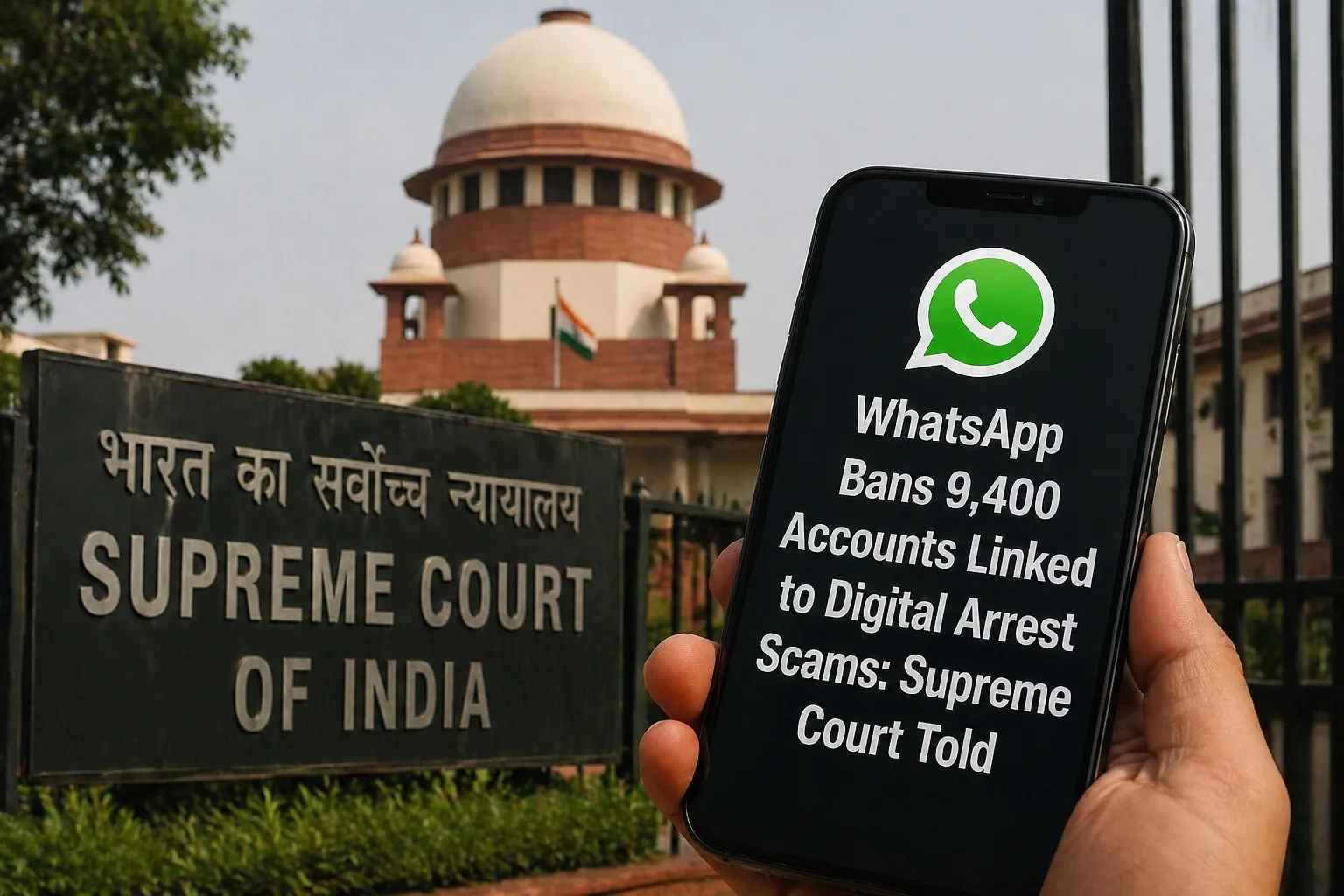
WhatsApp has banned over 9,400 accounts connected to digital arrest scams in India. The government revealed this in front of the Supreme Court as part of ongoing suo motu proceedings against cyber fraud.
This is one of the biggest coordinated actions taken against digital arrest scammers in India so far. And if you or someone in your family has ever received a suspicious call from someone claiming to be a CBI officer or a customs official on WhatsApp, this story directly concerns you.
Here is everything you need to know, based entirely on court submissions and verified news sources.
What Happened?
In January 2026, WhatsApp launched a dedicated 12-week investigation specifically targeting digital arrest scams in India. This was done in response to inputs from the Indian Cyber Crime Coordination Centre (I4C), the Ministry of Electronics and Information Technology (MeitY), and the Department of Telecommunications (DoT).
WhatsApp followed a clear strategy for this investigation: identify seed signals, map the full criminal network, ban the entire network, and then build automated defences to prevent new accounts from doing the same thing.
The result was 9,400 accounts banned in one targeted operation.
Critically, WhatsApp went much further than what government agencies had requested. Authorities had flagged around 3,800 scam-related accounts under Section 79 of the IT Act. Of those, only 17 were directly tied to digital arrest scams. But WhatsApp treated each government input as a starting point to map and disrupt entire criminal networks, which led to the much larger ban.
As WhatsApp stated in its submission: “WhatsApp does not treat signals from investigation agencies and Government of India as isolated, one-off reports. Each signal is treated as a seed to map and disrupt the entire criminal network.”
Source: Bar and Bench
Why Is the Supreme Court Involved?
This case began in October 2025 when a senior citizen couple from India wrote directly to the Supreme Court after losing Rs 1.5 crore in just 16 days. Between September 1 and 16, 2025, scammers had called them pretending to be CBI officers, Intelligence Bureau officials and judicial authorities. They showed forged Supreme Court orders on WhatsApp video calls and threatened the couple with arrest unless they paid immediately.
The Supreme Court took suo motu cognizance of the matter. This means the Court registered the case on its own without anyone filing a formal petition. It directed the CBI to investigate the digital arrest scam network and called for coordinated action across all central government agencies.
In December 2025 the Court went further and ordered a full CBI probe specifically into digital arrest scams across India. The agency was also given authority to investigate bankers linked to mule accounts being used to route cyber fraud money.
The update shared in court today was submitted by Attorney General R. Venkataramani on behalf of I4C. It was a formal status report covering all actions taken since the Supreme Court’s last directions on February 9, 2026.
Key Numbers from the Court Submissions
These figures come directly from the government’s status report filed before the Supreme Court today:
- 9,400 WhatsApp accounts banned linked to digital arrest scams
- 2,41,000+ complaints related to digital arrest scams recorded in India
- Rs 30,000 crore in total losses reported by victims across the country
- Rs 22.92 crore lost by a single victim in one Delhi case
- Rs 1.5 crore lost by the senior citizen couple whose letter triggered the Supreme Court case
- 3 major cases re-registered by CBI, each involving losses above Rs 10 crore (two from Gujarat, one from Delhi)
Where Are These Scammers Operating From?
According to WhatsApp’s own investigation findings submitted to the court, most accounts targeting Indian users were being run from organised scam centres in Southeast Asia, particularly Cambodia.
These are not individuals acting alone. They are professional criminal operations running coordinated call centres with scripts, fake uniforms, fake government office setups, and teams working around the clock to target Indian phone numbers.
WhatsApp found that fraudsters were using display names like “Delhi Police,” “Mumbai HQ,” “CBI,” and “ATS Department,” along with official-looking logos as profile pictures to appear credible to victims.
This is also why this problem cannot be solved by Indian law enforcement alone. As WhatsApp noted in its submission, “many scams involve off-platform payment, coercion, and criminal infrastructure. WhatsApp can disrupt the accounts and networks; dismantling the underlying criminal operations requires coordinated multi-jurisdictional law enforcement action.”
Also Read: WhatsApp Wedding Invite Scam: One Tap Can Empty Your Bank
What New Technology Is WhatsApp Deploying?
Beyond just banning accounts, WhatsApp has also built new systems to detect and prevent such scams going forward. These include:
- A logo-matching system to detect accounts impersonating police or government bodies
- Logging of account display names to track scam patterns
- A large language model trained specifically to identify evolving digital arrest scam tactics
- A database of known scam assets to enable faster detection of repeat offenders
WhatsApp is also rolling out user-facing protections, including:
- Warnings for suspicious first-time messages from unknown numbers
- Visibility of account age for unknown contacts
- Suppression of profile photos in high-risk interactions
- Enhanced caller information display for unknown numbers
WhatsApp says these combined measures are expected to create a “material and observable decline” in such scams on the platform.
What Other Agencies Are Doing
The status report also covered steps being taken by other government departments:
- Department of Telecommunications: The proposed Biometric Identity Verification System for real-time SIM verification is currently at proof-of-concept stage. Full implementation is not expected before December 2026.
- Telecom operators have been directed to reduce SIM blocking time for suspicious numbers to 2 to 3 hours, since most fraudulent calls happen within the first few hours of a new SIM being activated.
- Reserve Bank of India: RBI has issued draft directions proposing that victims losing up to Rs 50,000 in fraudulent digital transactions may be compensated up to 85 per cent of the net loss or Rs 25,000, whichever is lower. This compensation would be available once per customer’s lifetime.
- Department of Revenue: No rules have yet been framed under Section 12AA of the Prevention of Money Laundering Act, 2002, which would allow banks to temporarily freeze suspicious transactions. The Department indicated that framing these rules may take 30 to 45 days.
- CBI: Three major digital arrest cases have been re-registered for deeper investigation. The Delhi case involves a single victim who lost Rs 22.92 crore.
Check: LPG Cylinder Scam on WhatsApp
What Is a Digital Arrest Scam?
If this is your first time hearing this term, here is what it means.
Scammers call you on WhatsApp video, dressed in fake police uniforms or sitting in front of what looks like a government office background. They tell you that your Aadhaar card, phone number or bank account has been linked to a serious crime like drug trafficking or money laundering.
Then they tell you that you are under digital arrest. You cannot hang up, cannot contact anyone, and will be physically arrested if you disconnect. They keep you on that call for hours, sometimes days, wearing you down until you transfer money just to make it stop.
Here is the most important thing to understand about digital arrest in India. It does not exist. There is no such thing in Indian law. No police officer, no CBI agent, no court official in India will ever call you on WhatsApp to threaten you with arrest or demand money over a video call.
If you receive a call like this, hang up immediately. It is a scam, every single time.
How to Protect Yourself
You do not need to wait for the government or WhatsApp to protect you. Here is what you can do right now:
- If you receive a WhatsApp video call from an unknown number claiming to be a police officer, CBI agent or any government official, hang up immediately. Do not engage, do not explain yourself, just hang up
- Never share your OTP, Aadhaar number, bank details or UPI PIN during any call, no matter how official the person sounds or looks
- Do not transfer money to anyone who identifies themselves as a law enforcement officer over a call. Real officers do not work this way
- Enable two-step verification on WhatsApp right now. Go to Settings, then Account, then Two-Step Verification. Takes two minutes and makes your account significantly harder to misuse
- Save 1930 in your phone contacts today. This is India’s National Cyber Crime Helpline and the first number you should call if something like this happens to you or anyone in your family.
If you receive a suspicious link on WhatsApp, do not click it. Paste it into ScamDekho’s free URL Checker to find out instantly whether it is safe or a scam.
If You Have Already Lost Money
Act immediately. Every hour matters.
- Call 1930 right now. This is the National Cyber Crime Helpline and the fastest way to get the right people alerted
- File a complaint at cybercrime.gov.in with all the details you have, screenshots, transaction records, the scammer’s number, everything
- Call your bank immediately and ask them to freeze or reverse the transfer before the money moves further
- Save everything. The scammer’s number, their account details, any screenshots from the call or chat
The Supreme Court has specifically pushed for faster response times from banks in digital arrest cases. The sooner you report, the better your chances of getting something back..
Why This News Matters
Two things stand out from today’s court proceedings.
First, the scale of the problem is enormous. Over 2.41 lakh complaints. Rs 30,000 crore in losses. A single victim in Delhi losing Rs 22.92 crore. These are not isolated incidents. This is a national crisis that is actively growing.
Second, the response is finally becoming coordinated. For the first time, WhatsApp, the CBI, RBI, DoT, MeitY, and I4C are all working together under Supreme Court supervision. That kind of multi-agency coordination has not happened before on this issue.
But even with all of this, scammers create new accounts every single day. No government action replaces personal awareness. Knowing how this scam works is the single most effective protection you have.
Share this article with your family today, especially parents and elderly relatives. One conversation could stop someone from losing everything.