You need money urgently. Rent is due. A medical bill is pending. Your salary is still a week away.
You search online and find an app that promises ₹10,000 in 10 minutes — no documents, no credit check, instant approval. You download it, fill in your details, and wait.
What happens next is not a loan. It is the beginning of a nightmare.
Why this scam is growing so fast:
Fake loan app scams are one of the fastest-growing cybercrimes in India. Every month, thousands of people are targeted — students, small business owners, daily wage workers, and salaried employees. By the time most victims realize what happened, they have already lost money, lost their personal data, and sometimes lost their dignity.
What you will learn in this guide:
- Exactly how these scams work
- How to spot a fake loan app before it is too late
- What to do if you have already been targeted
What Is a Fake Loan App?
A fake loan app is an illegal mobile app that pretends to give you an instant personal loan — but actually works against you.
These apps are not registered with the Reserve Bank of India (RBI) or connected to any real NBFC (Non-Banking Financial Company). They do not give loans in any legal or regulated way.
What they actually do:
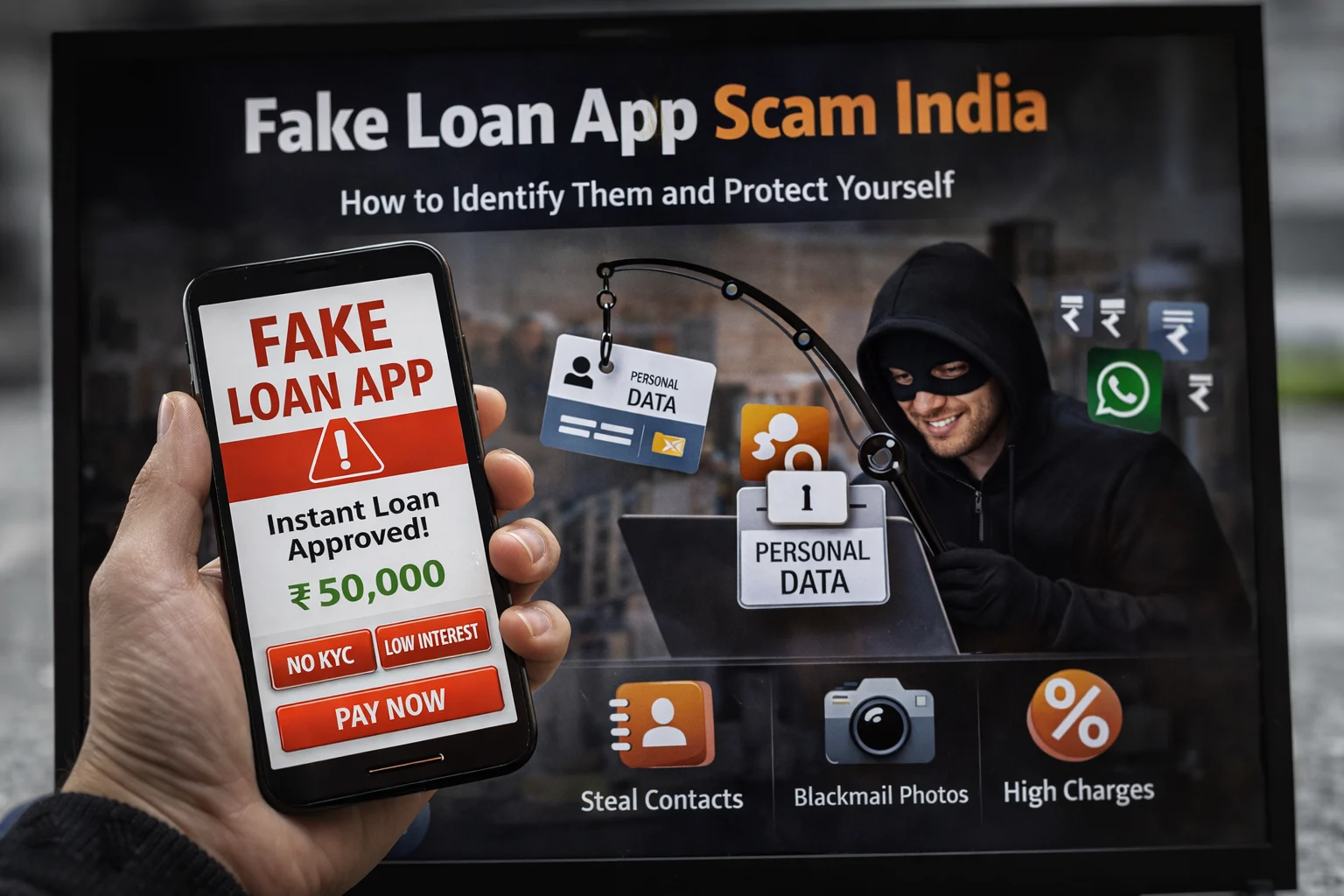
- Steal your personal data
- Charge hidden fees you never agreed to
- Trap you in a cycle of debt and harassment
What about RBI approval?
The RBI does not directly approve or license loan apps. What it does is regulate banks and NBFCs.
Any genuine loan app must clearly tell you — which RBI-registered bank or NBFC it is partnered with.
If an app cannot answer this question — or says it is “RBI approved” without naming a lender — that is a red flag.
Real lender = names a registered bank or NBFC
Fake lender = just says “RBI approved” with no details
Fake Loan App List — Commonly Reported Apps in India
Several apps have been widely reported for fraud, harassment, or operating without proper NBFC backing. Some commonly flagged names include:
- Flip Cash
- ApnaAroham
- CashFish
- Kredipe
- FlyCash
- LoanCube
- Rupee Master
- GuayabaCash
- AA Kredit
- 4S Cash
- FlashLoan / Flash Loan
- EasyCredit (fake version)
- QuickCashNow / InstaLoan Pro
- UltraLoanX / SpeedLoan
- RupeePocket / CashAdvance Go
But here is the problem:
Google has already removed more than 4,700 illegal loan apps from the Play Store over the past two years. They updated their policies to make sure all loan apps must be linked to a regulated lender.
Despite this, new fake apps keep appearing — just under different names.
This is why a list is not enough.
By the time an app gets reported and removed, a new one has already taken its place. The name changes. The logo changes. But the scam stays the same.
What actually protects you is not memorizing a list.
It is knowing how to spot a fake loan app before you ever download it.
How Fake Loan App Scams Work — Step by Step
Understanding the pattern is the best way to protect yourself.
Step 1: The attractive offer
The scam starts with a social media ad, a WhatsApp message, or a search result. It promises instant cash with no paperwork, no credit check, no questions asked.
The app looks professional. It has a clean logo. It even has reviews — most of which are fake.
It feels safe. That is exactly how it is designed to feel.
Step 2: Excessive app permissions
Once you download the app, it asks for access to your contacts, photos, camera, and location.
None of this is needed for a loan. But you tap Allow without reading carefully.
That one tap gives them everything they need.
Step 3: Upfront fee demand
Before sending you any money, the app asks for a processing fee, insurance charge, or security deposit.
Legitimate loan apps never charge fees before giving you the loan.
Once you pay — either you never hear from them again, or you receive a small loan with shockingly high interest rates.
Step 4: The harassment begins
Now comes the worst part.
Abusive calls. Threatening messages. And in many cases — your photos from your gallery are morphed and sent to your contacts.
This is not a lending company anymore. This is blackmail.
Step 5: The debt trap
Even after you repay the full amount, some apps keep demanding more money. Victims report being charged again and again with no end in sight.
The loan never really ends. That was the plan from the beginning.
Real Cases of Fake Loan App Fraud in India
These are not hypothetical examples. They are real incidents that have been reported.
Kerala ED Case, 2026
In early 2026, the Enforcement Directorate arrested two men in Kerala for running a network of fake Chinese loan apps.
These apps promised quick loans. But once users downloaded them, the apps stole personal data from their phones — private photos, contact lists, everything.
Then came the blackmail. Victims were threatened with their own photos being shared with family and friends.
The total fraud — over ₹719 crore. The money was moved abroad through cryptocurrency and shell companies. Authorities managed to freeze ₹123 crore during the investigation.
Delhi Student Trap
A college student saw an Instagram ad for a quick loan app. He downloaded it and received ₹3,000 — but ₹800 was immediately deducted as a processing fee.
Within days, recovery agents started calling his family members. They had access to his full contact list from when he installed the app.
The original loan was ₹3,000. They were now demanding ₹9,000.
Small Business Owner Fraud — Hyderabad
A shopkeeper in Hyderabad needed ₹25,000 for his business. He found a loan app through a simple Google search. It looked legitimate.
He paid a ₹2,000 processing fee as asked.
After that — complete silence. Customer support number switched off. No loan. No response.
When he investigated further, he found the app had no NBFC partner and was not listed on any RBI registry.
The ₹2,000 was gone. So was his data.
Check: Latest Online Scams in India (2026): New Fraud Trends You Must Know
How to Check if a Loan App Is Real or Fake
This is the most important section. Before you download any loan app, run through this checklist.
1. Check the RBI NBFC list Go to rbi.org.in and search for the lender’s name in the official NBFC registry. If the app’s lending partner does not appear there — do not proceed.
2. Look for the NBFC name inside the app Every genuine loan app clearly tells you which bank or NBFC it is partnered with. If this information is missing, hidden, or vague — treat it as a fake loan app.
3. Check the app permissions A real lending app does not need access to your contacts, photos, or camera. If the app asks for these permissions during install — uninstall it immediately.
4. Look for a physical address and real customer support Fake apps have no real office address and no working helpline. Genuine lenders are required by RBI guidelines to provide a proper grievance redressal system. If you cannot find one — it is a red flag.
5. Search for reviews and complaints Search the app name on Google along with words like “fraud,” “scam,” or “complaint.” Victims almost always leave warnings. Take those warnings seriously.
6. No upfront fee is a good sign A legitimate lender never asks for money before your loan is approved and disbursed. Any app asking for a processing fee, insurance charge, or deposit upfront — is suspicious.
7. Check download count and developer details On the Play Store, check:
- The developer’s name
- Total number of downloads
- Date and quality of reviews
Very few downloads + recent one-line five-star reviews = almost certainly fake.
Is Navi Loan App Fake or Real?
Many users search specifically for “Navi loan app fake or real” — so let us address this directly.
Navi is a legitimate financial services company founded in India and is backed by a registered NBFC. It is listed on regulated platforms and complies with RBI digital lending guidelines. It is not a fake app.
However, scammers sometimes create apps with names similar to well-known brands like Navi to confuse borrowers. Always verify that you are downloading from the official Play Store listing and that the developer name matches the official company.
Also Visit: Common digital banking fraud types growing in India (avoid these mistakes)
What to Do If You Have Been Scammed by a Fake Loan App
Act immediately. Do not let shame or fear stop you from reporting. You are not alone — thousands of people face this every month.
Step 1: Stop all payments
Do not pay any more money — even if they threaten you.
Paying does not stop the harassment. In most cases, it only makes it worse.
Step 2: File a complaint on the Cyber Crime Portal
Go to cybercrime.gov.in and register your complaint.
Keep these ready:
- App name and screenshots
- Conversation history
- Payment receipts
- Any threats you received
Step 3: Call the Cyber Crime Helpline
Dial 1930 — India’s official cyber fraud helpline, available 24/7.
Reporting quickly can sometimes help freeze fraudulent transactions before more damage is done.
Step 4: Report on the RBI Sachet Portal
Go to sachet.rbi.org.in to report unauthorized lending apps directly to the Reserve Bank of India.
Step 5: Inform your bank
If you shared your bank account details or UPI ID with the app — call your bank immediately.
Ask them to do a security review of your account. Do not wait.
Step 6: Check your credit report
If you shared your Aadhaar or PAN details, check your CIBIL or Experian credit report.
Make sure no unauthorized loans have been taken in your name without your knowledge.
Safe Loan Apps You Can Trust
If you genuinely need a personal loan, stick to apps that are backed by RBI-registered lenders.
Some trusted options include:
- KreditBee
- PaySense
- CASHe
- Bajaj Finserv
All of these clearly display their NBFC or bank partnerships and follow RBI’s digital lending guidelines.
Not sure about any loan message or website?
Before you download anything, verify it first.
Use ScamDekho scam detector simply enter the loan message or website link and the tool will immediately flag whether it’s safe or scam.
The One Rule That Protects You
If you remember nothing else from this guide, remember this — a legitimate lender never asks you to pay before giving you the loan. No processing fee in advance. No insurance deposit upfront. No security amount before disbursal. If any app asks for money before the loan reaches your account, it is a scam. Every single time.
Fake loan apps target people in financial distress. They count on your urgency. They count on your trust. They count on you not having time to think. That is their strategy. Now you know it.
The good news is that your defense is simple. Take a few minutes before you download anything. Check the RBI NBFC list. Read the app permissions carefully. Search the app name with “fraud” or “scam” on Google. Those few minutes can save you months of stress, harassment, and financial loss.