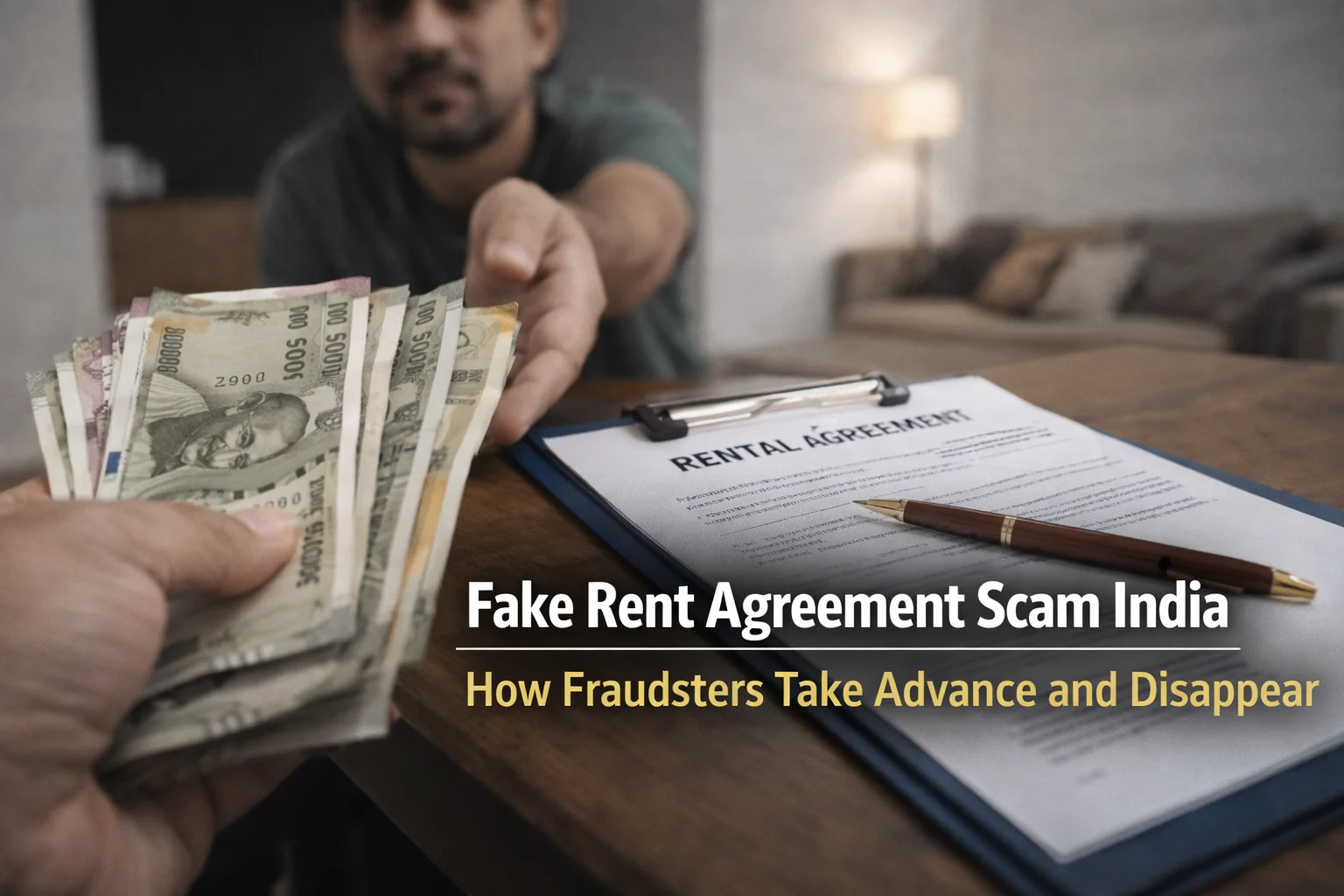
Real Case: Shriram Natarajan, a 44-year-old Mumbai resident, was browsing for a 2BHK flat on the NoBroker app when he found a listing in his own housing society at ₹47,000 per month. He contacted the “landlord,” paid an advance, and only later discovered the account the money went to was linked to a petrol pump in Bhopal. The real flat owner had no idea their listing was being used to run a scam. Shriram lost ₹2.8 lakh.
This case isn’t an exception. It’s the pattern.
If you’re currently house hunting in Delhi, Bangalore, Mumbai, Pune, or anywhere else in India, this blog could save you lakhs.
Why Rent Scams Have Gotten Much Worse Recently
Finding a flat in any Indian metro today is already stressful. Demand is high, good flats get taken fast, and brokers push you to “decide quickly or lose it.” Scammers have studied this pressure very closely. They know that when someone is desperate to find a flat near their office, or moving from another city, or relocating for a new job, they’re not thinking straight. That’s exactly when they strike.
The rental fraud problem in India has also gone digital in a much more sophisticated way. Scammers no longer just post obviously fake ads. They copy real listings from 99acres, NoBroker, and MagicBricks, replace the contact number with their own, and wait for calls. They use AI-generated face overlays on video calls. They send fake e-stamp certificates that look completely official. In late 2025, Bengaluru police registered an FIR where a victim was pulled into a private Telegram chat, guided step by step through a payment process, and lost ₹6.25 lakh. The “landlord” was never real.
Understanding exactly how these scams work is the first step to not becoming the next case.
The 6 Most Common Fake Rent Scams in India Right Now
1. The Fake Listing / Token Money Trap
This is the most common scam and it targets people who are searching on their own. No broker, just scrolling through apps late at night.
Here’s how it plays out: You find a beautifully photographed 2BHK at a rent that’s 25–30% below what similar flats in the area cost. You message the “owner.” They respond quickly, seem friendly, answer your questions confidently. They say the flat is getting a lot of interest and they need a small token amount, usually ₹5,000 to ₹20,000, to “block it for you” before others book it.
You pay. They disappear.
Sometimes the flat doesn’t exist at all. Other times, it’s a real flat that’s already occupied. The scammer just copied the listing, photos and all, from another platform and replaced the contact number.
Red flag: Any landlord or agent asking for money before you’ve physically visited the property is running a scam.
2. The Fake Visiting Pass Fee
This one is increasingly common in Bangalore and Hyderabad, where rental markets are extremely competitive.
The “landlord” tells you that the flat is part of a gated society that requires a “visiting pass” or “entry fee” to see the property. They ask you to pay ₹2,000–₹3,000 as a refundable deposit to arrange the visit. You pay, you never hear from them again.
No legitimate housing society in India charges a potential tenant a fee to visit a property. If someone tells you this, hang up.
3. The Fake Army Officer / Government Employee Landlord Scam (Landlords Beware Too)
This one doesn’t target tenants. It targets landlords. And it’s especially cruel because it exploits the trust and respect people naturally have for defence personnel.
A gang in Noida was recently found to be systematically running this scam on 99acres, MagicBricks, and OLX. Here’s how it works:
A person posing as an Army officer or senior government employee contacts a landlord whose flat is listed. They say they’re being transferred suddenly and need to move in next month with their family. They’re very polite, very professional. They say they’re willing to pay the full security deposit plus two or three months’ rent in advance, whatever the landlord wants.
The “tenant” then sends a QR code to the landlord saying “please scan this to receive the advance payment.” The moment the landlord scans and enters their UPI PIN, money is debited from the landlord’s account, not credited. The scammer disappears.
Elderly landlords are targeted most frequently because they are less familiar with how UPI and QR codes actually work.
Remember: Scanning a QR code and entering your PIN means you are sending money. You never scan a QR code to receive money.
4. The Illegal Sublet Scam
This one is very sneaky because the person you’re dealing with is actually living in the flat. They’re just not the owner.
The actual tenant of a property poses as the landlord, shows you the flat, and collects a security deposit or advance rent from you. Sometimes they do this to multiple people simultaneously, collecting deposits from 3 to 4 different people for the same flat.
When you arrive on move-in day and find someone else living there, or the real landlord shows up, there’s nothing you can do. The fake “landlord” has switched off their phone.
A real case from NoBroker: A man posed as a NoBroker agent, showed a flat to a prospective tenant, and collected ₹50,000 as a “pre-deposit.” He turned out to be the tenant illegally subletting the flat. The actual owner had no idea any of this was happening.
5. The Fake E-Stamp / Fake Rent Agreement Scam
This is the most sophisticated scam on this list, and it’s growing fast since the 2025 update to the Model Tenancy Act made digital rent agreements more common.
Here’s what happens: You’ve found a flat, you like it, you’ve met the “landlord” (or so you think). They say they’ll get the rent agreement registered digitally and ask you to pay stamp duty and registration charges upfront, usually ₹5,000 to ₹15,000. This sounds completely normal because digital stamp duty and e-registration are genuinely real things now.
A few days later, they send you a PDF agreement with an official-looking e-stamp number, a proper format, and both signatures. It looks 100% legitimate. But the e-stamp number is either fake or belongs to an entirely different transaction filed years ago. You’ve paid for nothing, and you have no legal protection.
Most people never check the e-stamp number on the government portal. Scammers know this.
How to verify: Every genuine e-stamp certificate issued in India can be verified on the Stock Holding Corporation of India (SHCIL) portal at shcilestamp.com or the respective state’s stamp verification portal. Always verify the certificate number before handing over any money.
6. The Catena Homes Model: Large-Scale Organised Fraud
In late 2025, Bangalore saw one of the largest organised rental scams in recent memory. A company called Catena Homes was arrested for defrauding over 400 tenants of more than ₹50 crore.
Their method was disturbingly professional: they rented high-end apartments from genuine landlords, then sub-leased the same flats to multiple tenants for lump-sum “lease” amounts ranging from ₹10 lakh to ₹29 lakh per person, promising 2–3 years of rent-free stay. They had a proper office, a proper website, professional staff, and legal-looking agreements.
This is now called the “lease company” scam. Be extremely cautious about any company asking for a large upfront lump sum in exchange for a multi-year rent-free period.
How to Verify Before You Pay: A Practical Checklist for Indian Tenants
This is the part most blogs skip. The actual “how to check.” Here’s what you can do in 2026 before paying a single rupee:
Step 1: Visit the Property in Person. Always.
This sounds obvious but it’s the single rule that prevents 90% of rental scams. No exceptions. Do not pay any token money, booking amount, or deposit until your feet have physically been inside the flat and you’ve met the landlord face to face.
If someone says they’re abroad, on transfer, or “too busy to meet,” that is a scam.
Step 2: Verify Property Ownership Online
Every state in India has an official land records portal where you can verify who actually owns a property. Here are the most commonly used ones:
| State | Portal Name | What to Check |
|---|---|---|
| Karnataka | Kaveri Online / Bhoomi | Owner name, survey number |
| Maharashtra | IGR Maharashtra | Registration records, ownership |
| Delhi | DORIS (Delhi Online Registration) | Property registration status |
| UP | UP Bhulekh (upbhulekh.gov.in) | Khasra/Khatauni ownership |
| Telangana | Dharani Portal | Pattadar passbook, land details |
| Haryana | Jamabandi Portal | Record of Rights |
| Tamil Nadu | TNREGINET | EC, registration documents |
Enter the owner’s name or survey number and confirm that the person showing you the flat is actually the registered owner. This takes 5 minutes and can save you lakhs.
Also ask to see a recent electricity bill, property tax receipt, or water bill in the landlord’s name. Scammers can fake IDs, but utility bills linked to the property are harder to fake.
Step 3: Verify Their Identity Through Multiple Means
Don’t accept just an Aadhaar card or ID on WhatsApp. Ask to see the original property documents. Ask to meet at the property, not at a cafe or via video call only. Talk to neighbours or the building society’s security guard to confirm the person you’re dealing with is actually the owner.
If someone claiming to be an Army officer is the landlord or tenant, you can request a verification through their unit’s official contact. Real officers won’t be offended by this. Scammers will immediately become defensive.
Step 4: Verify the Rent Agreement’s E-Stamp
If you’re given a digitally stamped rent agreement, take the e-stamp certificate number and verify it on:
- shcilestamp.com (for most states)
- Your state’s official stamp verification portal
The portal will tell you the date the stamp was issued, the amount, and what it was issued for. If the stamp was issued for a different transaction, you have a fake agreement.
Step 5: Never Pay Cash, Never Pay Before the Agreement Is Signed
All payments, whether token money, security deposit, or advance rent, should go through bank transfer or UPI with a clear transaction record. Never pay in cash for a rental transaction. And never pay before you have a signed, verified rent agreement in hand.
If the landlord insists on cash only, or wants payment before signing the agreement, walk away. These are not negotiating styles. They are fraud tactics.
Step 6: Know Your Legal Rights on Security Deposit
Under the Model Tenancy Act 2021, the maximum security deposit is:
- 2 months’ rent for residential properties
However, landlords in cities like Bangalore routinely demand 6–10 months. While not always strictly illegal under state law, a very high deposit significantly increases your risk if something goes wrong. Always negotiate, and always get the deposit terms, including the refund timeline, clearly written in the agreement.
The Exact Conversation Pattern Scammers Use (So You Can Spot It)
If you know what the script looks like, you’ll recognize it immediately. Rental scammers almost always follow the same pattern:
- They respond immediately and seem very eager. Real landlords are busy. A “landlord” who responds within minutes at odd hours is likely a scammer monitoring multiple listings.
- The price is attractive but not ridiculous. It’s not ₹5,000 for a ₹30,000 flat, that would be too obvious. It’s ₹25,000 instead of ₹32,000. Just attractive enough to make you want to act quickly.
- They create urgency. “Three other people are coming to see it tomorrow.” “My current tenant is leaving this weekend, I need someone to book it today.” Urgency is their most important tool.
- They ask for a small “token” first. Not the full deposit, just a “token to block the flat.” This lowers your psychological resistance because it feels like a small risk.
- They go quiet after payment. Sometimes immediately, sometimes after a few more messages to keep you comfortable.
- They explain they can’t meet right now. They’re “on transfer,” “out of station,” “at the army base,” or “abroad.” This explains why everything has to be done remotely.
If you see 3 or more of these in one conversation, stop and do not pay.
Also Read: Why Is Your Bank Account Frozen Without Warning & How to Get It Back
I’ve Already Paid. What Do I Do Right Now?
If you’ve just been scammed, speed matters enormously.
In the first hour: Call your bank immediately at their 24/7 helpline and report the transaction as fraud. Ask them to flag the transaction or attempt a recall. If the money hasn’t been withdrawn yet from the scammer’s end, there’s a small chance it can be stopped.
Within 24 hours:
- File a complaint on cybercrime.gov.in or call the Cyber Crime Helpline 1930
- File an FIR at your nearest police station. Bring: your bank statement, screenshots of all conversations with the “landlord,” their phone number, UPI ID, and any documents they shared
- Report the fake listing on the platform (99acres, NoBroker, OLX) so it gets taken down and others are protected
Know your rights: Under RBI guidelines, if a fraudulent transaction is reported within 3 working days, your liability may be zero. Banks are required by law to investigate. Many victims have successfully recovered funds, but only when they reported quickly. Do not wait.
Check: KYC Scam in India: Fake Bank Messages That Are Stealing Your Money
Quick Reference: Red Flags vs. Green Flags
| Red Flag | Green Flag |
|---|---|
| Rent is 25–40% below market rate | Price matches area market rates |
| Landlord can’t meet in person | Meeting happens at the property |
| Asks for token money before visit | Visit first, payment only after agreement |
| Insists on cash payment only | Accepts traceable bank transfer/UPI |
| Sends QR code “to pay you” | Gives their UPI ID for you to send normally |
| No original property documents shown | Property documents and utility bills in their name |
| Creates extreme urgency | Patient and transparent |
| Agreement e-stamp can’t be verified | E-stamp verified on government portal |
| Only communicates via WhatsApp | Okay with meeting and official channels |
Final Thought
The reason rental scams work is simple: people are under pressure when they’re house hunting. Deadlines, new jobs, kids’ school admissions, the urgency is real. Scammers use that urgency against you. They want you to act before you think.
The one habit that protects you from every single rental scam on this list is this: Never pay anyone money before you have physically visited the property, met the landlord in person, verified their ownership documents, and signed a verified rent agreement.
That’s it. One rule. It sounds simple because it is simple. But in the pressure of house hunting, it’s surprisingly easy to skip. Don’t.
Frequently Asked Questions
Fake listings usually have prices that are noticeably lower than the area’s market rate. Reverse image search the photos. If the same images appear on multiple listings or on interior design websites, the listing is fake. Always call and insist on an in-person visit before any payment.
Yes. Check the e-stamp number on shcilestamp.com or your state’s stamp portal. Also check that the agreement has a proper registration number if it’s a lease exceeding 11 months. Unregistered agreements for longer periods are legally weak and often used in scams.
The Model Tenancy Act 2021 recommends a maximum of 2 months’ rent for residential properties. Some states have their own rules. In practice, Bangalore landlords ask for 6–10 months, which is legally grey territory. Always negotiate and always get refund terms in writing.
No. This is always a scam. You never scan a QR code to receive money. Scanning a QR code and entering your UPI PIN means you are paying money from your account. If anyone asks you to do this, report them immediately.
Treat this with maximum caution. Real Army officers buy and sell property like anyone else and can arrange a meeting or have a family member show the property. If they insist on everything being done remotely and want advance payment, do not pay. The “Army officer” identity is the most commonly used cover story in rental scams across India.