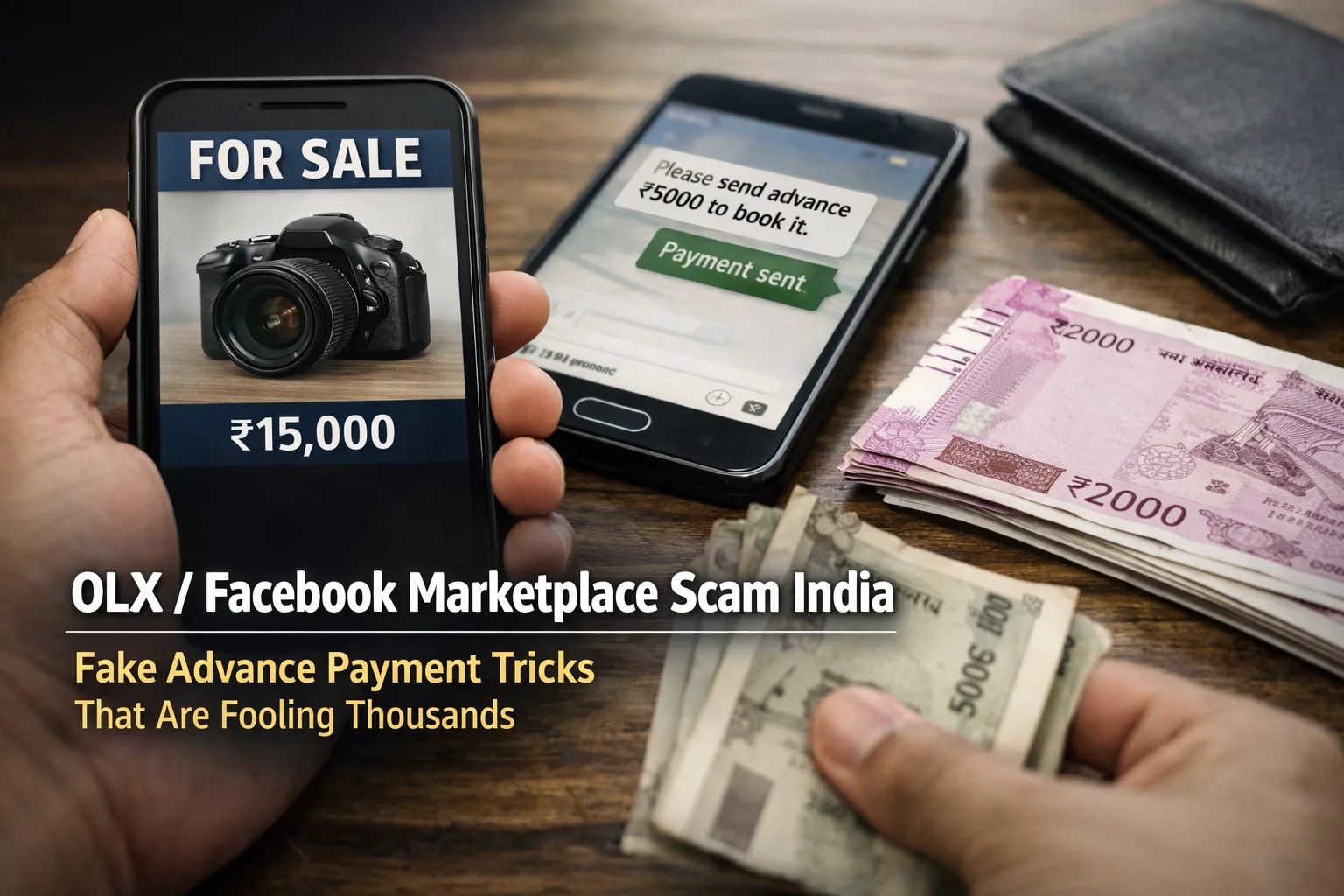
Real Case: Ankur Dutta, a 30-year-old from Hyderabad, was trying to sell his motorcycle on OLX. A buyer claiming to be an Army officer contacted him, sent a QR code “to pay,” and the moment Ankur scanned it ₹46,000 was instantly drained from his account. The “buyer” disappeared.
This is not a rare case. This happens every single day across India.
What Is the OLX / Facebook Marketplace Advance Payment Scam?
India’s second-hand goods market is booming. Millions of people every day buy and sell phones, bikes, cars, furniture, and electronics on platforms like OLX, Facebook Marketplace, and Quikr. And scammers know this.
The fake advance payment scam is a type of fraud where a scammer posing as either a buyer or seller tricks you into paying money upfront through UPI, QR code, or a fake payment link. Once the money leaves your account, they vanish.
What makes this scam dangerous is how believable it looks. The scammer doesn’t ask for your OTP. They don’t ask for your bank details. They simply use your own trust against you.
The 5 Most Common Tricks Used on OLX and Facebook Marketplace
1. The Fake Army/Defence Personnel Scam (Most Common)
This is India’s most reported OLX scam, documented by Delhi Police, Tamil Nadu Police, and Rajasthan Police.
How it works:
A scammer contacts you as a buyer on OLX. They say they are posted in the Indian Army or paramilitary forces and are being transferred to another location, so they urgently need to buy or sell an item. They sound professional and trustworthy.
- As a seller scam: They agree to buy your item at full price, then say they’ll pay via UPI. They send a “payment request” — which looks like a credit notification — and ask you to enter your UPI PIN to “confirm receipt.” The moment you enter your PIN, money is debited from your account, not credited.
- As a buyer scam: They post a vehicle, phone, or laptop at a price 30–40% below market rate. They share fake Army ID cards, canteen cards, and even courier receipts. They ask for an advance amount of ₹20,000–₹50,000 to “book” the item. After receiving the money, their phone is switched off permanently.
Real example: Tamil Nadu Police traced a scam operation to 10 villages in Rajasthan’s Bharatpur district where hundreds of people were running this scheme as a full-time operation.
2. The QR Code Trap (Seller Gets Robbed)
This is one of the most technically clever tricks used on OLX.
How it works:
You are selling an item. The buyer says they want to pay via Google Pay or PhonePe. They send you a QR code and say: “Scan this to receive the money.”
What they don’t tell you: In UPI, you scan a QR code to make a payment — not to receive one. When you scan a scammer’s QR code and enter your PIN, you are paying them, not the other way around.
The scammer often doubles down. After you lose money, they say it was a “mistake” and send another QR code for “double the amount as compensation.” Victims lose money again.
Rule to remember: You never need to scan a QR code or enter your UPI PIN to receive money. If someone asks you to do this, it is 100% a scam.
3. The Fake Payment Screenshot Trick
A scammer buys something from you on OLX or Facebook Marketplace. They send you a fake payment screenshot often a doctored PhonePe, GPay, or Paytm confirmation and ask you to hand over the item or ship it immediately.
The screenshot looks completely real with transaction IDs, timestamps, and your name. But no money was ever actually sent.
How to protect yourself: Never hand over any item or ship a product until you can physically see the amount credited in your bank account or UPI app not in a screenshot someone sent you.
Use tools like ScamDekho’s Fake Payment Screenshot Checker to verify if a payment screenshot is genuine before releasing any goods.
4. The Courier / Delivery Charge Scam
This scam mainly targets buyers of vehicles and electronics.
How it works:
A seller (usually posing as Army personnel or someone relocating abroad) lists a car, bike, or iPhone at an attractive price. They say they cannot meet in person but will ship the item via courier. They send you:
- A fake courier booking receipt
- A fake OLX “escrow” confirmation email
- Sometimes even a fake tracking number
Once you pay the item price or “advance booking,” they ask for additional charges — GST fees, insurance, customs duty, or delivery confirmation fees. These fees keep coming. The item never arrives.
Red flag: No legitimate seller on OLX or Facebook Marketplace ships vehicles or high-value items via courier to a stranger. If they refuse to meet in person, walk away.
5. The “Payment Upgrade” Scam (New in 2025–26)
This is a newer scam making waves on Facebook Marketplace India.
How it works:
A buyer contacts you, agrees to your price, and says they’ve already paid. You then receive a message — either from a fake email or a WhatsApp message — saying your account needs to be “upgraded to a business account” to receive the funds, and you need to pay a small activation fee of ₹499 or ₹999.
This fee is the scam. No payment platform in India charges you to receive money. The buyer was never real.
Why Do So Many People Fall for These Scams?
Understanding the psychology helps you stay safe:
1. Authority Bias
The moment someone says “I am an Army officer,” most people lower their guard. Scammers know this. They show fake ID cards that look completely official and use military language to sound credible. Respect for authority is natural — but it can be exploited.
2. Artificial Urgency
“I am getting transferred tomorrow.” “Ten other buyers are waiting.” These lines are designed to stop you from thinking clearly. When you feel rushed, you skip the verification steps. That is exactly what the scammer wants.
3. Confusion Around UPI
Many people, especially new UPI users, do not fully understand how payment requests work. A scammer sends a payment request and the victim thinks money is coming in — but approving it actually sends money out. This one gap in knowledge has cost thousands of people their savings.
4. Prices That Seem Too Good
A phone worth ₹60,000 listed for ₹35,000 feels like a great deal. But that excitement switches off the part of your brain that asks questions. If the price makes no logical sense, the listing is almost certainly fake.
How to Verify Before You Pay: Step-by-Step
Step 1: Reverse image search the product photos
Copy the product image and search it on Google Images. If the same photo appears on multiple listings or stock photo websites, the seller is using stolen images. Move on.
Step 2: Check the seller’s profile carefully
Look at when the account was created. No reviews, no history, and a recently made profile are all red flags. On Facebook Marketplace, a genuine seller usually has friends, old posts, and visible activity on their profile.
Step 3: Verify identity through a video call
Anyone can claim to be an Army officer or a government employee. Ask for a video call before any transaction. If they refuse or keep making excuses, do not proceed.
Step 4: Meet in person for anything above ₹5,000
Insist on meeting at a public place a busy market, shopping mall, or police station parking lot. No exceptions for high-value items.
Step 5: Verify payment in your own app
Open PhonePe, GPay, or Paytm yourself and check your actual balance before handing over anything. Screenshots sent by buyers can be easily faked. Only trust what your own app shows.
Step 6: Never scan a QR code to receive money
You only scan QR codes to send money. If a buyer tells you to scan to receive payment, disconnect immediately.
Real Scam Warning Signs — Quick Checklist
Use this before any OLX or Facebook Marketplace transaction:
| Warning Sign | What It Means |
|---|---|
| Seller/buyer claims to be Army personnel | Possible impersonation scam |
| Price is 30–50% below market rate | Bait to attract victims |
| Refuses to meet in person | Almost always a scam |
| Asks for advance before showing the item | Classic advance payment scam |
| Sends QR code “to pay you” | QR code trap — you will lose money |
| Shares payment screenshot before item | Fake screenshot scam |
| Asks you to pay extra “GST/insurance/courier” fees | Courier fee scam |
| Profile is newly created, no reviews | High risk account |
| Moves conversation to WhatsApp immediately | Avoiding platform detection |
I Already Paid — What Do I Do Now?
If you’ve been scammed, act immediately:
Within 1 hour:
- Call your bank’s 24/7 helpline and report the fraudulent transaction. Ask them to flag or freeze the transaction.
- Note down the UPI transaction ID, the scammer’s phone number, and UPI ID.
Within 24 hours:
- File a complaint on the National Cyber Crime Reporting Portal: cybercrime.gov.in or call 1930 (Cyber Crime Helpline).
- File an FIR at your nearest police station. Take your bank statement, screenshots, and chat history.
Important: As per RBI guidelines, if a fraudulent transaction is reported within 3 days, your liability may be zero. Banks are required to investigate and may refund the amount. Do not delay.
How OLX and Facebook Are (Trying to) Fight Back
OLX India has deployed fraud detection algorithms that flag listings with unusually low prices relative to market rate. They also have a Trust & Safety team reachable at +91 9999140999 and allow users to hide their phone numbers in privacy settings while posting ads.
Facebook Marketplace uses AI-based listing review and has increased enforcement against fake profiles — but with over 1.1 billion monthly users globally, no automated system catches everything.
The responsibility ultimately lies with the user.
Final Word: The Rule That Saves You Every Time
Never pay advance to anyone you haven’t met in person. Never enter your UPI PIN to “receive” money. If the deal is too good to be true, it always is.
Scammers on OLX and Facebook Marketplace are getting more sophisticated every year. AI-generated fake profile photos, forged government IDs, and scripted conversations make them harder to spot. But the core of every scam is the same: they need you to send money before you’ve verified anything.
Slow down. Verify. Meet in person.
Frequently Asked Questions
Yes, if you act fast. Report to your bank within 3 days and file a complaint on cybercrime.gov.in. Banks are required under RBI rules to investigate, and many victims have successfully recovered funds when fraud is reported quickly.
Yes, if you follow basic precautions: meet in person, never accept advance payments, and verify payment in your own app before handing over any item.
Go to the listing, click the three-dot menu, and select “Report Ad.” You can also email OLX’s safety team. For Facebook Marketplace, use the “Report” button on the listing or the seller’s profile.
This is a classic overpayment scam. They will ask you to refund the “excess.” The original payment is fake or will be reversed — you lose the refund amount. Never refund an overpayment.
Not always, but the specific pattern of urgency + asking for advance payment + refusing in-person meeting is almost always a scam. Real Army personnel buy and sell things like everyone else — they don’t ask strangers for advance payments.