“A Gurugram IT engineer lost ₹42 lakh. A Pune doctor lost ₹24 lakh. A Greater Noida man lost ₹51 lakh. All from a single WhatsApp message offering a “simple part-time job.”
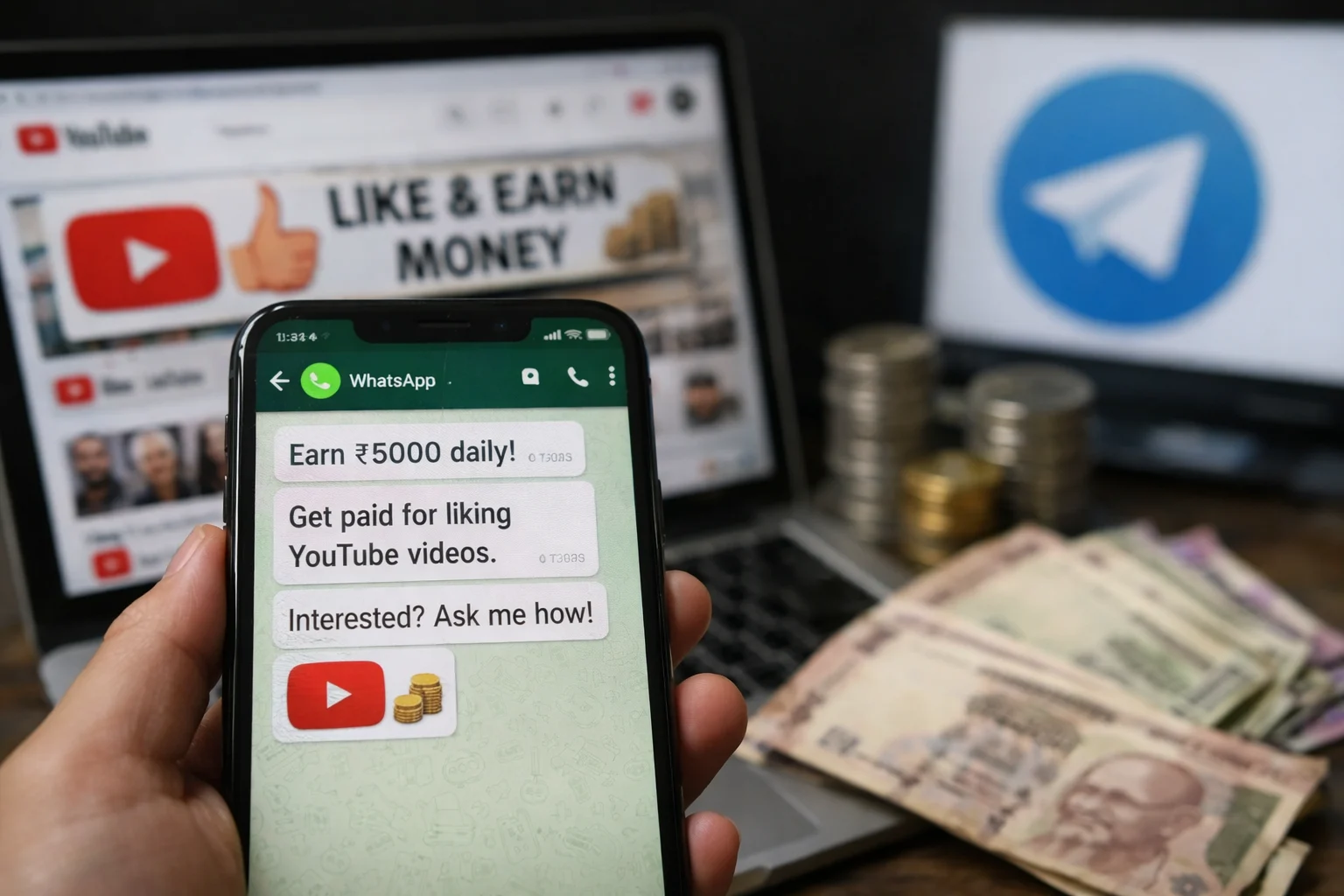
It starts innocently. You get a WhatsApp message from an unknown number: “Are you interested in a part-time work-from-home opportunity? Earn ₹500–₹5,000 daily by liking YouTube videos.”
No OTP asked. No bank details requested. Just like some videos and earn money. Sounds harmless, right?
That is exactly what scammers want you to think. This is one of the fastest-growing cyber frauds in India — and thousands of people, including educated professionals, are falling for it every single month.
In this article, we break down exactly how this scam works, who is behind it, real victim stories, and most importantly — how you can protect yourself.
How Big Is This Problem?
This is not a small-scale fraud. The numbers are staggering:
- ₹200 crore lost by 30,000 Delhi residents in a single month
- ₹3.97 crore lost by 181 Chandigarh residents in task scams alone
- 22,680 complaints filed in just Q1 of 2024 related to Telegram task fraud
- 400% year-over-year increase in task-based scams globally
And these are only the reported cases. Most victims — especially those who lost smaller amounts — never file a complaint out of shame or not knowing where to report.
How This Scam Works — Step by Step
This fraud is carefully designed to look real at every stage. Here is the exact playbook scammers follow:
Step 1: The WhatsApp Message
You receive a message from an unknown number — often a +91 mobile or an international number. It offers a simple part-time job: like YouTube videos, subscribe to channels, or rate hotels and apps. No experience required. Flexible hours. ₹150–₹250 per task.
Step 2: You Are Moved to Telegram
Once you show interest, a “receptionist” adds you to a Telegram group. The group already has 20 to 500 members — but most of them are fake bots posting screenshots of their “earnings” every few minutes to make the group feel active and legitimate.
Step 3: You Get Paid. For Real.
This is the most important step. You complete a few tasks and the scammer actually pays you ₹150 to ₹500 in real money via UPI. This builds genuine trust. You think: “This is working. It is legitimate.”
Step 4: The “Prepaid Task” Trap
Now comes the trap. You are invited to a “VIP Task Group” where earnings are much higher — but you must pay an upfront amount to “unlock” the task. They say: “Deposit ₹3,000 and complete this task to earn ₹7,000.” You pay ₹3,000 — and you receive ₹4,500 back. It works!
Step 5: The Stakes Keep Rising
The amounts keep getting bigger. ₹10,000 to earn ₹25,000. Then ₹50,000 to earn ₹1.5 lakh. The fake app shows your “balance” growing. Fake screenshots of others withdrawing lakhs flood the group. You are told your total profit is now ₹3 lakh or ₹5 lakh.
Step 6: Withdrawal Is Blocked
When you try to withdraw, scammers tell you that you need to pay taxes, a “processing fee,” or complete one more task to unlock funds. Victims often pay more money at this stage hoping to recover everything. Then the Telegram account vanishes. The group disappears. The money is gone.
Real Victim Cases in India
Case 1: Gurugram, Haryana — ₹42,31,600 Lost
A software engineer at an IT company received a WhatsApp message offering part-time income for liking YouTube videos. He was added to a Telegram group. Group members showed him fake profits of ₹69 lakh. When he tried to withdraw, they demanded more fees. He had already transferred money from both his and his wife’s bank accounts before realising it was a scam.
Case 2: Greater Noida, Uttar Pradesh — ₹51 Lakh Lost
A man was invited to a close-knit “investment group” on Telegram. Small returns kept coming in and he was encouraged to invest more and more. Once he transferred a large sum, all communication from the scammers stopped immediately.
Case 3: Chandigarh — ₹3.97 Crore Lost (City-Wide)
Chandigarh Police registered 181 cases from residents who lost money to Telegram task scams. Among the victims were chartered accountants, legal advocates, and private bank employees. Police traced the network to Gurugram — with funds being moved through shell companies and converted to cryptocurrency.
Case 4: Agra, Uttar Pradesh — ₹11.31 Lakh Lost
A man looking for extra income was added to a WhatsApp group and then Telegram. Fraudsters initially paid ₹600 for 3 tasks. Then came prepaid tasks – ₹2,000 returned ₹2,800, then ₹5,000 returned ₹8,060. Confidence built. He kept paying. Then it stopped completely.
Who Is Running These Scams?
These are not random individuals. They are highly organised criminal networks — many operating from outside India.
Delhi Police investigations revealed that Telegram IDs used by scammers were being operated from Beijing, China. WhatsApp numbers used in the fraud were traced to foreign origins. Money collected through UPI was immediately moved through multiple shell company accounts and converted to cryptocurrency within hours — making it nearly impossible to trace.
Cyber experts note that this scam model grew rapidly after Chinese loan app fraud declined due to government crackdowns. Criminal networks simply switched to task-based fraud as their new model.
The Telegram channels themselves operate like fake companies — with roles like “intern,” “staffer,” “receptionist,” and “teacher” — each assigned to specific stages of manipulating victims.
Warning Signs — Spot the Scam Before It Is Too Late
Watch out for these red flags:
- You received an unsolicited WhatsApp message offering part-time income from an unknown number
- The job requires no skills, no interview, no documents — just “simple tasks”
- You are asked to move to Telegram after showing interest on WhatsApp
- The Telegram group is full of people constantly posting earning screenshots
- You are asked to pay money upfront to “unlock” a higher-paying task
- An app or platform shows a large “balance” that you cannot actually withdraw
- They ask for more payment to “release” your withdrawal — taxes, fees, or one final task
- Famous brand names like TCS, Infosys, Tripadvisor, or Netflix are used to appear legitimate
What To Do and What To Avoid
Do This
- Block and report the WhatsApp number immediately
- Screenshot all chats and payment receipts before blocking
- Call cybercrime helpline 1930 right away
- File a complaint at cybercrime.gov.in
- Contact your bank to flag the fraudulent transactions
- Warn your family and friends about this scam
- Check unknown URLs and UPI IDs on ScamDekho before clicking or paying
Never Do This
- Never pay any upfront amount to “unlock” a task or earn money
- Never join Telegram groups based on WhatsApp messages from strangers
- Never trust screenshots of earnings as proof of legitimacy
- Never invest more money to try and recover what you already lost
- Never share your UPI PIN or bank OTP with anyone
- Never believe a job offer just because it uses a famous company name
Already Scammed? Do This Immediately
Time is critical. The faster you act, the better the chance that your money can be frozen before it is moved.
1. Call 1930 Right Now
This is India’s National Cybercrime Helpline, available 24×7. Call immediately and report the fraud. Cyber cells can request banks to freeze accounts if reported within hours of the transaction.
2. File a Complaint at cybercrime.gov.in
Go to the National Cyber Crime Reporting Portal and file a detailed complaint. Include all screenshots, UPI transaction IDs, and the Telegram or WhatsApp numbers involved.
3. Contact Your Bank
Call your bank’s fraud helpline and inform them of the fraudulent transactions. Request them to flag or freeze the beneficiary accounts. Provide your transaction reference numbers.
4. Visit Your Nearest Cyber Police Station
File a physical FIR at your local cyber police station. Bring printed copies of all evidence — chats, payment receipts, and screenshots.
Can You Get Your Money Back? The Honest Answer
This is the first question every victim asks. The honest answer is: it depends entirely on how fast you act.
When you transfer money via UPI, it does not sit in one account. Scammers move it through multiple accounts within minutes and eventually convert it to cryptocurrency. Once that happens, recovery becomes nearly impossible.
Here is the reality based on how quickly victims report:
- Within 0–4 hours: Best chance of recovery. Cyber cell can contact the beneficiary bank and request an emergency freeze before money is moved further. Many victims have recovered full amounts at this stage.
- Within 4–24 hours: Still possible but harder. Money may have moved one or two accounts ahead. Partial recovery is realistic if you act now.
- Within 24–72 hours: Very difficult. Funds are usually split across shell accounts by this point. Recovery is rare but an FIR is still essential.
- After 72 hours: Recovery is unlikely but do not skip filing a complaint. An FIR creates a legal record, helps police track patterns, and is required for any insurance or bank dispute claim.
The single most important thing you can do right now is call 1930 and file at cybercrime.gov.in. Every hour you wait reduces your chances.
Warning: The “Recovery Scam” — Getting Scammed a Second Time
This is something most awareness articles never mention — and it is costing victims even more money.
After you get scammed, criminals often contact you again. This time they pretend to be a bank officer, a cyber police official, a legal consultant, or a “money recovery expert.” They say they can help you get your money back — for a fee.
They know you are desperate. They know you are ashamed. And they use that against you.
Here is how to identify a recovery scam:
- They contacted you first — you did not find them
- They claim to be from a bank, RBI, CBI, or cyber cell but called on WhatsApp or Telegram
- They ask for an upfront “processing fee,” “legal fee,” or “tax” to release your funds
- They ask you to transfer money to a “safe account” to protect it
- They promise guaranteed recovery — no legitimate authority ever guarantees this
The rule is simple: no legitimate bank, police officer, or government official will ever contact you on WhatsApp or Telegram to recover your money. If someone does, it is a scam.
Real help is always free. Call 1930. Visit cybercrime.gov.in. Go to your nearest cyber police station in person.
Also Read: Fake Online Shopping Websites in India: How to Identify Them Before You Lose Money
Exactly What to Say to Your Bank — Use This Template
Most victims do not report to their bank because they do not know what to say. Here is the exact script you can use — on call or in writing.
1. On the Phone — Say This
“I am a victim of a cyber fraud. On [date], I was deceived into transferring ₹[amount] to UPI ID [UPI ID / account number]. This was done under false pretences by scammers. I request you to immediately flag this transaction and send a hold request to the beneficiary bank under RBI cybercrime guidelines. My complaint reference number on cybercrime.gov.in is [number]. Please treat this as urgent.”
In Writing — Email or Branch Letter
“Subject: Urgent — Cyber Fraud Transaction Dispute
Dear Sir/Madam,
I am writing to report a cyber fraud transaction made from my account [account number] on [date]. I was deceived by scammers operating on WhatsApp and Telegram into transferring ₹[amount] to the following UPI ID / account: [details].
I have already filed a complaint on the National Cyber Crime Reporting Portal (cybercrime.gov.in) with reference number [number] and called helpline 1930.
I request you to: (1) immediately place a hold on the beneficiary account, (2) raise an inter-bank fraud alert, and (3) provide me with a written acknowledgement of this complaint for my records.
Time is critical. Please treat this as an emergency.
Yours sincerely,
[Your Name]
[Account Number]
[Contact Number]”
Documents to Keep Ready
- Screenshot of every UPI transaction (from PhonePe, GPay, or your bank app)
- Screenshot of all WhatsApp and Telegram chats
- The UPI ID or account number you sent money to
- Your cybercrime.gov.in complaint reference number
- Date, time, and exact amount of each transaction
Important: Banks are required under RBI guidelines to acknowledge fraud complaints within 3 working days. If your bank does not respond, escalate to the RBI Banking Ombudsman at bankingombudsman.rbi.org.in.
Conclusion
The “Like YouTube Videos and Earn Money” scam is not a small-time fraud. It is a professionally run criminal operation that has stolen hundreds of crores from ordinary Indians — students, engineers, doctors, homemakers, and retired professionals alike.
The reason it works so well is simple. It does not ask for your OTP. It does not hack your account. It does not even lie to you at first. It pays you real money, builds your trust slowly, and then uses that trust against you. By the time most victims realise what is happening, they have already lost lakhs.
But now you know exactly how it works.
You know the six steps scammers follow. You know the red flags to watch for. You know what to do in the first four hours if something goes wrong. And you know that if someone contacts you promising to recover your money — that is the second scam.
The most powerful thing you can do right now is not just protect yourself — it is to share this article with the people around you. Your parents who are looking for extra income. Your college friends who might get a random WhatsApp message. Your relatives who trust any message that offers easy money.
One conversation could save someone from losing their life savings.
And if you ever receive a suspicious link, a unknown UPI ID, or a website that looks off — check it for free on ScamDekho before you click or pay. That one check could make all the difference.
Stay alert. Stay safe.