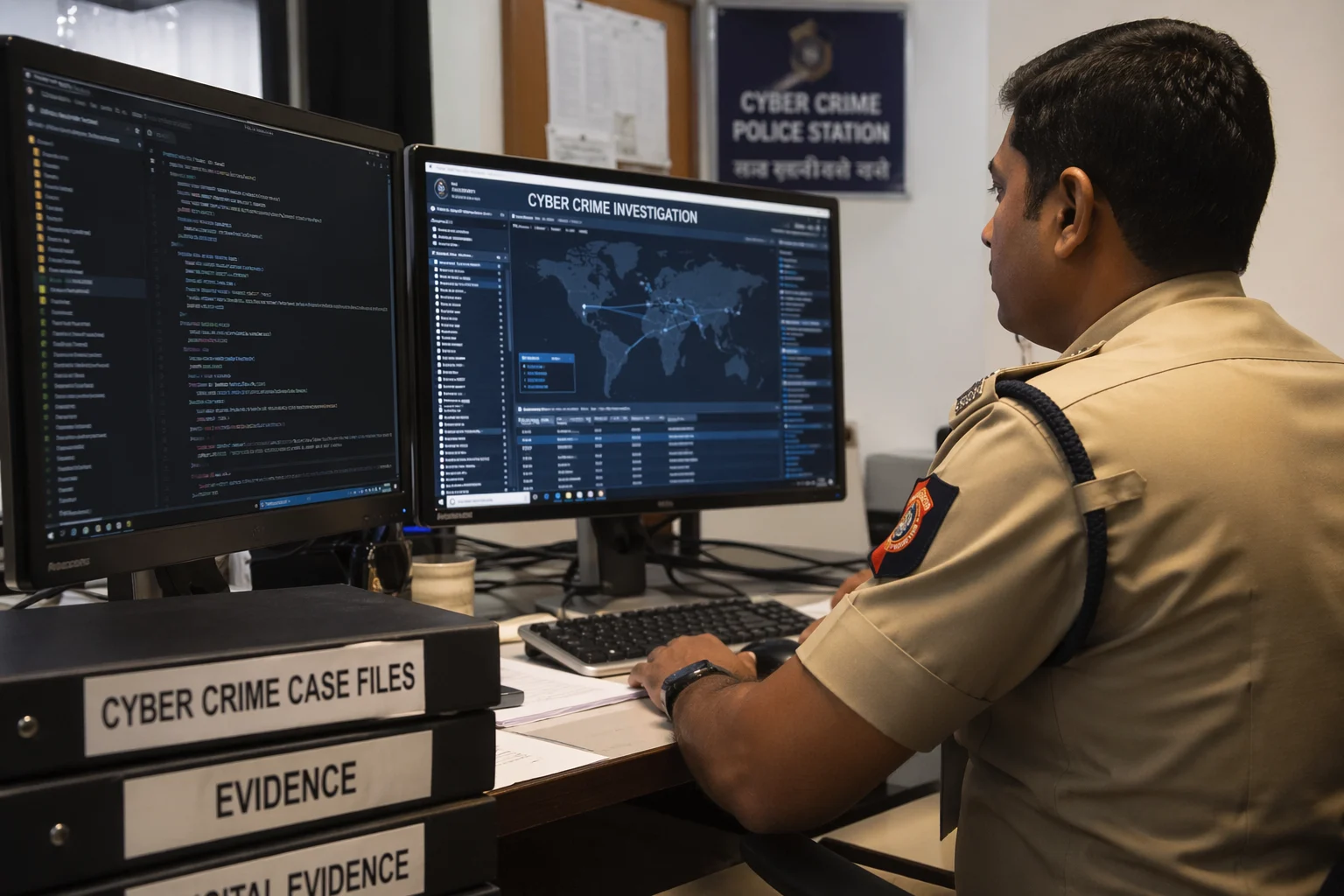
Category: Blog

Your blog category

  • FedEx & DHL Parcel Scam in India: How “Your Parcel Is Stuck” Call Steals Your Money

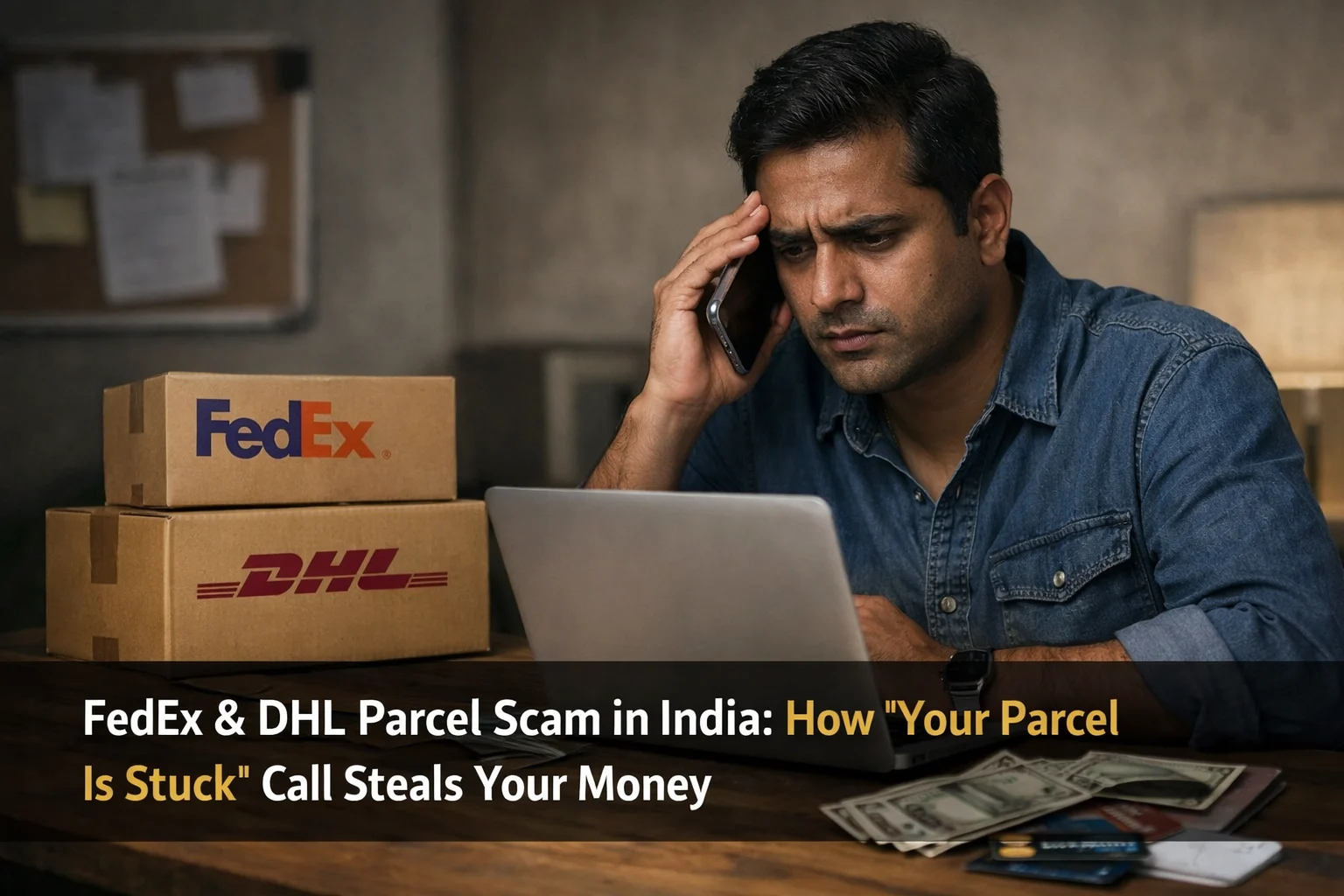
    FedEx & DHL Parcel Scam in India: How “Your Parcel Is Stuck” Call Steals Your Money

    Imagine this. You are in the middle of a normal workday and your phone rings. A robotic voice says, “Your FedEx package has been blocked, press 1 to speak to an officer.” You press 1 out of curiosity. A person on the other end tells you that a parcel booked in your name is stuck at Mumbai customs, and it contains narcotics, fake passports, and illegal SIM cards. Before you can process what is happening, the call is transferred to a man in police uniform on Skype who says you are now under “digital arrest” and must transfer money to prove your innocence.

    This is not a movie plot. This is the FedEx and DHL parcel customs scam, and it has already stolen over ₹1,806 crore from Indians in just one year, according to Bengaluru City Police data. The scary part is how real it feels, because the caller already knows your Aadhaar number. This guide explains exactly how the scam works, the red flags to catch in the first 30 seconds, and what to do if you or a family member has already picked up the call.

    What Is the FedEx / DHL Parcel Customs Scam?

    The FedEx parcel scam is a phone-based impersonation fraud where criminals pretend to be courier company employees and accuse you of sending or receiving an illegal international parcel.

    Once they have your attention, the call is transferred to a fake police officer, NCB agent, or customs official who demands a “security deposit” or “verification payment” to clear your name.

    This scam is also known as:

    • “Your parcel is stuck at customs” fraud
    • Fake courier call scam
    • Digital arrest parcel scam
    • Narcotics parcel scam

    How Big Is the Problem? (Data You Should Know)

    The parcel scam is not a fringe crime. It is one of the fastest-growing cyber frauds in India.

    RegionCases ReportedLosses / StatusSource
    Bengaluru1,417 cases in 2024 (up 251% from 2023)Part of ₹1,806 crore total cyber losses in 2024Bengaluru City Police
    Telangana645 cases in 2023 vs 64 in 2022₹18.24 crore lost; ₹4.77 crore recoveredTelangana State Cyber Security Bureau
    Krishnagiri (TN)337 cases in 2024Zero cases in 2023The New Indian Express
    All India7.4 lakh+ cyber complaints in 2024₹11,333 crore+ lost overallI4C, Ministry of Home Affairs

    What makes this scam especially dangerous is the psychology behind it. Over 70% of victims in reported cases have said they initially sensed something was off. But the moment the scammer correctly recited their Aadhaar number, their doubt collapsed. This is the real weapon of the scam: leaked personal data combined with fear.

    How the Scam Actually Works Step by Step

    Here is the exact playbook scammers follow, reconstructed from FIRs, FedEx’s official advisory, and verified news reports.

    Step 1: The IVR Call

    You receive an automated call in English or Hindi saying:

    “Your FedEx package has been blocked. Press 1 to speak to customer care.”

    The moment you press 1, you are connected to a live “agent”.

    Step 2: The Hook

    The “agent” claims a parcel booked in your name is stuck at Mumbai or Delhi airport and contains one or more of the following:

    • MDMA or other narcotics
    • Fake passports
    • Illegal SIM cards
    • Foreign currency
    • Expired credit cards

    They quote your full name and Aadhaar number, obtained from data leaks, to appear legitimate.

    Step 3: The Transfer to “Police”

    The call is transferred to a fake officer from the “Mumbai Cyber Cell” or “Narcotics Control Bureau”. They instruct you to download Skype, Zoom, or a custom app for a “digital statement”.

    Step 4: The Digital Arrest

    On video, you see a man in police uniform, often with a fake police station backdrop. He tells you:

    • You are under “digital arrest” and cannot contact anyone
    • Your Aadhaar is linked to a money-laundering case
    • You must transfer money to a “verification account” for clearance

    Step 5: The Drain

    Victims are kept on the call for hours or even days, sometimes forced to check into hotel rooms to isolate them. Money is transferred in multiple tranches to mule accounts, from where it moves through UPI chains to Dubai, Cambodia, or Myanmar.

    Real Case Studies

    Case 1: Bengaluru Journalist (2023) A 70-year-old journalist received a WhatsApp call from someone claiming to be FedEx Mumbai. The caller alleged her parcel contained 240 grams of MDMA. After being transferred to a fake NCB officer on Skype, she transferred ₹1,20,36,246 to four different accounts. Source: The News Minute.

    Case 2: Hyderabad IT Employee (2023) A 36-year-old software engineer, Yashaswi, lost ₹8,74,998, her entire savings including a recurring deposit, after being told her FedEx parcel to Taiwan was flagged for “identity theft”. Source: The Hindu / Hyderabad Cyber Crime.

    Case 3: Retired Delhi Couple (2025) A retired doctor couple in Greater Kailash lost nearly ₹15 crore after being held on a two-week “digital arrest” video call by fraudsters pretending to be TRAI and Mumbai Police officials. Source: Times of India.

    9 Red Flags to Identify a FedEx / DHL Parcel Scam Call

    If any ONE of these appears, it is a scam:

    1. The call starts with a recorded (IVR) message asking you to “press 1”
    2. The caller claims your parcel contains drugs, passports, or SIM cards
    3. They know your Aadhaar number but still ask you to “confirm” it
    4. You are asked to download Skype, Zoom, or any “official police app”
    5. A police officer in uniform appears on video call
    6. You are told you are under “digital arrest” and cannot inform anyone
    7. They ask for money transfer to a “RBI verification account” or “government account”
    8. The urgency is extreme, you must pay within minutes or hours
    9. Caller ID shows +92, +84, +855, +1, or an unusual +91 prefix

    Important: Indian law does not recognise any concept of “digital arrest”. The Ministry of Home Affairs and PIB have officially confirmed this is a complete fabrication used only by scammers. (Source: PIB Fact Check.)

    How Scammers Get Your Aadhaar & Personal Details

    This is the part most articles skip. Scammers get your data from:

    • Data leaks from telecom operators, e-commerce sites, and loan apps
    • Cyber cafés and photocopy shops that store Aadhaar copies
    • Resold CRM databases sold on Telegram for ₹500 to ₹5,000 per 10,000 records
    • Phishing links sent through SMS and fake job portals

    If you have ever uploaded your Aadhaar to an unverified job site or loan app, your data is already on a list somewhere. A safer habit is to run any suspicious link through our free URL Checker tool before clicking. It instantly flags known phishing and scam domains.

    What to Do If You Receive Such a Call (Step by Step)

    Within 0 to 5 minutes

    1. Disconnect the call immediately. Do not say anything, do not press any number.
    2. Do not download any app they recommend (Skype, AnyDesk, TeamViewer, or custom apps).
    3. Block the number on WhatsApp and your dialler.

    Within 30 minutes

    1. Call your family and tell them. Isolation is the scammer’s main weapon.
    2. Verify the parcel claim by visiting the official FedEx, DHL, or Blue Dart tracking websites. Never use any link the caller sent.
    3. Take screenshots of the call log, WhatsApp chat, and any SMS received.

    If You Have Already Transferred Money

    1. Call 1930, the National Cyber Helpline, within the Golden Hour (first 60 minutes). This is the window during which banks can freeze the receiving mule account.
    2. File a complaint at cybercrime.gov.in
    3. Visit your bank branch and file a written dispute for the specific transaction IDs.
    4. File an FIR at your local police station under IT Act Sections 66C, 66D, and IPC Section 420. For a full walkthrough, read our step-by-step money recovery guide.

    FedEx, DHL & Blue Dart: What the Companies Officially Say

    According to the official FedEx India advisory (fedex.com/en-in/trust-center/report-fraud.html):

    • FedEx never solicits personal information through unsolicited calls, email, or SMS.
    • FedEx has no affiliation with any law enforcement agency.
    • FedEx will never ask you to transfer money for “parcel clearance” or “fines”.

    DHL and Blue Dart have issued identical advisories on their official websites. If you are unsure whether a message from any courier is genuine, you can paste the suspicious text into our scam message checker. It analyses wording, sender patterns, and known fraud templates instantly.

    FedEx Parcel Scam vs Genuine Courier Call: Quick Comparison

    FactorScam CallGenuine Courier Call
    SourceRandom mobile/VoIP number, +92/+84 codesRegistered landline of courier branch
    LanguageIVR + hostile “police” toneNormal customer-care tone
    Asks for moneyYes, immediatelyNo. Payments only at delivery or on official portal
    Mentions narcotics / Aadhaar / NCBYesNever
    Asks you to install appsYes. Skype, AnyDesk, custom appsNo
    TrackingNo valid AWB number visible on official websiteAlways matches official courier website

    Who Is Most at Risk?

    Based on case data, the highest-risk groups are:

    • Senior citizens (60+), emotionally vulnerable and less familiar with digital tools
    • NRIs and families of NRIs, international parcels sound plausible
    • Students and job seekers, often share Aadhaar with fake recruiters (see our detailed guide on spotting fake job offers)
    • Small business owners using international logistics

    If your parents or elderly relatives use smartphones, keep two of our free tools bookmarked on their phones for quick safety checks.

    Internal Safety Checklist (Print or Save This)

    • Never press “1” on unknown IVR calls claiming to be a courier
    • Never share Aadhaar, PAN, or OTP on phone/video calls
    • Never download Skype, AnyDesk, or “police apps” on someone’s instruction
    • Never transfer money to verify innocence. That concept does not exist in Indian law
    • Always verify courier claims on the official company website
    • Always report scams within the 60-minute Golden Hour
    • Always tell an elderly family member this scam exists. Prevention is 10x better than recovery

    Final Word

    The FedEx and DHL parcel customs scam works because it attacks three human instincts at once: fear of law, trust in brands, and urgency under pressure. The moment you understand the pattern, the scam loses all power.

    If you ever get that “your parcel is stuck at customs” call, remember one sentence: no genuine courier company, police officer, or customs agent will ever demand money over a phone or video call. Hang up, check the official website, and report it.

    Share this guide with at least one senior citizen in your family today. That single forward can save someone ₹1 crore.

    FAQs: People Also Ask

    Q1: Is the FedEx parcel scam call real or fake?

    It is 100% fake. FedEx India has officially confirmed it does not make such calls or accept money for “parcel clearance”. Any call claiming your parcel contains drugs or illegal items is a scam. Real customs enforcement in India does not happen over phone calls or Skype.

    Q2: What is “digital arrest” and is it legal in India?

    Digital arrest is not a legal concept in Indian law. The Ministry of Home Affairs and PIB Fact Check have repeatedly confirmed that no Indian police, CBI, NCB, or court ever conducts “arrests” over video calls. Anyone claiming this is a fraudster.

    Q3: Can I recover money lost in a FedEx or DHL parcel scam?

    Recovery depends on speed. If you report within the 60-minute Golden Hour on 1930 or at cybercrime.gov.in, banks can sometimes freeze the mule account before the money moves further. Telangana’s TSCSB, for example, recovered ₹4.77 crore out of ₹18.24 crore lost. After 24 hours, recovery chances drop significantly.

    Q4: How did scammers get my Aadhaar and personal details?

    Most parcel scammers buy data in bulk from leaks, telecom breaches, loan app leaks, e-commerce data dumps, and Telegram database sellers. Them knowing your Aadhaar does not mean the call is real.

    Q5: Should I answer unknown international calls in India?

    Avoid answering calls starting with +92, +84, +855, +1, or any unusual international code unless you are expecting one. TRAI has officially advised citizens to disconnect and report such calls through the Sanchar Saathi portal (sancharsaathi.gov.in).

    Q6: Can FedEx or DHL themselves reimburse me if I fall for the scam?

    No. The companies are not liable because the scammers only impersonate them and are not their employees. Your only legal route is reporting to cybercrime authorities and your bank.

    This article is for educational and awareness purposes only. It does not constitute legal or financial advice. If you are a scam victim, please consult a qualified cybercrime lawyer and your bank immediately.

  • Fraud Pattern Alert: Multiple Complaints Reported Across Maharashtra, Karnataka and Goa

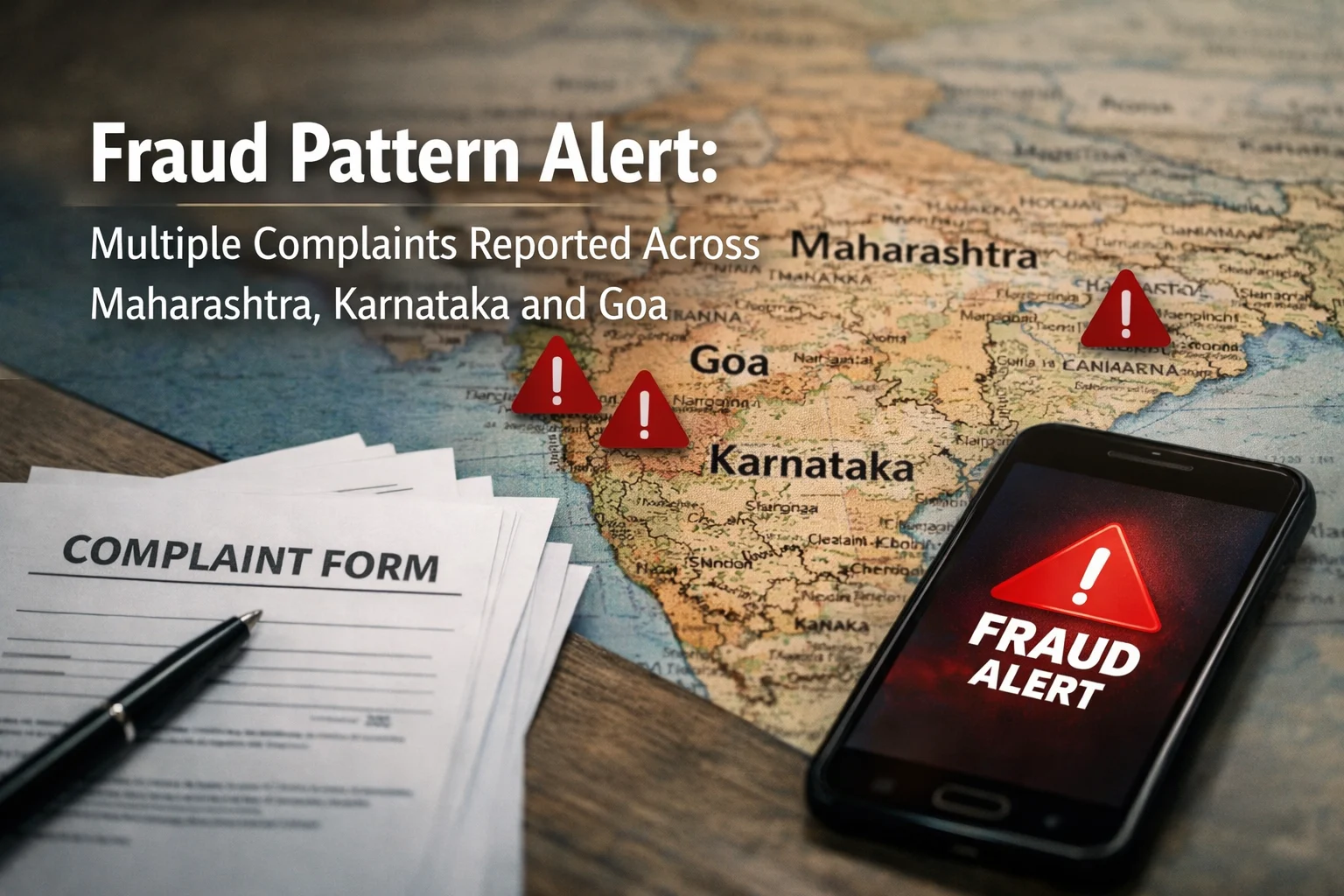
    Fraud Pattern Alert: Multiple Complaints Reported Across Maharashtra, Karnataka and Goa

    Multiple individuals have reported being cheated by someone following the same pattern of behavior. The alleged fraud involves building false trust, using social engineering tactics, and requesting large UPI transfers before cutting off contact. This post is published purely for public awareness. No victim identities are disclosed anywhere in this report.

    Reported Loss: ₹1,95,000 | States Mentioned in Complaints: 3 | Reported Victims: 2 or more

    Important Notice

    This blog post is published purely for public awareness. All victim identities are kept strictly private. The pattern described here is based on complaints reportedly filed with cybercrime authorities. If you have had a similar experience, please report it immediately at cybercrime.gov.in or call 1930.


    1. About This Case

    Complaints have been received regarding an individual allegedly operating from one region of India. According to victims, this person presents themselves as trustworthy and well-connected, building a false sense of credibility before making financial requests.

    Complaints have come from victims across Maharashtra, Karnataka, and Goa, suggesting the individual may deliberately target people who are geographically distant, making it harder for them to take immediate action.

    The individual is reportedly reachable through multiple phone numbers and social media profiles. Victims claim that complaints have been filed with authorities, and the matter is reportedly under legal process.

    2. The Alleged Pattern — As Reported by Victims

    The following pattern has been described consistently across multiple complaints.

    Stage 1 — Building trust Contact is reportedly made through social media or mutual acquaintances. Victims describe the person as charming, responsive, and attentive. This phase reportedly continues for days or weeks before any financial request is made.

    Stage 2 — Creating a believable situation A situation is presented that appears to require urgent financial help, such as a business opportunity, a personal emergency, or a favour. Victims describe the story as specific and emotionally compelling.

    Stage 3 — Requesting large UPI transfers Victims report being asked for large transfers via UPI, often in amounts close to ₹1 lakh, sometimes in multiple transactions within the same day.

    Before sending money, you can verify suspicious requests using our UPI QR checker tool

    Stage 4 — Communication changes after payment Victims reported that communication changed significantly after payment was made. Responses became infrequent, excuses were offered, and in some cases contact stopped entirely.

    Stage 5 — Pattern repeats The same pattern of behavior has reportedly been described by more than one victim, with similar amounts and similar methods mentioned across separate complaints.

    A Closer Look at the Reported Incident

    In one complaint, two separate UPI transactions of ₹97,000 and ₹98,000 were reportedly made within the same evening, approximately 24 minutes apart, to the same recipient account (as per complaint). The total reported loss in this single incident is ₹1,95,000. A cybercrime complaint has reportedly been filed and acknowledged. Legal proceedings are said to be ongoing.

    3. Warning Signs to Watch For

    If someone you have recently met online matches several of these patterns, exercise caution before transferring any money.

    Requests for large UPI transfers, particularly amounts close to ₹1 lakh per transaction, especially if asked for quickly or urgently.

    Multiple transfer requests within the same day or within a short period of time.

    Contact initiated through social media or indirect connections, with unusually fast emotional closeness followed by a financial request.

    A compelling story involving urgency, such as a business deal, emergency, or personal crisis, that specifically requires an immediate transfer.

    Communication that slows down, becomes evasive, or stops entirely after money has been sent.

    Use of multiple contact numbers or accounts that change over time.

    Requests coming from someone who is located far from you and whom you have never met in person.

    In many cases, scammers also send fake payment proofs. Learn how to detect them using our fake payment screenshot checker.

    4. How to Protect Yourself

    These simple habits can significantly reduce your risk.

    Always verify before transferring money. Regardless of how well you feel you know someone online, do a video call and confirm that the person, location, and situation match what they have described.

    Do not act under pressure or urgency. Creating urgency is a known tactic used in fraud. Most genuine situations can wait 24 hours while you verify.

    Search the person online before trusting them. Searching a name alongside words like “fraud” or “complaint” can sometimes surface prior reports. You can also check cybercrime.gov.in for registered cases.

    Trust your instinct. If the pace of emotional connection feels unusually fast or if a financial request arrives before a relationship is truly established, pause before acting.

    Avoid transferring money to anyone you have not met in person, especially if the account or contact details are new or unfamiliar.

    Talk about cases like this openly. Awareness is one of the most powerful tools against fraud. Share this post with people who may be vulnerable.

    5. If You Have Already Lost Money — Act Immediately

    Time matters greatly in UPI fraud cases. Here is what to do right away.

    Call 1930 immediately. This is India’s National Cybercrime Helpline. An early call can sometimes prompt banks to flag or hold the recipient account before funds are moved further.

    File a complaint at cybercrime.gov.in. Upload all evidence including screenshots, payment receipts, and chat records. Keep your acknowledgement number safe.

    Visit your nearest police station. File an FIR citing IT Act Section 66D and IPC 420. Bring printed copies of all evidence. An FIR is necessary for bank-level dispute processes.

    Contact your bank directly. Report the transaction to your bank’s fraud helpline and ask about raising a dispute. Provide your FIR number to the relevant bank as well.

    Preserve all evidence. Do not delete any messages, call logs, or transaction records. Every piece of communication is potentially useful in legal proceedings.

    Also Read: How to Report a Cyber Crime in India: Complete Step-by-Step Guide

    Disclaimer

    This blog post is published by ScamDekho for public awareness purposes only. The information presented is based on complaints reportedly submitted by victims and has not been independently verified by ScamDekho. All individuals are presumed innocent until proven guilty by a court of law. No victim identities have been disclosed. This post does not constitute legal advice. ScamDekho is a fraud awareness platform and is not responsible for any independent legal action taken by readers. If you recognise this pattern, please report directly to cybercrime authorities.

    Have you experienced something similar? Submit your report anonymously at support@scamdekho.in. Your identity will remain confidential. Report fraud at cybercrime.gov.in or call 1930.

  • Fake UPI Payment Apps in India: How to Spot Fake PhonePe & GPay

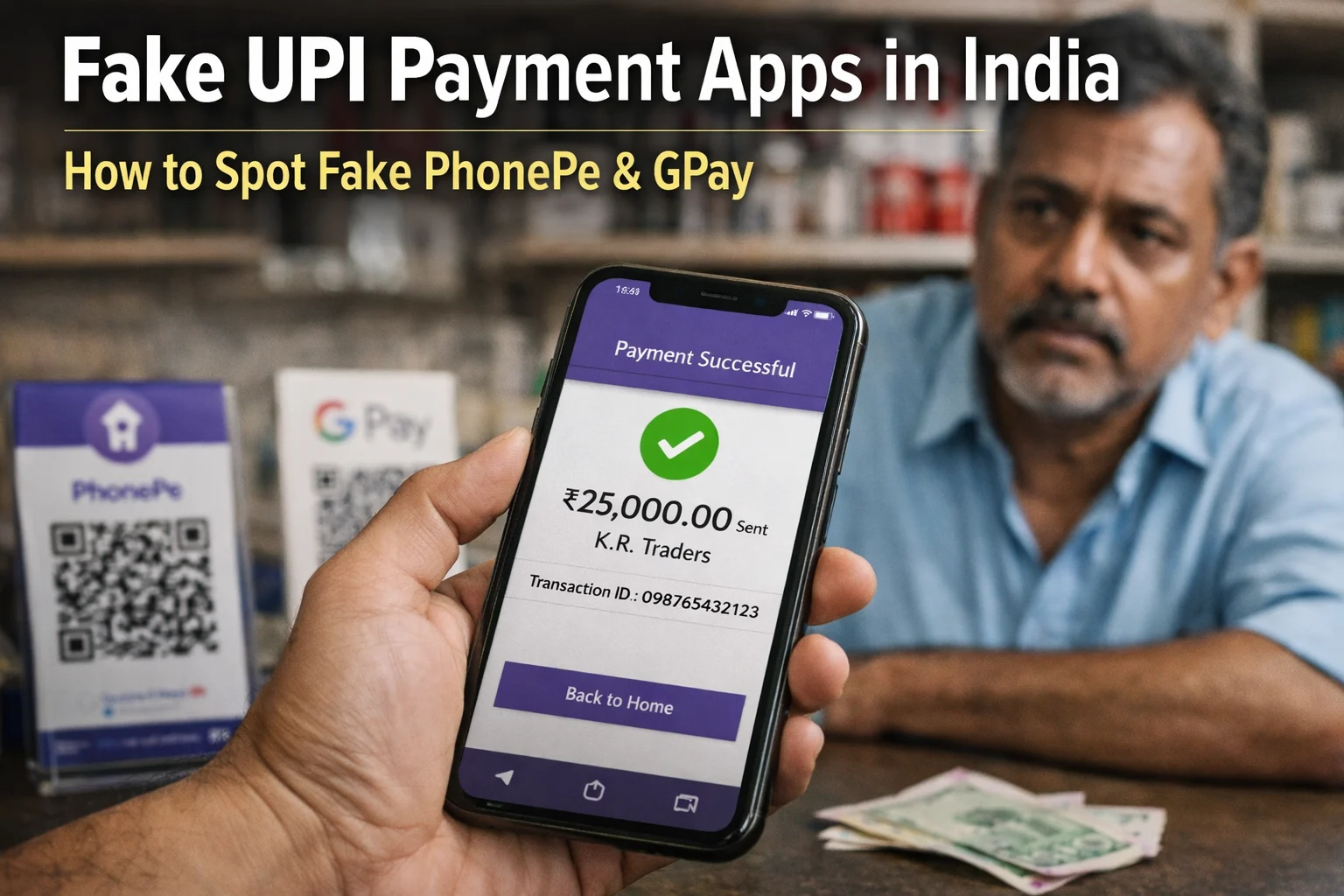
    Fake UPI Payment Apps in India: How to Spot Fake PhonePe & GPay

    Last month, a mobile shop owner in Bengaluru’s Rajajinagar handed over a phone to a customer who showed a “Payment Successful” screen. Three hours later, when he checked his bank account, the ₹76,000 had never arrived. The app on the customer’s phone looked exactly like PhonePe same colors, same success animation, same notification sound. It just wasn’t real.

    This isn’t a one-off case. Asianet News reported that an entire gang is active across Bengaluru targeting small shopkeepers with this exact method. In July 2025, two men were convicted in Arunachal Pradesh for running a similar scam using a fake PhonePe app, as reported by India Today NE. And during Diwali 2025, Gujarat Samachar reported a spike in fake payment app fraud targeting sweet shops and small traders across Gujarat.

    Running a tool that analyzes payment screenshots daily, I see this pattern constantly. The fake UPI app isn’t a theoretical threat, it’s in wallets right now, being used at petrol pumps, mobile shops, and vegetable stalls across India. This guide explains exactly how these apps work, how to spot them in seconds, and what to do if you’ve already been scammed.

    Disclaimer: This article is for informational and awareness purposes only. It is not legal or financial advice. If you have suffered a financial loss, consult your bank, local police, and the National Cyber Crime Helpline (1930) immediately. Laws and fraud patterns evolve, always verify current guidance with official sources like the Reserve Bank of India and NPCI.

    What Is a Fake UPI Payment App?

    A fake UPI payment app is a counterfeit Android APK built to look and behave exactly like a real UPI app – PhonePe, Google Pay, Paytm, BHIM, or any popular payment app in India. The fake app copies the real app’s color scheme, logos, success screen, and even the payment confirmation sound.

    The critical difference: a fake UPI app never connects to real UPI infrastructure. It doesn’t communicate with NPCI servers, your bank, or any actual payment network. It’s essentially a local animation on the scammer’s phone that produces a convincing illusion of payment.

    These are different from fake payment screenshots, which are static images edited with photo tools. A fake app is a live, interactive fraud, the scammer can type any amount, any recipient name, any UPI ID, and produce what looks like a real transaction. Some advanced versions even generate fake transaction IDs and play sounds that imitate the “ting” of a real payment.

    Launched by NPCI in 2016, UPI now processes over 21 billion transactions per month as of January 2026, according to official NPCI data.

    How Big Is the Problem? Real Numbers from Government Sources

    Let me put the scale of this issue in perspective using official numbers, not guesses.

    In December 2025, Union Minister of State for Finance Pankaj Chaudhary told the Lok Sabha that India saw UPI-related fraud worth ₹805 crore across 10.64 lakh incidents in just the first 8 months of FY26. For comparison, FY24-25 saw ₹981 crore across 12.64 lakh incidents, and FY23-24 recorded ₹1,087 crore in losses.

    A separate LocalCircles survey published in 2025 and covering 32,000+ respondents across 365 Indian districts found that 1 in 5 Indian families using UPI had experienced fraud at least once in the past three years. More worryingly, 51% of victims never reported the fraud meaning the real numbers are almost certainly higher than government records show.

    Fake payment apps aren’t the only category in this data, but they’re a growing share. NPCI advisories issued throughout 2025 and 2026 specifically flag counterfeit payment apps as a merchant-targeted fraud category requiring urgent awareness.

    The 5 Main Types of Fake UPI Apps Active in India

    Not all fake payment apps work the same way. After analyzing the reports flowing into our screenshot checker tool over the last year, I’ve grouped them into five distinct categories. Understanding each type helps you recognize the specific trick being used.

    1. Fake PhonePe APK Apps

    These are the most common variant in India. The fake PhonePe APK is distributed via Telegram groups, shady third-party app stores, and file-sharing links on WhatsApp. Once installed, the scammer can manually type the merchant’s UPI ID and an amount. The app then shows PhonePe’s signature purple success screen with a transaction ID that looks real but doesn’t exist in any bank’s records.

    Real PhonePe transaction IDs are exactly 12 digits and fully numeric. The fake app generates random 12-digit strings they look correct but won’t appear in your PhonePe merchant history or bank SMS.

    2. Fake Google Pay / GPay Clone Apps

    GPay clones are slightly harder to spot because Google Pay’s success screen is cleaner and less distinctive than PhonePe’s purple branding. The fake versions replicate the GPay logo, the payment confirmation checkmark, and the recipient name field.

    A genuine Google Pay transaction generates an alphanumeric UPI reference ID. Fake apps either generate all-numeric IDs (wrong format) or use random alphanumeric strings that don’t match Google’s actual transaction ID pattern.

    3. Fake Paytm Mod APKs

    According to a News9 report from 2022 (tracking an ongoing pattern that has only grown), Hyderabad police arrested two individuals specifically for using a fake Paytm “spoof app” against shopkeepers in Vanasthalipuram. The app let them enter the shopkeeper’s name, mobile number, amount, and other details then generate a fake payment success page.

    Some versions even send a fake SMS to the shopkeeper’s phone to add another layer of false confirmation. The only reliable way to detect these: open your actual Paytm for Business app and check whether the credit is there.

    4. Fake Payment Scanner Apps

    This is a category most people don’t recognize but it’s growing fast. A fake payment scanner app appears to “scan” a merchant’s QR code and then immediately displays a success screen. The shopkeeper sees the scanning animation and assumes a real transaction happened. No actual UPI network call is ever made.

    These scanner-style fake apps are particularly dangerous at petrol pumps and toll counters where staff rarely have time to double-check.

    5. Fake Payment Generator Websites (Browser-Based)

    Not technically apps, but they operate on the same principle. These are websites where a scammer can enter any amount, any UPI ID, any transaction ID, and generate a realistic-looking PhonePe, GPay, or Paytm screenshot. Some even produce fake sound files.

    Search traffic data shows tens of thousands of Indians search for these generator tools every month many innocently (curious or trying to detect fakes), others with clear fraudulent intent.

    Fake UPI App vs Real UPI App: Quick Comparison Table

    FeatureFake UPI AppReal UPI App
    Installation sourceAPK file from Telegram, WhatsApp, or third-party siteOfficial Google Play Store or Apple App Store
    Transaction IDRandomly generated, doesn’t exist in bank recordsValid UTR visible in sender’s and receiver’s bank
    Merchant-side notificationNone (only customer’s phone shows the “success”)Instant SMS, app notification, or SoundBox alert
    Bank account creditNever arrivesAppears in your account within seconds
    Settlement recordNo traceFull audit trail in NPCI and bank systems
    Internet requirementOften works offline (obvious red flag)Requires internet to connect to UPI servers
    UPI PIN prompt for senderFake prompt, no real authenticationReal PIN authentication against bank server

    If you can remember just one row of this table: the merchant-side notification. A real UPI payment triggers an alert on your phone or SoundBox. A fake payment only shows success on the customer’s phone.

    7 Ways to Spot a Fake Payment App at Checkout

    This is a practical checklist you can use in under 30 seconds at any transaction. I’ve ordered these from easiest to most thorough.

    1. Check Your Own Device for the Payment

    Open your merchant app Paytm for Business, PhonePe Business, or your bank’s UPI app. A real transaction appears instantly. If there’s no credit in your app, there’s no payment. Don’t release goods regardless of what the customer’s phone shows.

    2. Listen for the SoundBox Alert (Not Their App)

    If you have a Paytm SoundBox, PhonePe Smart Speaker, or any merchant audio device, the confirmation sound should come from your device. A fake app only plays sound from the customer’s phone. As the NDTV Tech coverage of the Hyderabad case pointed out, SoundBoxes are specifically effective against this scam because they’re tied to your actual bank credit.

    3. Verify the Bank SMS on Your Phone

    Every real UPI credit above ₹100 triggers an SMS from your bank. If your phone hasn’t buzzed with a credit message, the payment didn’t happen. Some fake apps send a fake SMS to the shopkeeper’s number always check that the sender ID matches your bank (e.g., “VK-SBIINB” for SBI, not a random 10-digit number).

    4. Look at the Transaction ID Format

    Each UPI app has a specific transaction ID format:

    • PhonePe: Exactly 12 digits, all numeric
    • Google Pay: Alphanumeric, specific pattern
    • Paytm: Long numeric string
    • BHIM: NPCI standard UTR format (12 digits)

    If the transaction ID looks too short, too long, or has letters where it should be numbers only it’s likely a fake.

    5. Check if the App Is Actually Online

    Ask the customer to show the transaction in their payment history, not just the screenshot of the success screen. Real apps sync with NPCI servers and will show the transaction. Fake apps have no history to sync.

    6. Refuse Urgency and Pressure Tactics

    Scammers consistently use phrases like “I’m running late,” “show this to your boss later,” or “the network is slow.” The Kerala Police advisory issued via Kerala Kaumudi specifically warned merchants that artificial urgency is one of the strongest indicators of fake payment fraud. A genuine customer will wait 60 seconds for you to verify.

    7. Never Enter Your UPI PIN to “Receive” Money

    This is critical and widely misunderstood. Entering a UPI PIN always authorizes money going OUT of your account, never IN. If someone says “scan this QR or approve this request to receive your payment,” they’re trying to debit your account, not credit it. The NPCI has issued repeated advisories on this, and RBI Q1 2026 data (as cited by the Nahar Blog analysis of UPI trends) flagged 18 lakh fake collect requests in a single quarter.

    Also Read: UPI QR Code Scam: How Fake QR Scanners Are Stealing Money in India (2026)

    Fake / Fraud Payment Apps List

    • Prank Payment APK
    • FakePay – Money Transfer Prank
    • FakePe APK
    • UPI Payment Generator APK
    • Fake Payment Screenshot App
    • Fake Pay Receipt Generator
    • UPI Screenshot Maker
    • Fake Balance Checker App
    • GPay MOD APK (fake)
    • PhonePe MOD APK (fake)
    • Paytm Spoof App
    • BHIM Clone APK
    • Fake QR Generator App
    • Fake Sound Payment App

    Real Cases: Fake UPI App Scams That Hit Indian Shopkeepers

    • Real cases make the pattern concrete. Here are four documented incidents from across India in the last two years.
    • Bengaluru, Rajajinagar (February 2026): A mobile shop owner was defrauded of ₹76,000 when a gang used a fake payment app to show successful UPI confirmation for an expensive smartphone. The Karnataka police is still tracking the suspects, per Asianet News coverage.
    • Ruksin, Arunachal Pradesh (July 2025): Two men – Raj Thapa and Boge Sonar, were convicted after using a fake PhonePe app to defraud a local shop. The case was originally registered at Ruksin Police Station in October 2024 and investigated by SI Igel Lollen. Both received two-month prison sentences, according to India Today NE.
    • Vanasthalipuram, Hyderabad (2022 onwards): Hyderabad police arrested two people for using a fake Paytm spoof app that could generate fake payment pages with shopkeeper details pre-filled. This case is older but represents a pattern that has only grown, as reported by News9 Live.
    • Gujarat Diwali Season (October 2025): Cybercrime officer Hardik Makadia issued a public warning via Gujarat Samachar about a coordinated fake PhonePe and Paytm fraud targeting sweet shops and crowded festive markets across Gujarat. The fake apps displayed credit confirmation messages, but no money actually transferred.

    What connects every case: the shopkeeper trusted a screen on the customer’s phone without verifying the credit on their own side. The fix is identical in every case verify on your device before releasing goods.

    What to Do If You’ve Already Accepted a Fake Payment

    The first hour is critical. Here’s the exact sequence recommended by RBI and the Indian Cyber Crime Coordination Centre (I4C).

    Step 1: Call 1930 immediately. This is the National Cyber Crime Helpline. The faster you report, the higher the chance of freezing the scammer’s account before funds are moved through mule accounts.

    Step 2: File a complaint at cybercrime.gov.in. Upload screenshots, CCTV footage if available, the scammer’s phone number, and any UPI IDs they used.

    Step 3: Inform your bank. File a written complaint about the failed transaction. RBI guidelines on unauthorised transactions protect merchants if they report within specific timeframes.

    Step 4: File a local police FIR. Include all digital evidence. Under Section 420 of the Indian Penal Code (cheating) and Section 66D of the IT Act (cheating by personation using a computer resource), using a fake payment app is a criminal offense in India.

    Step 5: Preserve evidence. Don’t delete any messages, don’t confront the scammer, don’t block their number before police advise you to. The digital trail helps investigation.

    Disclaimer: This is general guidance. Specific recovery outcomes depend on how fast you report, what evidence exists, and how the scammer moved the money. Consult a qualified lawyer for case-specific advice. No tool including ours can guarantee fraud recovery.

    How ScamDekho’s Free Tool Helps You Verify

    If you receive a payment screenshot and aren’t sure whether it’s real, ScamDekho’s Fake Payment Screenshot Checker runs 8 independent checks on any uploaded image UTR format validation, logo authenticity, font consistency, UPI ID pattern matching, timestamp validation, and template-database comparison against known fake generators.

    The tool is free, requires no login, and works for PhonePe, Google Pay, Paytm, BHIM, Amazon Pay, WhatsApp Pay, CRED, and 15+ other UPI apps. It’s designed as a first-pass filter use it alongside (not instead of) checking your own bank account.

    For QR code and UPI ID verification, we also have a free UPI & QR Code Checker that flags suspicious handles containing keywords like “support,” “refund,” or “kyc” that are commonly used by scammers.

    Final Word

    Fake UPI payment apps are a solvable problem. The technology exists on your side to verify every payment in seconds your merchant app, your bank SMS, your SoundBox. The scam only works when someone skips verification because of urgency or trust. Build a simple rule in your shop: no credit on my device, no product out the door. That single habit defeats every fake app in existence.

    If you’ve been scammed, report within the first hour by calling 1930 and filing at cybercrime.gov.in. Share this guide with any small business owner you know awareness is still the best defense India has against a problem that costs crores every month.

    Frequently Asked Questions

    Can a fake UPI app generate a real transaction ID?

    No. Fake apps generate random strings that match the visual pattern of a real transaction ID but don’t exist anywhere in the NPCI, bank, or UPI network. The only way to verify a transaction ID is real is to see it in your own bank statement or merchant app. This is explicitly confirmed by Cashfree’s merchant fraud guide and multiple NPCI advisories.

    Is using a fake payment app a crime in India?

    Yes. Using a fake UPI payment app to defraud a seller is a criminal offense under Section 420 of the Indian Penal Code (cheating) and Section 66D of the Information Technology Act, 2000 (cheating by personation using a computer resource). Both sections carry imprisonment and fines. Victims should file an FIR with local police in addition to reporting to 1930 and cybercrime.gov.in. Consult a qualified lawyer for case-specific advice.

    What’s the difference between a fake payment app and a fake payment screenshot?

    A fake payment screenshot is a static image usually created by editing a real screenshot or using a screenshot generator website. A fake payment app is a live, interactive application that generates new fake confirmation screens on demand. Apps are more dangerous because the scammer can tailor each fake payment to the exact transaction, including merchant name and amount. Our screenshot checker tool can detect both fake app outputs and edited screenshots using visual forensics and pattern matching.

    Will a SoundBox protect me from fake payment apps?

    Yes, largely. A Paytm SoundBox, PhonePe Smart Speaker, or any merchant audio device connects directly to your bank account and only speaks when real money is credited. Since fake apps can’t trigger a real bank credit, they can’t trigger your SoundBox either. The caveat: the fake app may play its own sound on the customer’s phone that mimics a SoundBox tone. Always listen for the sound coming from your device, not theirs. This is the specific recommendation from Paytm’s merchant fraud prevention guide and is echoed across multiple NPCI advisories.

    About the author: Written by the ScamDekho team. We build free AI-powered tools to help Indian consumers and small businesses detect online fraud — fake payment screenshots, suspicious UPI IDs, phishing URLs, and fraudulent job offers. Our screenshot checker analyzes over 1,000 submissions a month from users across India.

  • How to Verify UPI Transaction ID Online (Step-by-Step Guide 2026)

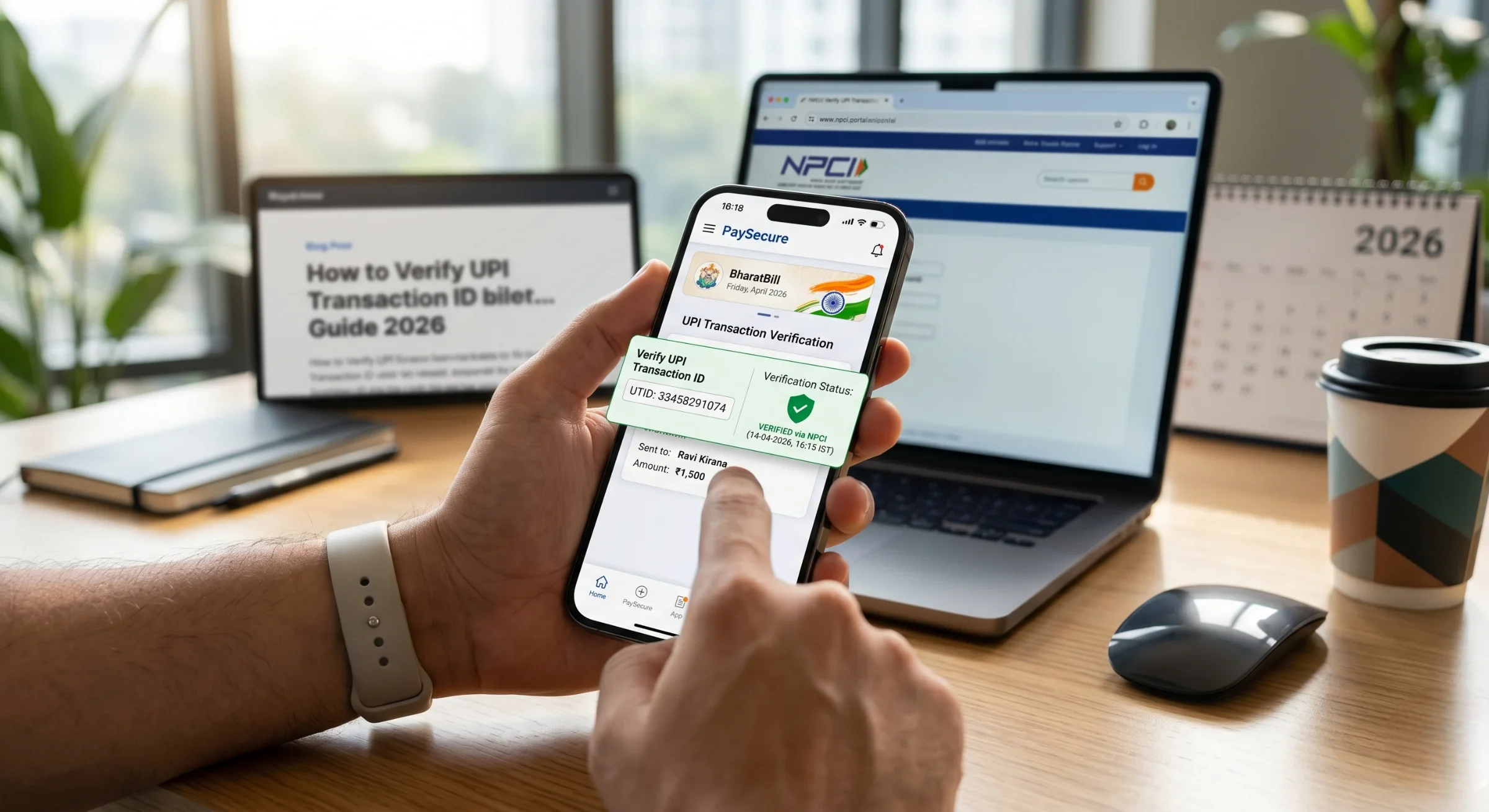
    How to Verify UPI Transaction ID Online (Step-by-Step Guide 2026)

    Disclaimer: Everything shared in this article is strictly for learning purposes. We’re not providing financial or legal advice. If someone has cheated you through a fake UPI transaction, act fast call your bank immediately and report it at cybercrime.gov.in or dial 1930. For case-specific guidance, consult a qualified professional.

    Key Takeaways

    • Every UPI payment creates a unique 12-digit number called a UPI Reference Number or UTR. This number tells you whether your payment actually went through or not.
    • To check if a transaction was successful, just open your UPI app and look at your transaction history. You can also log in to your bank’s mobile or internet banking, or use the NPCI dispute system to cross-check.
    • Here’s something important, scammers often send fake payment screenshots with made-up transaction IDs. So never trust a screenshot alone. Always match the transaction ID with your actual bank records. That’s the only way to know for sure.
    • If money got deducted from your account but never reached the other side, don’t panic. As per RBI rules, the amount should automatically get reversed within 5 working days. If that doesn’t happen, raise a complaint right away.
    • And the golden rule, never hand over any product, service, or refund unless the payment actually shows up in your bank account. A screenshot means nothing. Your bank balance does.

    Why You Need to Know How to Verify a UPI Transaction ID

    Here’s something I’ve seen happen repeatedly while working on scam awareness: a shopkeeper in a busy market gets shown a “successful payment” screenshot on someone’s phone, hands over the goods, and later discovers the money never arrived.

    This isn’t a rare edge case. According to RBI’s Annual Report for FY2024–25, digital payment frauds numbered 13,516 cases accounting for 56.5% of all reported banking frauds. A LocalCircles survey of over 32,000 UPI users found that 1 in 5 families experienced UPI fraud at least once in the past three years.

    The UPI ecosystem processed over 185.8 billion transactions in FY2024–25 alone (a 41.7% year-on-year increase, per NPCI data). With that volume, verifying whether a specific payment actually happened isn’t optional anymore, it’s a basic financial safety skill.

    And the simplest way to do it? Check the UPI Transaction ID.

    What Is a UPI Transaction ID (and How Is It Different from UTR)?

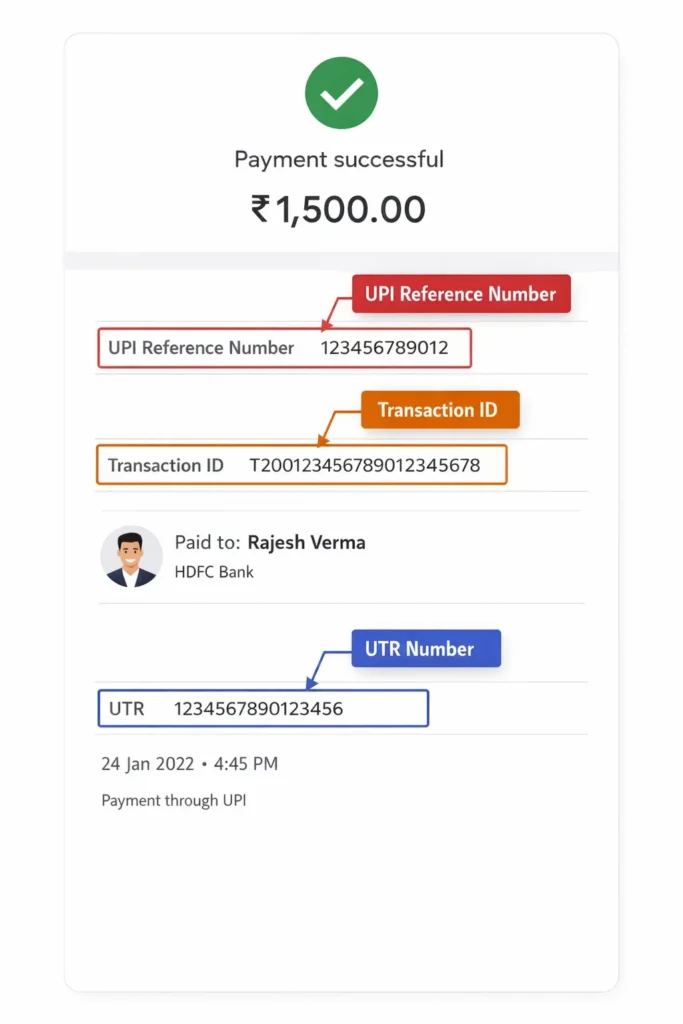
    Annotated UPI payment confirmation screen showing UPI Reference Number, Transaction ID, and UTR number on a successful ₹1,500 payment.

    Before diving into verification steps, let’s clear up a common confusion. There are multiple reference numbers involved in a single UPI payment, and people often mix them up.

    UPI Transaction ID vs UTR vs UPI Reference Number

    TermWhat It IsFormatWhere to Find It
    UPI Transaction IDA unique identifier generated by your UPI app for every transaction you initiateAlphanumeric (varies by app)Transaction history in your UPI app
    UPI Reference NumberA 12-digit number assigned by NPCI’s UPI system to track the transaction across banks12 digits (numeric)Transaction details screen, SMS alerts
    UTR (Unique Transaction Reference)A bank-level reference code used for interbank settlementAlphanumeric (format varies by bank)Bank statement, internet banking portal

    The UPI Reference Number is the most important one for verification purposes. It’s the number that NPCI, your bank, and the recipient’s bank all recognize. When someone shows you a payment screenshot, this is the number you should be cross-checking.

    How to Verify UPI Transaction ID Online: 5 Methods

    Method 1: Check Transaction History in Your UPI App

    This is honestly the simplest way to check. Just open your UPI app doesn’t matter if it’s Google Pay, PhonePe, Paytm, or BHIM.

    Once you’re in, look for your payment history. It’s usually sitting right there on the home screen or somewhere in the main menu. Find the transaction you’re looking for, scroll by date or use the search bar, and tap on it.

    You’ll see everything, the amount, when it was made, who received it, and whether it actually went through. Right there in the details, you’ll also find a 12-digit UPI Reference Number. Save that number. It comes in handy if anything goes wrong later.

    And if you’re selling something – please don’t trust a screenshot the buyer shows you. Check your own app. Check your own account. What’s on their screen is their business, not your proof.

    Always verify your UPI Id here

    Method 2: Verify Through Your Bank’s Mobile or Internet Banking

    Your bank records UPI transactions on its own, totally separate from your UPI app. So if you want to be really sure, this is where you go.

    Step 1: Log in to your bank’s official mobile app or internet banking portal.

    Step 2: Go to “Account Statement” or “Transaction History.”

    Step 3: Filter by date range to locate the specific UPI transaction.

    Step 4: The bank statement will show the transaction amount, the counterparty’s UPI ID or name, the UTR number, and the debit/credit status.

    Here’s the thing: If a payment looks “successful” in someone’s UPI app but shows nothing in your bank statement, something is off. Either the app hasn’t updated yet, or that screenshot was never real.

    Method 3: Use SMS Alerts from Your Bank

    Your bank texts you every single time money moves in or out. The message shows the amount, a partial account number, and a reference code.

    It’s a quick check, not a deep one but it works. If someone says they paid you and your phone got no message from the bank, don’t release anything. Just stop and verify first.

    Also, check that your SMS alerts are actually switched on. Surprisingly easy to turn them off by mistake and not realise it until something goes wrong.

    Method 4: Raise a Query Through NPCI’s UPI Help Portal

    If you need official confirmation of a transaction’s status especially for disputes, fraud cases, or when your bank isn’t resolving the issue NPCI has a dedicated system.

    Step 1: Visit the NPCI website (npci.org.in) and navigate to the “UPI” section, or directly contact them through their helpline at 1800-120-1740 (toll-free).

    Step 2: You’ll need to provide the UPI Transaction ID or Reference Number, the transaction date, the amount, and your registered mobile number.

    Step 3: NPCI can verify whether the transaction was processed on its system and confirm the settlement status between banks.

    This method is particularly useful when there’s a dispute between the sender’s bank and the receiver’s bank, and neither side is providing clarity.

    Method 5: Contact Your Bank’s Customer Support Directly

    Sometimes you just need to talk to a person. Call your bank’s customer care, give them your UTR number, the transaction date, and the amount and they’ll trace it for you on the spot.

    If money left your account but the transaction failed, RBI says the bank has to reverse it within 5 working days. If that window passes and nothing happens, escalate. You’re well within your rights to do so.

    As per RBI guidelines, banks are required to resolve UPI transaction complaints within specific timeframes. Failed transactions where money was debited should be auto-reversed within T+5 working days. If that doesn’t happen, you have the right to escalate.

    How to Spot a Fake UPI Payment Screenshot

    Knowing how to verify a UPI transaction ID is your strongest defence against fake payment screenshot scams. But it also helps to recognize the visual red flags before you even get to the verification stage.

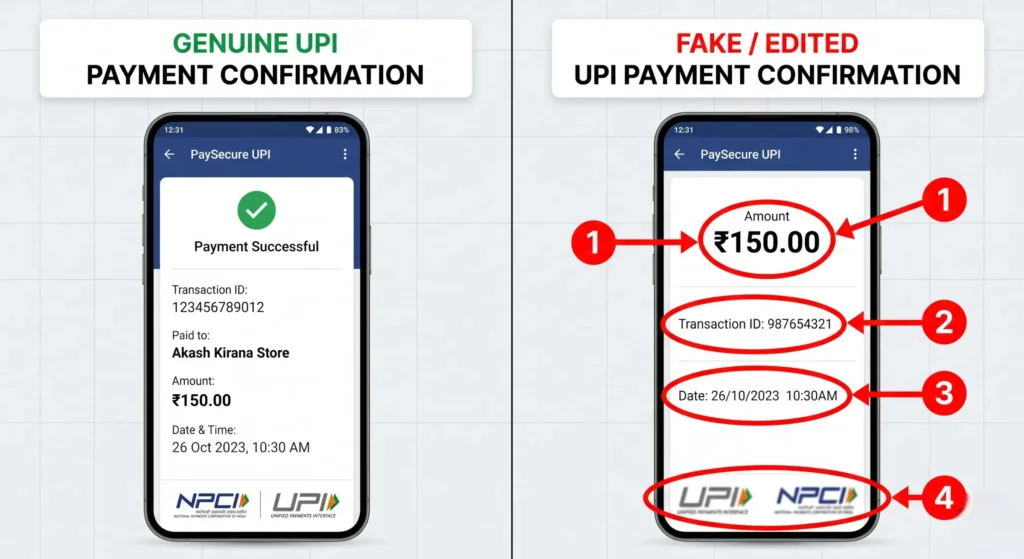
    Comparison of a real UPI payment screenshot and a fake edited screenshot highlighting visual differences

    Here are the most common signs of a fabricated screenshot:

    • Take a close look at the fonts and spacing. Most fake screenshots are made using photo editing apps. So zoom in a little does the font on the amount look the same as the rest of the text? Does anything look slightly off, stretched, or out of place? Even a small gap or alignment issue can give it away.
    • Check the UPI Reference Number carefully. Every real UPI transaction has a 12-digit number only digits, no letters. If the number in the screenshot is too short, too long, or has any alphabets in it, that’s your answer right there. It’s fake.
    • Did you get an SMS? A real payment hits your bank account and your phone gets a text immediately. No SMS means no payment. It really is that simple. Don’t let anyone convince you otherwise.
    • Check your own account, not their screen. This is the only thing that actually matters. Whatever someone’s phone is showing is irrelevant. Has the money landed in your account? If yes, great. If no, nothing else they show you counts.
    • Watch out for “Pending” being passed off as “Done.” Some scammers show a transaction that’s still pending and tell you the money is on its way. It’s not. A pending payment is an incomplete payment. Hold on to whatever they’re asking for until the status actually says successful and the amount is sitting in your account.

    Verify your screenshot: Fake Payment Screenshot Checker Tool

    What to Do If a UPI Transaction Fails but Money Is Debited

    This is genuinely one of the most frustrating things that can happen with UPI and honestly, it’s more common than people realise. A lot of times it’s just a server hiccup or a bad network moment.

    Step 1: First, just wait. Give it about 30 minutes before you do anything. A lot of these transactions sort themselves out automatically once the banking servers catch up. No need to spiral right away.

    Step 2: Then check your bank statement. If the money did get deducted, write down the UTR or UPI Reference Number. You’ll need it going forward.

    Step 3: Raise a complaint in your UPI app. Go to the specific transaction in your history and use the “Report a problem” or “Help” option. This creates a formal dispute ticket that your bank and NPCI can track.

    Step 4: If nothing moves in 48 hours, call your bank. Have your transaction details ready and explain what happened. According to RBI rules, any money deducted in a failed transaction must be reversed within 5 working days.

    Step 5: Still no resolution? Escalate. If your bank hasn’t sorted it out within 30 days, take it higher. You can approach the RBI Banking Ombudsman at rbi.org.in or file a grievance directly through NPCI’s portal.

    Step 6: And if you think fraud was involved, report it immediately. Don’t wait. Go to cybercrime.gov.in or call 1930 right away. The Government’s Cyber Crime Coordination Centre works directly with banks and law enforcement to handle exactly these situations.

    Understanding UPI Transaction Statuses

    When you check a UPI transaction, you’ll see one of these statuses. Here’s what each one actually means:

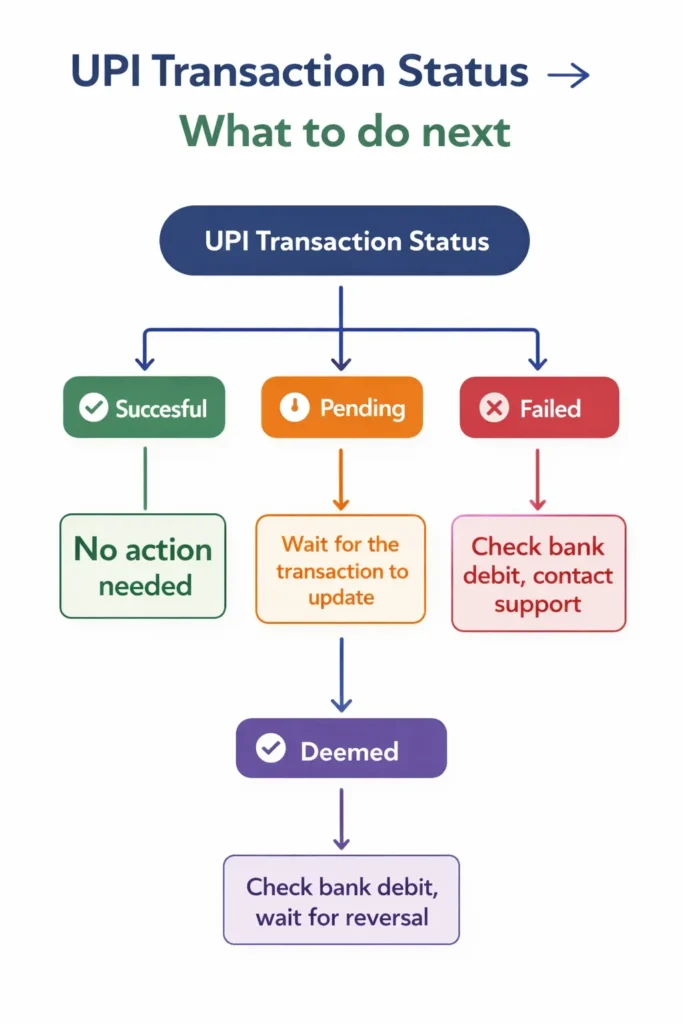
    Flowchart showing what to do based on your UPI transaction status successful, pending, failed, or deemed
    StatusWhat It MeansWhat You Should Do
    SuccessfulMoney has been debited from the sender and credited to the receiverNo action needed. Save the reference number for your records
    PendingThe transaction is still being processed by the banking systemWait 30-60 minutes. If still pending after 24 hours, raise a complaint with your bank
    FailedThe transaction did not go throughCheck if money was debited from your account. If yes, it should auto-reverse within 5 working days. If not reversed, contact your bank
    DeemedThe transaction status is uncertain due to a technical issue between banksContact your bank with the reference number. NPCI tracks deemed transactions for resolution

    RBI’s New Proposals to Curb UPI Fraud (April 2026 Update)

    Something worth paying attention to – the Reserve Bank of India released a discussion paper on April 9, 2026, titled “Exploring Safeguards in Digital Payments to Curb Frauds.” And some of the ideas being proposed could actually change how UPI works for everyday users.

    One of the key proposals is a “cooling-off period.” In simple terms, if you’re transferring above a certain amount, there could be a short delay built in. The logic is straightforward scammers usually rely on panic and urgency. They pressure you to act quickly so you don’t get time to think. A small delay could help break that pattern before any real damage is done.

    The paper also introduces something called a “Kill Switch.” This would allow you to instantly disable all digital payments from your account with a single tap. If you ever sense something suspicious, you wouldn’t need to call your bank or wait on hold just hit the switch, and everything stops immediately.

    These are still just proposals. Public feedback is open until May 8, 2026, so nothing has been finalised yet. But the fact that RBI is actively working on such measures says a lot UPI fraud is clearly being taken seriously at the highest level. And while regulators do their part, it’s equally important that we stay alert on ours.

    Also Read: How to Report a Cyber Crime in India: Complete Step-by-Step Guide (2026)

    Quick Checklist: Verifying a UPI Payment Before Releasing Goods

    If you’re a shopkeeper, freelancer, seller, or anyone who receives UPI payments from strangers, use this checklist every time:

    1. Check your own bank account or UPI app for the incoming payment never rely on the buyer’s screen.
    2. Wait for the bank SMS confirming the credit before handing over goods.
    3. Match the amount scammers sometimes send ₹1 and show a doctored screenshot for ₹1,000.
    4. Verify the UPI Reference Number if anything feels off cross-check it in your transaction history.
    5. Don’t accept “pending” as payment a pending transaction is not money in your account.
    6. Use ScamDekho’s Fake Payment Screenshot Checker to quickly analyse suspicious screenshots.

    Final Thoughts

    Verifying a UPI transaction ID isn’t complicated — but it’s a habit that can save you from losing real money to a fake screenshot. Whether you’re a street vendor, an online seller, or just someone who splits bills with friends, taking 10 seconds to check your own bank account before trusting someone else’s phone screen is the simplest fraud prevention step you can take.

    The tools exist. Your UPI app shows transaction history. Your bank sends SMS alerts. NPCI has a helpline. Use them.

    And if you suspect a payment screenshot is fake, run it through our Scamdekho’s free upi payment screenshot checker it’s free and takes seconds.

    Frequently Asked Questions

    How can I verify a UPI transaction ID online for free?

    Open your UPI app (Google Pay, PhonePe, Paytm, or BHIM), go to transaction history, and find the specific payment. The transaction details will show the status (successful, pending, or failed) along with the 12-digit UPI Reference Number. You can also verify through your bank’s mobile or internet banking portal at no cost. There is no charge for checking transaction status.

    What is the difference between a UPI Transaction ID and a UTR number?

    A UPI Transaction ID is generated by your UPI app to identify the transaction within that app. A UTR (Unique Transaction Reference) is a bank-level reference used for interbank settlement. The UPI Reference Number (12 digits) is the universal identifier recognized by NPCI, your bank, and the recipient’s bank. For verification and disputes, the UPI Reference Number is the most useful.

    Can a UPI Reference Number be faked?

    The number itself can be typed or photoshopped onto a fake screenshot, yes. However, a fabricated reference number will not show up in the receiver’s bank account or UPI app transaction history. That’s exactly why you should always verify payments from your own bank records — not from the sender’s phone screen.

    How long does it take for a failed UPI transaction to be reversed?

    According to RBI guidelines, if money was debited from your account but the transaction failed (i.e., it wasn’t credited to the recipient), the amount should be auto-reversed within T+5 working days (where T is the transaction date). If the reversal doesn’t happen within this timeframe, contact your bank and raise a formal complaint.

    Where can I complain if my UPI payment is stuck or money is lost?

    You have multiple options. Start by raising a dispute within your UPI app. If unresolved within 48 hours, contact your bank’s customer care. For fraud-related cases, file a report on cybercrime.gov.in or call 1930 (the National Cyber Crime Helpline). If your bank doesn’t resolve the issue within 30 days, escalate to the RBI Banking Ombudsman through rbi.org.in. NPCI also has a toll-free helpline at 1800-120-1740.

  • Top 10 Online Scams in India (2026) That Even Smart People Fall For

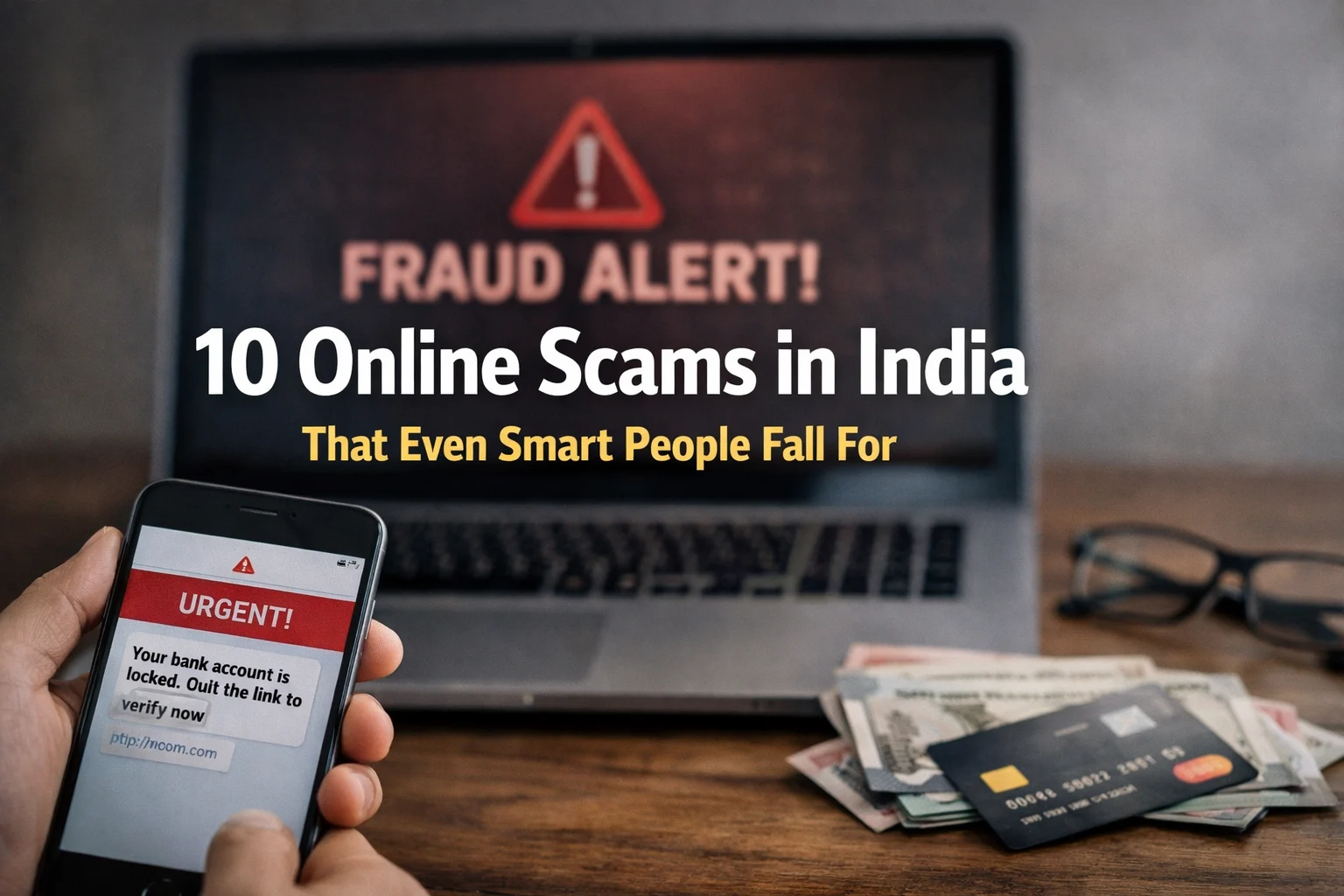
    Top 10 Online Scams in India (2026) That Even Smart People Fall For

    Let us tell you something that bothers us. In the last year alone, we have personally reviewed over 4,000 scam complaints that came through ScamDekho. And a surprising number of them came from people you would never expect to fall for a scam. Software engineers. Chartered accountants. Business owners who handle crores in transactions. A retired IAS officer.

    These are not careless people. They are busy, distracted, trusting, or simply unfamiliar with one specific trick that a scammer used on them at exactly the right moment. That is how modern scams work. They do not target the foolish. They target the moment you let your guard down.

    This article covers ten online scams that are actively running in India right now, in 2026. Each one has fooled otherwise intelligent, careful people. We are going to explain exactly how each scam works, show you the red flags, and tell you what to do if you are targeted.

    1. The Fake Customer Care Number Scam

    This is probably the most underrated scam in India right now, and it catches smart people more than any other.

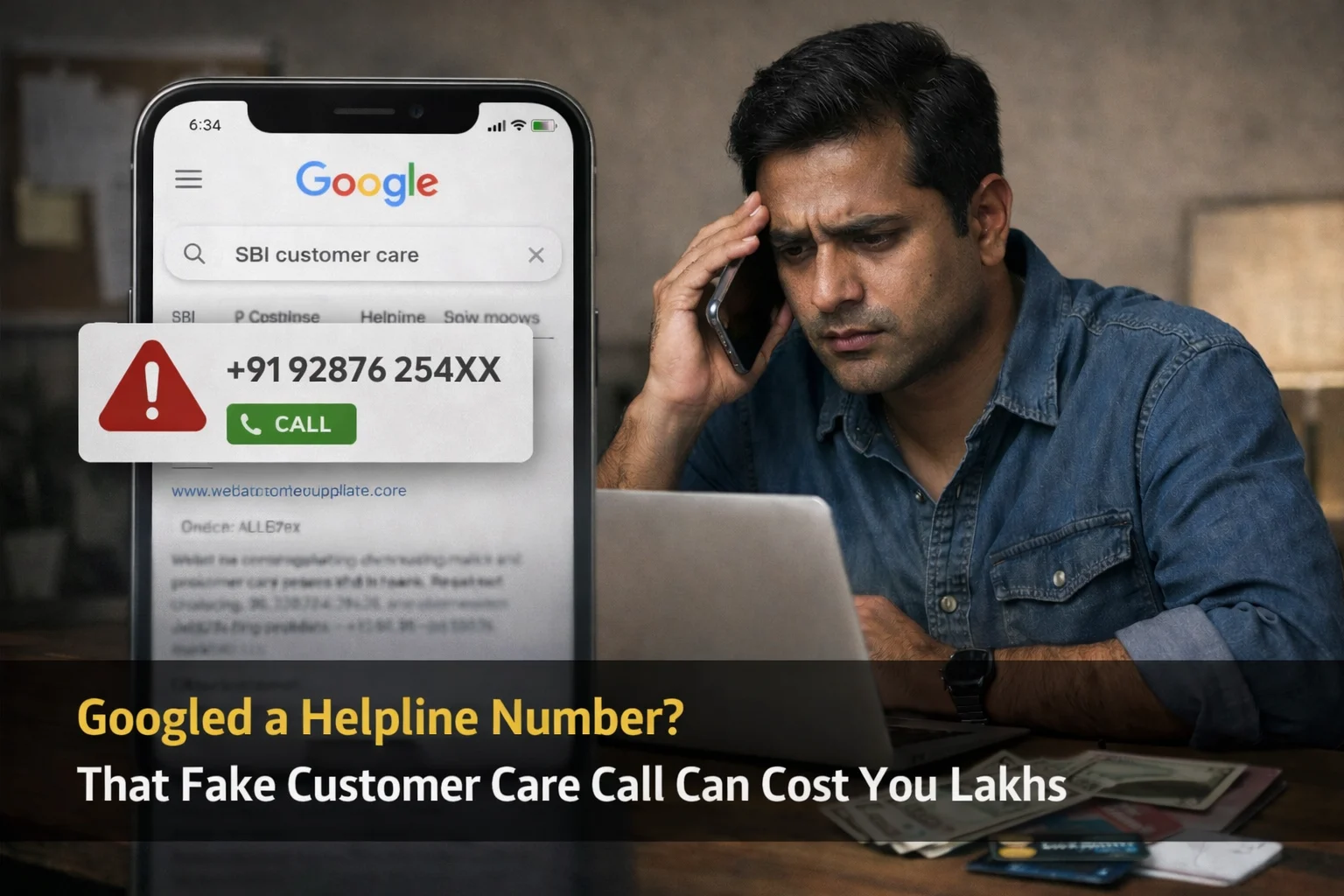
    Here is what happens. You have a problem with Swiggy, or your bank, or your broadband connection. You open Google and type something like “Swiggy customer care number” or “HDFC credit card helpline.” You see a number at the top of the results. You call it. The person who answers sounds professional. They ask for your account details to “verify your identity.” Then they ask you to share a screen, download an app, or read out an OTP. Within minutes, money is gone.

    The number you called was not Swiggy or HDFC. It was a scammer who paid to have their number show up on Google, sometimes through Google Ads, sometimes through fake websites that rank well because nobody is actively taking them down.

    We have seen this happen to people who work in tech. The problem is not intelligence. The problem is that when you are frustrated and searching for quick help, you do not stop to verify whether a phone number on Google is actually real.

    How to protect yourself: Never call a customer care number from a Google search. Go to the company’s official website or app and find the contact information there. If you receive a suspicious link during a customer care call, check it on our free website checker at scamdekho.in/url-checker before clicking anything.

    2. The UPI Collect Request Scam

    You list something for sale on OLX, Quikr, or Facebook Marketplace. A buyer contacts you within hours. They sound genuine. They agree to your price without bargaining. They say they will send the money now.

    Then instead of sending money, they send a UPI collect request. Your phone shows a payment notification. If you are not paying close attention, it looks like money is coming in. You approve it. And your money goes out.

    Some scammers make this more convincing by first sending you a small amount, say one or two rupees, so you trust them. Then they send a collect request for a large amount disguised as a payment.

    This scam catches smart people because the UPI interface on some apps does not clearly differentiate between “someone is sending you money” and “someone is requesting money from you.” The victim is expecting a payment, sees a notification, and approves without reading carefully.

    How to protect yourself: Remember that you never need to approve anything to receive money via UPI. If someone asks you to approve a request or enter your PIN to receive payment, it is a scam. Before transacting, you can verify the buyer’s UPI ID on our free UPI ID checker at scamdekho.in/upi-qr-checker.

    3. The Telegram Task Scam (Part-Time Job Fraud)

    This one has exploded in the last two years and the losses are staggering. We have personally spoken to people who lost ten lakh, twenty lakh, even fifty lakh rupees to this single scam type.

    It starts with a WhatsApp or Telegram message offering you a simple part-time job. Like videos on YouTube. Rate products on Amazon. Write reviews. The pay is 500 to 5,000 rupees per task. You start doing tasks and they actually pay you. Small amounts. 300 here, 800 there.

    Then comes the “prepaid task.” To unlock a higher-paying task, you need to deposit some money first. Maybe 1,000 rupees. You deposit it, complete the task, and they pay you 1,500 back. It works. So when the next task requires a 5,000 rupee deposit, you do it. Then 15,000. Then 50,000.

    At some point, the withdrawal gets “stuck.” They say there is a tax issue, or a system error, or you need to complete one more deposit to release all your earnings. By the time you realize it is a scam, you have deposited lakhs.

    This catches smart people because the initial payments are real. Your brain sees a pattern of legitimate returns and trusts it. That is exactly what the scammers are counting on.

    How to protect yourself: No legitimate company requires you to deposit your own money to earn money. If you receive a message offering easy part-time work, run it through our free message scam checker at scamdekho.in/scam-message-checker before responding.

    4. The Fake Payment Screenshot Scam

    You are selling something. The buyer shows you a payment screenshot proving they have made the transfer. You see the green tick, the transaction ID, the amount. It looks perfect. So you hand over the product or release the service.

    But the money never arrives in your account. The screenshot was fake. Made in two minutes using a free app or a photo editor.

    This catches sellers, delivery partners, and even small shopkeepers who are busy and check the screenshot instead of checking their actual bank account. The fake screenshots have become incredibly realistic. Some even include the correct bank logos, fonts, and timestamp formats.

    How to protect yourself: Never confirm a payment by looking at a screenshot. Always check your own bank account or UPI app for the actual credit. If you want to verify a screenshot someone sent you, upload it to our free fake payment screenshot checker at scamdekho.in/fake-payment-screenshot-checker. It detects edited images, fake UTR numbers, and manipulated amount fields.

    Also Read: IPL 2026 Betting App Scam – How Fake Apps Are Stealing Crores

    5. The KYC Expiry / Account Block Scam

    You receive an SMS or WhatsApp message saying your bank account will be blocked in 24 hours because your KYC is incomplete. There is a link. You click it. It opens a page that looks exactly like your bank’s website. You enter your login details. Done. The scammer now has your credentials.

    Some versions of this scam ask you to download an APK file for “KYC verification.” That file is a screen-sharing or keylogging app that gives the scammer complete access to your phone.

    This catches smart people because the urgency feels real. When your brain reads “your account will be blocked in 24 hours,” it triggers a fear response that overrides logical thinking. That is exactly what the scammer designed it to do.

    How to protect yourself: No bank sends KYC reminders via WhatsApp or SMS with clickable links. If you get such a message, ignore it. If you are worried, open your banking app directly or visit your bank branch. You can also verify the link by pasting it into our free URL checker at scamdekho.in/url-checker. We will tell you if it is a phishing page.

    6. The QR Code Scam at Shops and Markets

    This one is beautifully simple and almost impossible to detect without being told about it.

    A scammer visits a small shop, tea stall, or street vendor. They wait for a quiet moment and stick their own QR code label over the merchant’s existing QR code. Every customer who scans that QR code to pay the merchant is now paying the scammer instead. The merchant does not realize the problem until they check their account and see missing payments.

    A variation of this targets individuals. Someone sends you a QR code and tells you to scan it to receive money. You scan it, and it initiates a payment from your account. Remember: scanning a QR code is always a payment action, never a receiving action.

    How to protect yourself: If you are a merchant, regularly check that your QR code has not been covered with a sticker. If someone sends you a QR code and asks you to scan it to receive money, it is a scam. You can upload any QR code to our free QR code checker at scamdekho.in/upi-qr-checker to see exactly what UPI ID and amount is embedded inside before scanning.

    7. The Investment and Stock Market Scam

    Somebody adds you to a WhatsApp or Telegram group. The group has hundreds of members. An “expert” posts stock tips daily. Other members post screenshots of their profits. Everything looks active and genuine.

    Eventually, you are told about a “premium” trading platform with guaranteed 30 to 40 percent monthly returns. You sign up. You deposit money. The dashboard shows your investment growing. You even withdraw a small amount to test it and the money arrives.

    Then you invest a large sum. The dashboard still shows growing returns. But when you try to withdraw, there are delays. Then fees. Then taxes. Then the app stops responding. The website goes offline. The Telegram group is deleted.

    Every single member in that group except you was either a bot or part of the scam operation. The profit screenshots were fabricated. The trading platform was never connected to any real stock exchange.

    This catches smart people, including people who actually understand markets, because the initial returns are real and the social proof from the group feels convincing.

    How to protect yourself: No legitimate investment can guarantee fixed returns. Check if the platform is registered with SEBI. If someone adds you to a group promoting an investment opportunity, verify the website on our URL checker before depositing any money. And remember, if the returns sound too good, they are.

    Check: Cyber Insurance in India: Will It Pay You Back After a UPI Scam?

    8. The Fake Job Offer Letter Scam

    You applied for a job weeks ago. You get an email with a formal offer letter from what appears to be a real company. The letter has the company logo, HR contact details, salary breakdown, and a joining date. But before joining, you need to pay a “security deposit” or “training fee” or “laptop advance.”

    In 2026, these fake offer letters have become so polished that even HR professionals have trouble spotting them at first glance. Scammers are using real company names, real employee names pulled from LinkedIn, and realistic CTC tables.

    Fresh graduates are the primary target, but we have seen experienced professionals with ten plus years of experience fall for these, especially when they are between jobs and emotionally vulnerable.

    How to protect yourself: No legitimate employer asks for money before your joining date. If you receive an offer letter that requires any payment, it is a fraud. Upload the letter to our free job offer letter checker at scamdekho.in/fake-offer-letter-checker. We verify the sender, check the company details, and flag common red flags in fake offer letters.

    9. The Loan Approval Scam

    You need money. You search for a personal loan online. You find an app or website that promises instant approval, no documents, low interest. You apply. You get “approved” within minutes.

    Then the process starts. They need a processing fee of 2,000 rupees. You pay. Then GST charges. Then stamp duty. Then insurance for the loan. Each time, they promise the loan will be disbursed after this one last payment. It never is.

    Some of these fake loan apps actually disburse a small loan first, say 5,000 rupees, but then harass you for repayment of 15,000 or more. They access your phone contacts and send threatening messages to your friends and family, sometimes with morphed photos.

    This catches smart people because the apps look professional, the interest rates seem competitive, and the “approval” creates a sense of commitment. Once you have paid one fee, sunk cost fallacy kicks in and you keep paying more.

    How to protect yourself: Check if the lending app is RBI-registered. Legitimate lenders never ask for upfront fees before disbursement. If you receive a loan offer via SMS or WhatsApp, run the message through our free message scam checker at scamdekho.in/scam-message-checker and verify any website links on our URL checker at scamdekho.in/url-checker.

    10. The Parcel or Courier Scam (FedEx / Customs Fraud)

    You receive a call from someone claiming to be from FedEx, DHL, or India Post. They tell you that a parcel in your name has been intercepted by customs because it contains illegal items, maybe drugs, fake passports, or undeclared cash. They transfer you to a “customs officer” or “cyber crime officer.” This person tells you that an FIR has been filed in your name and you need to pay a fine or deposit money in a “verification account” to avoid arrest.

    Some versions involve a Skype or WhatsApp video call where the scammer is wearing a police uniform and sitting in front of a government-looking background. They show you a fake FIR with your name on it.

    This scam has taken crores from educated professionals across India. It works because the fear of legal trouble, especially involving drugs or forged documents, creates panic. When you are panicking, you do not think clearly. That is the entire design.

    How to protect yourself: No law enforcement agency in India calls you on the phone to collect fines. No customs officer will ask you to transfer money to avoid arrest. If you receive such a call, hang up immediately. If you are worried, call your local police station directly using the number from their official website, not a number the caller gives you.

    What All Ten Scams Have in Common

    If you read through all ten carefully, you will notice a pattern. Every single one of these scams relies on the same three psychological triggers.

    • The first is urgency. Your account will be blocked. Your parcel will be seized. The offer expires today. Scammers create artificial time pressure because they know that the longer you think, the more likely you are to spot the fraud.
    • The second is trust. A professional-sounding caller. A polished website. A legitimate-looking screenshot. An official-seeming letter. Scammers invest heavily in appearing credible because trust is what makes you lower your defenses.
    • The third is isolation. Scammers want you to act alone. They tell you not to discuss the matter with anyone, sometimes claiming it is “confidential” or “under investigation.” The moment you talk to a friend, family member, or colleague, the spell usually breaks.
    • The antidote to all three is simple. Slow down. Verify independently. And talk to someone you trust before making any payment or sharing any information.

    What to Do If You Have Been Scammed

    If you have already fallen for any of these scams, here is your action plan.

    • Call 1930 immediately. This is the National Cybercrime Helpline. The faster you call, the higher the chance they can freeze the scammer’s account before the money is moved.
    • File an online complaint at cybercrime.gov.in. Upload all the evidence you have, including screenshots, transaction IDs, phone numbers, and any messages or emails from the scammer.
    • Contact your bank. Ask them to flag the fraudulent transaction and freeze the recipient account. Banks are more responsive to this when you file within the first few hours.
    • Save everything. Do not delete any chats, call logs, emails, screenshots, or app data related to the scam. This is your evidence and you will need it for the police complaint and any recovery process.
    • Do not blame yourself. These scams are designed by professional criminals who do this full time. Being deceived does not make you stupid. Getting help quickly is what matters now.

    How ScamDekho Helps You Stay Protected

    ScamDekho is built to give you the tools to verify anything suspicious before you lose money. All our tools are free, require no login, and give results in seconds.

    • If you receive a suspicious message on WhatsApp, SMS, or email, check it on our Message Scam Checker.
    • If someone shares a website link or asks you to visit a URL, verify it on our Website and URL Checker.
    • If a buyer or seller sends you a payment proof, upload it to our Fake Payment Screenshot Checker.
    • If you are asked to pay a UPI ID or scan a QR code, verify it on our UPI ID and QR Code Checker.
    • If you receive a job offer letter that asks for money, upload it to our Job Offer Letter Checker.

    None of these checks take more than ten seconds. And ten seconds is often the difference between keeping your money and losing it.

    Frequently Asked Questions

    What is the most common online scam in India in 2026?

    The fake customer care number scam and the Telegram task scam are the two most reported online scams in India as of 2026. Both target people across all age groups and income levels. The customer care scam catches people in moments of frustration, while the task scam exploits the desire for easy income.

    Can I recover money lost to an online scam in India?

    Yes, recovery is possible if you act fast. Call 1930 within the first few hours and file a complaint at cybercrime.gov.in. Banks can freeze the recipient account and reverse transactions if notified quickly. The success rate drops significantly with every hour you delay.

    How do I report an online scam in India?

    Call the National Cybercrime Helpline at 1930. You can also file an online complaint with evidence at cybercrime.gov.in. For immediate financial fraud, contact your bank in parallel to request a freeze on the recipient account.

    Are educated people also targeted by online scams?

    Yes. Online scams do not depend on the victim being uneducated or careless. They exploit specific psychological triggers like urgency, trust, and isolation. Engineers, doctors, CAs, and senior professionals are regularly targeted and have lost significant amounts.

    What are the warning signs of an online scam?

    Any unsolicited message demanding urgent action, any request for OTP or PIN sharing, any requirement to pay money to receive money, any investment promising guaranteed high returns, and any phone call asking you to download an app or share your screen. If you encounter any of these, stop and verify before proceeding.

  • Cyber Insurance in India: Will It Pay You Back After a UPI Scam?

    Cyber Insurance in India: Will It Pay You Back After a UPI Scam?

    I have spent the better part of three years reading cybercrime complaints and talking to victims of online fraud in India. And there is one question that comes up more often than almost anything else, especially after someone has already lost money:

    “Is there some kind of insurance for this?”

    The answer is yes. Cyber insurance exists in India. Multiple insurance companies sell it. Some policies cost less than a thousand rupees a year. And yet, almost nobody buys it. The ones who do often discover at claim time that what they assumed was covered is not.

    This article is going to be honest with you about what cyber insurance in India can and cannot do. I am not going to sell you a policy. I am going to tell you what I have seen, what the fine print actually says, and whether it makes sense for someone like you.

    What Is Cyber Insurance? In Simple Terms

    Cyber insurance is a policy that pays you money if you suffer a financial loss because of a cyber event. That sounds broad, and it is intentionally so, because different insurers define “cyber event” differently.

    At its core, the idea is simple. If someone hacks your email and transfers money out of your account, or if you fall for a phishing attack and lose funds, the insurance company reimburses part or all of the loss. Some policies also cover identity theft, social media hacking, cyber extortion, and even legal costs if you need to go to court.

    In countries like the US and UK, cyber insurance has been around for over a decade, mostly sold to businesses. In India, it is still relatively new for individuals, and most people have never heard of it.

    Which Companies Offer Cyber Insurance for Individuals in India

    As of 2026, these are the main insurers offering standalone cyber insurance policies for individual buyers:

    • HDFC Ergo offers a policy called Cyber Sachet. It is one of the most widely discussed individual cyber insurance policies in India and covers a broad range of cyber events including identity theft, phishing, and financial fraud.
    • Bajaj Allianz has an individual cyber insurance plan that covers unauthorized digital transactions, email spoofing, cyber extortion, and media liability related to online activities.
    • ICICI Lombard offers cyber risk insurance for individuals that includes financial loss from phishing, vishing, and SIM swap fraud, along with identity theft expenses.
    • SBI General has entered the market with a cyber insurance product aimed at individual digital banking users, covering online banking fraud and UPI-related incidents.
    • IFFCO Tokio offers cyber insurance with coverage for social media identity theft and cyber stalking, in addition to standard fraud coverage.

    Some of these policies start at around ₹500 to ₹700 per year for basic coverage of one to two lakh rupees. Higher coverage of five to ten lakh rupees costs more, typically between ₹2,000 and ₹5,000 per year depending on the insurer and plan.

    What Does Cyber Insurance Actually Cover

    This varies from policy to policy, but most individual cyber insurance plans in India cover the following:

    • Unauthorized digital transactions: If someone gains access to your bank account, credit card, or UPI and makes transactions without your consent, the insurer covers the financial loss.
    • Phishing and vishing: If you receive a fake email, SMS, or call that tricks you into sharing your banking credentials, and money is then stolen, this is typically covered.
    • Identity theft: If someone uses your personal data to open accounts, take loans, or commit crimes in your name, the policy may cover expenses related to restoring your identity and any legal fees.
    • Cyber extortion: If someone threatens to release your personal data or photos unless you pay, some policies cover the extortion amount and related counseling expenses.
    • Social media hacking: If your social media account is hacked and used to damage your reputation, or if someone creates fake profiles in your name, some policies offer coverage for related expenses.
    • Malware and ransomware damage: If malware damages your devices or encrypts your data, certain policies cover the cost of data recovery or device replacement.
    • Legal costs: If you need to hire a lawyer because of a cyber incident, some policies reimburse legal fees up to a specified limit.

    What Cyber Insurance Does NOT Cover and This Is Where Most People Get Disappointed

    Here is the part that matters most, and the part that most people do not read before buying:

    • Losses where you voluntarily shared your OTP or password: This is the biggest exclusion and the one that catches the most victims. If a scammer called you, pretended to be from your bank, and convinced you to read out your OTP, most insurers will argue you voluntarily shared the credential. Your claim may be denied. This is exactly how most UPI fraud works in India, which means the most common type of scam affecting Indians right now may not be covered.
    • Losses from investing in fraudulent platforms: If you put money into a fake trading app, a Telegram task scam, or an IPL betting app, that is not a hack. You transferred the money yourself. Most policies do not cover this.
    • Losses from cryptocurrency transactions: Most Indian insurers explicitly exclude crypto-related fraud from individual cyber insurance policies.
    • Pre-existing incidents: If the fraud happened before the policy start date, it is not covered, even if you discover it later.
    • Losses exceeding the coverage limit: If your policy covers two lakh rupees and you lose five lakh, you only get two lakh.
    • Business losses: Individual policies do not cover losses related to your business, freelancing income, or professional activities. For that, you need a commercial cyber insurance policy.
    • Waiting period: Some policies have a waiting period of 15 to 30 days after purchase, during which claims are not accepted.

    I want to be direct about this. The majority of online fraud cases I have seen at ScamDekho would fall into one of these exclusion categories. It does not mean cyber insurance is useless. It means you need to know exactly what scenario your policy covers before you assume you are protected.

    Is Cyber Insurance Worth It for You

    This depends on who you are and what risks you face.

    • It probably makes sense if you regularly shop online with multiple cards, use several banking apps, and your exposure to digital fraud is high. For someone handling lakhs of rupees through UPI every month, a policy that costs 1,500 rupees a year for five lakh coverage is not a bad tradeoff, assuming the policy covers the specific risks you face.
    • It also makes sense if you are a senior citizen or someone who is not very comfortable with digital transactions but is forced to use them. The risk of unknowingly clicking a phishing link or falling for a fake app is higher for this group.
    • It may not be necessary if you use only one bank account, rarely transact online, and already follow basic digital safety practices. The premium might be low, but the probability of an eligible claim is also very low.

    And it is definitely not a substitute for being careful. No insurance company is going to reimburse you if you ignored every red flag and sent money to a stranger on WhatsApp. Insurance works as a safety net for situations where you did everything right and still got hit.

    How to File a Cyber Insurance Claim

    If something does happen and you believe it is covered by your policy, here is the general process:

    • File a complaint with the police and cybercrime cell immediately. Call 1930 and register your complaint at cybercrime.gov.in. Get the complaint number.
    • Inform your bank and request them to flag the transaction and freeze the recipient account if possible.
    • Notify your insurance company within the time window specified in your policy. Most insurers require notification within 24 to 72 hours of the incident. Late reporting is one of the most common reasons for claim rejection.
    • Gather all evidence. Transaction screenshots, bank statements showing the fraud, cybercrime complaint receipt, FIR if filed, communication records with the scammer, and any other relevant proof.
    • Fill out the claim form provided by the insurer. Attach all supporting documents.
    • Wait for the investigation. The insurer will verify the incident, check whether it falls within coverage, and may ask for additional documents. The process usually takes 15 to 45 days.

    One important thing. If the police or bank manage to recover the stolen money, the insurer will deduct that amount from your claim payout. You are not going to get double compensation.

    What I Actually Recommend to People Who Ask

    When someone who has just been scammed asks me whether they should buy cyber insurance, I tell them two things.

    First, file your complaint right now. Insurance is not going to help you with an incident that already happened. Focus on recovery through the cybercrime helpline.

    Second, before you buy a policy, read the exclusions page. Not the brochure. Not the advertisement. The exclusions. If you understand exactly what is not covered and you are comfortable with that, buy the policy. If you read the exclusions and realize that the exact scenario you are worried about is not covered, then the policy is not for you.

    Prevention is cheaper and more reliable than insurance. Checking a suspicious link before clicking it takes ten seconds. Verifying a payment screenshot before handing over goods takes thirty seconds. These small habits prevent the kinds of losses that insurance often refuses to cover anyway.

    The goal is not to become paranoid. The goal is to build a few simple habits that make you a harder target. Insurance is a backup for the rare case where those habits are not enough.

    Frequently Asked Questions

    Does cyber insurance cover UPI fraud in India?

    It depends on the circumstances. If someone hacked into your phone and initiated a UPI transfer without your knowledge, most policies cover that. But if a scammer called you and you shared your UPI PIN or approved a collect request yourself, most insurers treat that as a voluntary action and deny the claim. Read your policy exclusions carefully.

    How much does cyber insurance cost in India?

    Individual cyber insurance policies in India start at around 500 to 700 rupees per year for basic coverage of one to two lakh rupees. For higher coverage of five to ten lakh rupees, premiums range between 2,000 and 5,000 rupees per year, depending on the insurer and plan.

    Can I buy cyber insurance after being scammed?

    You can buy a policy at any time, but it will not cover incidents that occurred before the policy start date. Insurance is prospective, not retrospective. If you have already been scammed, your immediate step should be reporting to the cybercrime helpline at 1930 and filing a complaint at cybercrime.gov.in.

    Is cyber insurance mandatory in India?

    No. There is no law or regulation in India that requires individuals to carry cyber insurance. It is entirely optional and a personal financial decision based on your digital risk exposure.

    Which is the best cyber insurance policy in India for individuals?

    There is no single best policy because the right choice depends on your specific needs. Compare the exclusions more than the coverage limits. A policy that covers five lakh rupees but excludes phishing is less useful than a policy that covers two lakh rupees and includes phishing. Read the policy wording document, not just the marketing material.

  • IPL 2026 Betting App Scam – How Fake Apps Are Stealing Crores

    IPL 2026 Betting App Scam – How Fake Apps Are Stealing Crores

    Every IPL season, millions of Indians glued to their screens become easy targets for a very specific kind of fraud. It does not come through a stranger at the door. It comes through your own WhatsApp. It looks like a tip from a friend. It starts with a winning prediction. And by the time most people realize what happened, their money is already gone.

    This is not a new scam. But in 2026, it has grown more sophisticated, more widespread, and more convincing than ever. Cybercrime police in India have recorded over 1,400 complaints since this IPL season began, with individual losses ranging from ten thousand rupees to several lakhs.

    This article explains how these fake IPL betting apps work, how to recognize them before you fall for them, and what steps to take immediately if you or someone you know has already lost money.

    What Actually Happens When You Join One of These Groups

    Most people who lose money to this scam did not look for it. The scam found them.

    Someone adds you to a WhatsApp group. The group is called something like IPL Match Experts or Cricket VIP 2026. There are dozens, sometimes hundreds of members. The admin is an analyst who says he has contacts inside IPL franchises and claims to know the outcome of matches before they are played.

    He gives one free prediction. It comes true. He gives another. That one comes true too. By the third correct prediction, people in the group are convinced. Comments start rolling in. Members share screenshots of their winnings. The energy in the group feels real.

    But here is what is actually happening behind the scenes. The scammer is running multiple groups at the same time. Each group is given a different prediction for the same match. Whichever group receives the correct prediction becomes the primary target. The members of that group have been pre-selected by chance, not by expertise. The analyst is not a genius. He is playing probability with your trust.

    Once the trust is established, he introduces the app.

    How the App Itself Is Used to Steal From You

    The app is never on Google Play Store. It is always shared as a downloadable file, called an APK, directly through WhatsApp or through a link that takes you to an unofficial website. This alone should stop anyone from proceeding, but most people do not know what an APK is or why it matters.

    You download it, create an account, and deposit a small amount to try. Maybe five hundred rupees. Maybe a thousand. The app shows you winning almost immediately. Your balance grows. The interface looks clean and professional. There are live score updates, transaction histories, and a withdrawal button that works without any friction the first time.

    If you try to withdraw a small amount early on, some scammers actually let it go through. This is deliberate. It builds more confidence. You deposit a larger amount next time.

    Then one day, after you have put in a significant sum, the withdrawal stops working. The app gives you an error message, or it says your account is flagged or pending verification. A support agent contacts you, usually through WhatsApp, and explains that you need to pay a tax fee, a GST charge, or a security deposit before your funds can be released.

    People pay it. And then there is another fee. And another. Every time you threaten to stop, the agent says your money is right there, just one more payment and it will be released. This second layer of extraction is often where victims lose far more than their original deposit.

    When you finally refuse to pay, the app goes offline. The WhatsApp support disappears. The group admin vanishes. You are left with transaction records you made to a number that no longer exists.

    Who Is Most at Risk

    The pattern in cybercrime reports shows that these scams do not only target people who are financially naive. Victims include software engineers, teachers, small business owners, and government employees. People in their thirties and forties make up the majority of reported cases.

    The common thread is not lack of education. It is a combination of excitement about cricket, social validation from the group, and the very human tendency to believe good things when they seem to be happening.

    Young men who follow IPL closely are the most targeted demographic. But cybercrime cells also report a growing number of women and senior citizens being targeted through different entry points, such as investment groups that slowly pivot toward IPL predictions once trust is established.

    Why These Fake Apps Are So Convincing

    The apps themselves are often built by professional developers hired through dark web forums or shell companies. They are not rough or poorly designed. They have real-looking dashboards, fake transaction histories, and even customer support scripts.

    Some of the more advanced operations use actual UPI payment infrastructure for initial deposits, which means the first few transactions appear legitimate in your bank statement. This is why many victims do not realize they have been scammed until withdrawals are blocked.

    The apps also use fake social proof aggressively, including screenshots from other winners, leaderboards showing high earners, and push notifications congratulating you on winnings you never actually received.

    A cybersecurity researcher at ScamDekho who analyzed three such apps in April 2026 found that all of them used the same payment gateway backend and had domain names registered in the same week, indicating a single organized network behind multiple app brands.

    Pig Butchering Scam in India: How Fake Trading Apps Stole ₹14,000 Crore

    How to Identify a Fake IPL Betting App

    There are specific markers that separate fake apps from legitimate platforms. Knowing these before you act is the most effective protection.

    • The app is not listed on Google Play Store or Apple App Store. This is the single most important indicator. Every legitimate fantasy or gaming platform in India maintains a verified listing on official app stores. If someone is asking you to download through a link or APK file, the conversation should end right there.
    • It promises guaranteed match outcomes. Cricket is a live sport played by real athletes under real conditions. No person or software tool can guarantee a result. Any claim of 90 percent accuracy, insider information, or fixed predictions is either a lie or an advertisement for criminal activity.
    • Withdrawal requires you to pay first. In any legitimate financial platform, you withdraw what you have earned. You do not pay fees, taxes, or deposits to access money that is already yours. The moment an app asks you to pay to get your money out, you are being robbed.
    • The only payment method is UPI to a personal number. Regulated fintech companies in India have verified business accounts and official payment systems. Scammers avoid these because business bank accounts can be traced and frozen quickly. If payments go to a personal UPI number, that platform is not a legitimate business.
    • There is no verifiable company behind it. No registered company name, no GSTIN, no physical office, no contact information beyond a WhatsApp number. Searching the company name on the Ministry of Corporate Affairs portal returns nothing.

    The Only Safe Platforms for IPL Fantasy Cricket

    If you enjoy IPL and want to participate in fantasy cricket, there are legitimate options that operate within Indian law and are subject to regulatory oversight.

    Dream11 is the largest fantasy sports platform in India and is available on both Android and iOS through official stores. My11Circle operates similarly and has a substantial user base. MPL, or Mobile Premier League, offers fantasy cricket along with other gaming options. Ballebaazi is another licensed platform with a smaller but established audience.

    All of these are companies registered in India, file taxes, and operate under licenses where applicable. None of them will ever ask you to download an APK from a WhatsApp message.

    It is also important to note that fantasy sports platforms are legal in India because the Supreme Court and multiple High Courts have classified them as games of skill. What is illegal is fixed-odds betting on match outcomes, which is what fake apps claim to offer. There is no legal platform in India that sells match predictions for money.

    What to Do Immediately If You Have Already Been Scammed

    If you have already transferred money into one of these apps, the actions you take in the next few hours matter significantly.

    • Call 1930 right away. This is India’s National Cyber Crime Helpline. When you call early enough, they can initiate a freeze on the recipient account before the scammer withdraws the funds. The window for this is short, sometimes just a few hours, so do not wait.
    • File a complaint at cybercrime.gov.in. Select Online Financial Fraud in the complaint form. You will need the UPI transaction IDs, the phone numbers involved, screenshots of the app and any conversations, and details of the amounts paid. Keep all of this ready before you start.
    • Tell your bank immediately. Ask them to raise a formal cyber fraud dispute at the branch level. Give them your cybercrime complaint number as a reference. Ask whether the recipient UPI ID can be flagged within their system.
    • Do not delete anything. WhatsApp chats, the APK file if you still have it, browser history, any email correspondence, and all payment screenshots are evidence. A lawyer or cybercrime officer will need these if the case goes further.
    • Go to your nearest police station and file an FIR. Refer to Section 420 of the IPC for cheating and Sections 66C and 66D of the IT Act for identity fraud and personation using digital means. The cybercrime complaint number you received online will support this.

    The Ministry of Home Affairs has confirmed that through the national fraud reporting system, over 1,200 crore rupees have been recovered for fraud victims since the platform launched. Recovery is genuinely possible when you act fast.

    How to Recover Money Lost in Online Scam in India (Step-by-Step Guide 2026)

    A Note for People Who Have Not Been Scammed Yet

    The people most vulnerable to this scam are not the ones who have heard about it. They are the ones who assume it cannot happen to them.

    If someone adds you to a WhatsApp group with IPL tips, leave it. If someone in a group recommends downloading an app that is not on the Play Store, leave the group and report the admin on WhatsApp. If an app promises you a guaranteed win, close it.

    Share this article with one person in your family or among your friends. Not because they are gullible, but because these operations are designed by people who do this full time and have studied exactly what makes someone trust quickly and question slowly.

    Checking any website or app link through ScamDekho’s URL Checker before you deposit anything is a free, ten-second step that could save you from losing money you cannot get back.

    Frequently Asked Questions

    Are IPL betting apps legal in India?

    No. Fixed-odds betting on sports outcomes is illegal in most Indian states under the Public Gambling Act of 1867. Fantasy sports, where you build a team and earn points based on player performance, are legal under Indian law as games of skill. The apps being promoted in WhatsApp groups are not fantasy platforms. They are illegal betting operations, and most of them are outright frauds that will never pay you anything.

    Can betting app victims get their money back?

    In many cases, yes. The national cybercrime helpline at 1930 is connected to India’s financial fraud reporting system, which can initiate holds on bank accounts and UPI wallets when complaints are filed early. The sooner you report, the better your chances. Cases reported within 24 hours have a significantly higher recovery rate than those reported after days or weeks.

    How do fake betting apps get away with it?

    Most of these operations are run from outside the city or outside the country. They use burner phone numbers, temporary UPI accounts linked to mule bank accounts, and quickly disappearing websites. By the time a formal investigation begins, the money has already been moved. This is why speed in reporting matters.

    What if someone I know is currently talking to one of these apps?

    Tell them to stop all transactions immediately. Do not attempt to recover any losses by depositing more money, which is a common trap. Show them this article or take them directly to your nearest cybercrime police station.

    How do I verify if an IPL app is legitimate?

    Go to the Google Play Store or Apple App Store and search for the app by name. If it does not appear there, it is not a verified platform. Additionally, search the company name on mca.gov.in to check if it is a registered legal entity in India. Legitimate platforms will always have verifiable legal registrations.

  • Is This URL Safe? 5 Free Ways to Check Any Link for Scams & Malware

    Is This URL Safe? 5 Free Ways to Check Any Link for Scams & Malware

    Every day, millions of Indians receive links on WhatsApp, SMS, email, and social media. Some links are genuine. But many are designed to steal your money, passwords, or personal information.

    So before you click any link, you need to ask one question: is this URL safe?

    In this guide, we will show you 5 simple and free ways to check if any URL is safe or dangerous — even if you are not a tech expert. All methods work on mobile and desktop, and take less than a minute.

    Quick answer: Paste any suspicious link into ScamDekho’s free URL checker to get an instant safety verdict with a trust score. No login, no download — results in 10 seconds.

    Why Checking URL Safety Matters More Than Ever

    India reported over 12 lakh cyber fraud cases in 2025, and the number is growing every year. Most of these frauds start with a single click on a dangerous link.

    Here is what can happen if you click an unsafe URL:

    • Phishing: A fake website steals your bank login, UPI PIN, or credit card details
    • Malware: The link downloads a virus or spyware onto your phone or laptop
    • Data theft: Your personal information (Aadhaar, PAN, contacts) gets stolen
    • Money loss: Scammers can drain your bank account in minutes

    The scary part? Most dangerous URLs look completely normal. A link like sbi-kyc-update.net looks real, but it is a scam. That is why you need to check URL safety before clicking — every single time.

    5 Free Ways to Check if a URL is Safe

    Method 1: Use ScamDekho URL Safety Checker (Fastest & Easiest)

    The simplest way to check any URL is to use a dedicated URL safety checker like ScamDekho.

    How to use it:

    1. Copy the suspicious link (do NOT click it — long press and copy)
    2. Go to scamdekho.in
    3. Select Url Checker
    4. Paste the link and click “Check if Safe or Scam”
    5. Get your result in 10 seconds — SAFE, SUSPICIOUS, or SCAM

    What it checks automatically:

    • SSL certificate validity
    • Domain registration age
    • Phishing database matches
    • Malware and virus signals
    • Server location and IP reputation
    • AI-powered content analysis

    You also get a trust score out of 100 and specific reasons explaining why the link is safe or dangerous. No login needed. Completely free.

    Pro tip: This is the only method that checks all 12+ signals at once. All other methods below check only 1-2 signals each.

    Method 2: Check the Domain Name Carefully

    Before using any tool, look at the URL itself. Scammers create domain names that look almost identical to real websites.

    Examples of fake vs real domains:

    Fake DomainReal DomainDifference
    sbi-kyc-update.netonlinesbi.sbiCompletely different domain
    amaz0n-india.comamazon.inZero instead of “o”
    flipkart-sale99.inflipkart.comExtra words added
    hdfc-netbanking.orghdfcbank.comWrong extension

    Red flags in domain names:

    • Extra words like “login”, “secure”, “update”, “verify”
    • Hyphens that the real website does not use
    • Unusual extensions like .xyz, .top, .buzz, .info
    • Misspelled brand names

    This method helps you catch obvious fakes, but clever scammers use domains that look very convincing. That is why an automated URL checker is more reliable.

    Method 3: Look for HTTPS and the Padlock Icon

    Check the browser address bar before entering any personal details on a website.

    • HTTPS = The connection is encrypted (data travels safely)
    • HTTP (no S) = The connection is NOT encrypted (anyone can see your data)

    But here is the important thing: HTTPS alone does NOT mean the website is safe. Scammers can also get SSL certificates for their fake sites. In fact, over 80% of phishing websites now use HTTPS.

    So HTTPS is a basic minimum — not a guarantee of safety. You still need to check domain age, blacklist status, and content using a proper safe URL checker.

    Method 4: Check the Domain Age

    This is a very powerful check. If a website was registered only a few days or weeks ago and it is asking for your bank details or OTP — it is almost certainly a scam.

    How to check domain age:

    • Use a WHOIS lookup tool (like whois.domaintools.com)
    • Or simply use ScamDekho URL checker — it checks domain age automatically

    What to look for:

    • Domain registered less than 6 months ago = High risk
    • Domain registered 6-12 months ago = Medium risk
    • Domain registered more than 1 year ago = Lower risk

    Real banks like SBI, HDFC, and ICICI have domains registered for 15-20 years. A “bank website” with a 2-week-old domain is 100% fake.

    Method 5: Search the Website Name + “Scam”

    This is a quick manual check. Open Google and search:

    "website-name.com" scam

    or

    "website-name.com" fake

    If other people have been scammed by this website, you will often find complaints on forums, Reddit, Twitter, or consumer complaint websites.

    Limitations:

    • New scam websites may not have complaints yet
    • This method is slow and unreliable for brand new scams
    • Works best as a secondary check alongside automated tools

    URL Safety Checker vs Manual Checking — What is Better?

    FeatureManual CheckingScamDekho URL Checker
    Time needed5-10 minutes10 seconds
    SSL checkVisual onlyDeep analysis
    Domain ageNeed separate WHOISBuilt-in
    Phishing databaseNot possibleAuto scan
    Malware detectionNot possibleAuto scan
    AI content analysisNot possibleBuilt-in
    Trust scoreNo scoreScore out of 100
    Works on mobileDifficultEasy
    CostFreeFree

    Verdict: Manual checking catches obvious scams but misses sophisticated ones. A URL safety checker like ScamDekho runs 12+ checks in seconds and catches threats that human eyes cannot see.

    For maximum safety, do both — glance at the domain name first, then run it through the URL checker.

    Most Common Types of Dangerous URLs in India

    Understanding what kinds of URLs are dangerous helps you stay alert:

    2. Fake Shopping Websites

    • Example: “90% off on Nike shoes — limited time: nikesale-india.com”
    • Takes payment but never delivers products
    • Often promoted through Instagram and Facebook ads

    3. Fake Government Scheme Portals

    • Example: “Free gas cylinder under PM scheme — register at pmyojana-register.in”
    • Collects Aadhaar, bank details, and personal information
    • Shared heavily on WhatsApp groups
    • Example: “Pay your traffic challan now: echallan-payment.in”
    • Redirects to a fake payment page
    • Example: bit.ly/xyz123 or tinyurl.com/abc456
    • You cannot see the real destination
    • Always check shortened links before clicking

    What to Do if You Already Opened an Unsafe URL

    If you already clicked a suspicious link, act fast:

    Step 1: Do NOT enter any details Close the browser tab immediately. If you have not entered any information, you are likely safe.

    Step 2: Clear your browser data Go to browser settings → Clear cache, cookies, and browsing history.

    Step 3: If you entered bank details or OTP

    • Call your bank immediately and block your account
    • Change your internet banking and UPI PIN
    • Most banks have a 24-hour window to reverse fraudulent transactions

    Step 4: Report the scam

    • Call the National Cybercrime Helpline: 1930
    • File a complaint at cybercrime.gov.in
    • Report the URL to ScamDekho so we can warn other users

    Step 5: Check for malware If you downloaded anything from the link, run an antivirus scan on your device immediately. If you received a suspicious message along with the link, check it using our Message Scam Checker.

    For a complete step-by-step recovery guide, read: How to Recover Money Lost in Online Scam in India

    7 Red Flags That a URL is Not Safe

    Here is a quick checklist you can use every time you receive a link:

    1. Domain registered less than 6 months ago — New domains asking for money = scam
    2. URL has misspelled brand names — amaz0n, flipkart-sale, sb1-bank
    3. No HTTPS or SSL warning — Never enter details on HTTP sites
    4. Link creates urgency — “Act NOW or your account will be blocked”
    5. Asks for OTP, Aadhaar, or bank details — No legitimate site asks this via links
    6. Sent by unknown number on WhatsApp or SMS — Do not trust, verify first
    7. Too-good-to-be-true offers — “Win iPhone 16 FREE” or “₹10,000 cashback”

    If a link shows even 2-3 of these red flags, do not click it. Run it through a URL safety checker first.

    Stay Safe Online — Check Before You Click

    The internet is full of useful information, but it is also full of traps. Every month, thousands of Indians lose money because they clicked a link without checking first.

    The good news is that protecting yourself is easy. It takes just 10 seconds to check if a URL is safe before clicking. Make it a habit — just like locking your door before leaving the house.

    Remember these 3 rules:

    1. Never click links from unknown senders
    2. Always check URLs before entering personal details
    3. If it sounds too good to be true, it probably is

    Stay alert. Stay safe. And when in doubt — check the URL first 

  • Fake Rent Agreement Scam India: How Fraudsters Take Advance and Disappear

    Fake Rent Agreement Scam India: How Fraudsters Take Advance and Disappear

    Real Case: Shriram Natarajan, a 44-year-old Mumbai resident, was browsing for a 2BHK flat on the NoBroker app when he found a listing in his own housing society at ₹47,000 per month. He contacted the “landlord,” paid an advance, and only later discovered the account the money went to was linked to a petrol pump in Bhopal. The real flat owner had no idea their listing was being used to run a scam. Shriram lost ₹2.8 lakh.

    This case isn’t an exception. It’s the pattern.

    If you’re currently house hunting in Delhi, Bangalore, Mumbai, Pune, or anywhere else in India, this blog could save you lakhs.

    Why Rent Scams Have Gotten Much Worse Recently

    Finding a flat in any Indian metro today is already stressful. Demand is high, good flats get taken fast, and brokers push you to “decide quickly or lose it.” Scammers have studied this pressure very closely. They know that when someone is desperate to find a flat near their office, or moving from another city, or relocating for a new job, they’re not thinking straight. That’s exactly when they strike.

    The rental fraud problem in India has also gone digital in a much more sophisticated way. Scammers no longer just post obviously fake ads. They copy real listings from 99acres, NoBroker, and MagicBricks, replace the contact number with their own, and wait for calls. They use AI-generated face overlays on video calls. They send fake e-stamp certificates that look completely official. In late 2025, Bengaluru police registered an FIR where a victim was pulled into a private Telegram chat, guided step by step through a payment process, and lost ₹6.25 lakh. The “landlord” was never real.

    Understanding exactly how these scams work is the first step to not becoming the next case.

    The 6 Most Common Fake Rent Scams in India Right Now

    1. The Fake Listing / Token Money Trap

    This is the most common scam and it targets people who are searching on their own. No broker, just scrolling through apps late at night.

    Here’s how it plays out: You find a beautifully photographed 2BHK at a rent that’s 25–30% below what similar flats in the area cost. You message the “owner.” They respond quickly, seem friendly, answer your questions confidently. They say the flat is getting a lot of interest and they need a small token amount, usually ₹5,000 to ₹20,000, to “block it for you” before others book it.

    You pay. They disappear.

    Sometimes the flat doesn’t exist at all. Other times, it’s a real flat that’s already occupied. The scammer just copied the listing, photos and all, from another platform and replaced the contact number.

    Red flag: Any landlord or agent asking for money before you’ve physically visited the property is running a scam.

    2. The Fake Visiting Pass Fee

    This one is increasingly common in Bangalore and Hyderabad, where rental markets are extremely competitive.

    The “landlord” tells you that the flat is part of a gated society that requires a “visiting pass” or “entry fee” to see the property. They ask you to pay ₹2,000–₹3,000 as a refundable deposit to arrange the visit. You pay, you never hear from them again.

    No legitimate housing society in India charges a potential tenant a fee to visit a property. If someone tells you this, hang up.

    3. The Fake Army Officer / Government Employee Landlord Scam (Landlords Beware Too)

    This one doesn’t target tenants. It targets landlords. And it’s especially cruel because it exploits the trust and respect people naturally have for defence personnel.

    A gang in Noida was recently found to be systematically running this scam on 99acres, MagicBricks, and OLX. Here’s how it works:

    A person posing as an Army officer or senior government employee contacts a landlord whose flat is listed. They say they’re being transferred suddenly and need to move in next month with their family. They’re very polite, very professional. They say they’re willing to pay the full security deposit plus two or three months’ rent in advance, whatever the landlord wants.

    The “tenant” then sends a QR code to the landlord saying “please scan this to receive the advance payment.” The moment the landlord scans and enters their UPI PIN, money is debited from the landlord’s account, not credited. The scammer disappears.

    Elderly landlords are targeted most frequently because they are less familiar with how UPI and QR codes actually work.

    Remember: Scanning a QR code and entering your PIN means you are sending money. You never scan a QR code to receive money.

    4. The Illegal Sublet Scam

    This one is very sneaky because the person you’re dealing with is actually living in the flat. They’re just not the owner.

    The actual tenant of a property poses as the landlord, shows you the flat, and collects a security deposit or advance rent from you. Sometimes they do this to multiple people simultaneously, collecting deposits from 3 to 4 different people for the same flat.

    When you arrive on move-in day and find someone else living there, or the real landlord shows up, there’s nothing you can do. The fake “landlord” has switched off their phone.

    A real case from NoBroker: A man posed as a NoBroker agent, showed a flat to a prospective tenant, and collected ₹50,000 as a “pre-deposit.” He turned out to be the tenant illegally subletting the flat. The actual owner had no idea any of this was happening.

    5. The Fake E-Stamp / Fake Rent Agreement Scam

    This is the most sophisticated scam on this list, and it’s growing fast since the 2025 update to the Model Tenancy Act made digital rent agreements more common.

    Here’s what happens: You’ve found a flat, you like it, you’ve met the “landlord” (or so you think). They say they’ll get the rent agreement registered digitally and ask you to pay stamp duty and registration charges upfront, usually ₹5,000 to ₹15,000. This sounds completely normal because digital stamp duty and e-registration are genuinely real things now.

    A few days later, they send you a PDF agreement with an official-looking e-stamp number, a proper format, and both signatures. It looks 100% legitimate. But the e-stamp number is either fake or belongs to an entirely different transaction filed years ago. You’ve paid for nothing, and you have no legal protection.

    Most people never check the e-stamp number on the government portal. Scammers know this.

    How to verify: Every genuine e-stamp certificate issued in India can be verified on the Stock Holding Corporation of India (SHCIL) portal at shcilestamp.com or the respective state’s stamp verification portal. Always verify the certificate number before handing over any money.

    6. The Catena Homes Model: Large-Scale Organised Fraud

    In late 2025, Bangalore saw one of the largest organised rental scams in recent memory. A company called Catena Homes was arrested for defrauding over 400 tenants of more than ₹50 crore.

    Their method was disturbingly professional: they rented high-end apartments from genuine landlords, then sub-leased the same flats to multiple tenants for lump-sum “lease” amounts ranging from ₹10 lakh to ₹29 lakh per person, promising 2–3 years of rent-free stay. They had a proper office, a proper website, professional staff, and legal-looking agreements.

    This is now called the “lease company” scam. Be extremely cautious about any company asking for a large upfront lump sum in exchange for a multi-year rent-free period.

    How to Verify Before You Pay: A Practical Checklist for Indian Tenants

    This is the part most blogs skip. The actual “how to check.” Here’s what you can do in 2026 before paying a single rupee:

    Step 1: Visit the Property in Person. Always.

    This sounds obvious but it’s the single rule that prevents 90% of rental scams. No exceptions. Do not pay any token money, booking amount, or deposit until your feet have physically been inside the flat and you’ve met the landlord face to face.

    If someone says they’re abroad, on transfer, or “too busy to meet,” that is a scam.

    Step 2: Verify Property Ownership Online

    Every state in India has an official land records portal where you can verify who actually owns a property. Here are the most commonly used ones:

    StatePortal NameWhat to Check
    KarnatakaKaveri Online / BhoomiOwner name, survey number
    MaharashtraIGR MaharashtraRegistration records, ownership
    DelhiDORIS (Delhi Online Registration)Property registration status
    UPUP Bhulekh (upbhulekh.gov.in)Khasra/Khatauni ownership
    TelanganaDharani PortalPattadar passbook, land details
    HaryanaJamabandi PortalRecord of Rights
    Tamil NaduTNREGINETEC, registration documents

    Enter the owner’s name or survey number and confirm that the person showing you the flat is actually the registered owner. This takes 5 minutes and can save you lakhs.

    Also ask to see a recent electricity bill, property tax receipt, or water bill in the landlord’s name. Scammers can fake IDs, but utility bills linked to the property are harder to fake.

    Step 3: Verify Their Identity Through Multiple Means

    Don’t accept just an Aadhaar card or ID on WhatsApp. Ask to see the original property documents. Ask to meet at the property, not at a cafe or via video call only. Talk to neighbours or the building society’s security guard to confirm the person you’re dealing with is actually the owner.

    If someone claiming to be an Army officer is the landlord or tenant, you can request a verification through their unit’s official contact. Real officers won’t be offended by this. Scammers will immediately become defensive.

    Step 4: Verify the Rent Agreement’s E-Stamp

    If you’re given a digitally stamped rent agreement, take the e-stamp certificate number and verify it on:

    • shcilestamp.com (for most states)
    • Your state’s official stamp verification portal

    The portal will tell you the date the stamp was issued, the amount, and what it was issued for. If the stamp was issued for a different transaction, you have a fake agreement.

    Step 5: Never Pay Cash, Never Pay Before the Agreement Is Signed

    All payments, whether token money, security deposit, or advance rent, should go through bank transfer or UPI with a clear transaction record. Never pay in cash for a rental transaction. And never pay before you have a signed, verified rent agreement in hand.

    If the landlord insists on cash only, or wants payment before signing the agreement, walk away. These are not negotiating styles. They are fraud tactics.

    Step 6: Know Your Legal Rights on Security Deposit

    Under the Model Tenancy Act 2021, the maximum security deposit is:

    • 2 months’ rent for residential properties

    However, landlords in cities like Bangalore routinely demand 6–10 months. While not always strictly illegal under state law, a very high deposit significantly increases your risk if something goes wrong. Always negotiate, and always get the deposit terms, including the refund timeline, clearly written in the agreement.

    The Exact Conversation Pattern Scammers Use (So You Can Spot It)

    If you know what the script looks like, you’ll recognize it immediately. Rental scammers almost always follow the same pattern:

    1. They respond immediately and seem very eager. Real landlords are busy. A “landlord” who responds within minutes at odd hours is likely a scammer monitoring multiple listings.
    2. The price is attractive but not ridiculous. It’s not ₹5,000 for a ₹30,000 flat, that would be too obvious. It’s ₹25,000 instead of ₹32,000. Just attractive enough to make you want to act quickly.
    3. They create urgency. “Three other people are coming to see it tomorrow.” “My current tenant is leaving this weekend, I need someone to book it today.” Urgency is their most important tool.
    4. They ask for a small “token” first. Not the full deposit, just a “token to block the flat.” This lowers your psychological resistance because it feels like a small risk.
    5. They go quiet after payment. Sometimes immediately, sometimes after a few more messages to keep you comfortable.
    6. They explain they can’t meet right now. They’re “on transfer,” “out of station,” “at the army base,” or “abroad.” This explains why everything has to be done remotely.

    If you see 3 or more of these in one conversation, stop and do not pay.

    Also Read: Why Is Your Bank Account Frozen Without Warning & How to Get It Back

    I’ve Already Paid. What Do I Do Right Now?

    If you’ve just been scammed, speed matters enormously.

    In the first hour: Call your bank immediately at their 24/7 helpline and report the transaction as fraud. Ask them to flag the transaction or attempt a recall. If the money hasn’t been withdrawn yet from the scammer’s end, there’s a small chance it can be stopped.

    Within 24 hours:

    • File a complaint on cybercrime.gov.in or call the Cyber Crime Helpline 1930
    • File an FIR at your nearest police station. Bring: your bank statement, screenshots of all conversations with the “landlord,” their phone number, UPI ID, and any documents they shared
    • Report the fake listing on the platform (99acres, NoBroker, OLX) so it gets taken down and others are protected

    Know your rights: Under RBI guidelines, if a fraudulent transaction is reported within 3 working days, your liability may be zero. Banks are required by law to investigate. Many victims have successfully recovered funds, but only when they reported quickly. Do not wait.

    Check: KYC Scam in India: Fake Bank Messages That Are Stealing Your Money

    Quick Reference: Red Flags vs. Green Flags

    Red FlagGreen Flag
    Rent is 25–40% below market ratePrice matches area market rates
    Landlord can’t meet in personMeeting happens at the property
    Asks for token money before visitVisit first, payment only after agreement
    Insists on cash payment onlyAccepts traceable bank transfer/UPI
    Sends QR code “to pay you”Gives their UPI ID for you to send normally
    No original property documents shownProperty documents and utility bills in their name
    Creates extreme urgencyPatient and transparent
    Agreement e-stamp can’t be verifiedE-stamp verified on government portal
    Only communicates via WhatsAppOkay with meeting and official channels

    Final Thought

    The reason rental scams work is simple: people are under pressure when they’re house hunting. Deadlines, new jobs, kids’ school admissions, the urgency is real. Scammers use that urgency against you. They want you to act before you think.

    The one habit that protects you from every single rental scam on this list is this: Never pay anyone money before you have physically visited the property, met the landlord in person, verified their ownership documents, and signed a verified rent agreement.

    That’s it. One rule. It sounds simple because it is simple. But in the pressure of house hunting, it’s surprisingly easy to skip. Don’t.

    Frequently Asked Questions

    Q: How do I know if a rental listing on NoBroker or 99acres is fake?

    Fake listings usually have prices that are noticeably lower than the area’s market rate. Reverse image search the photos. If the same images appear on multiple listings or on interior design websites, the listing is fake. Always call and insist on an in-person visit before any payment.

    Q: Can I verify if a rent agreement is real without a lawyer?

    Yes. Check the e-stamp number on shcilestamp.com or your state’s stamp portal. Also check that the agreement has a proper registration number if it’s a lease exceeding 11 months. Unregistered agreements for longer periods are legally weak and often used in scams.

    Q: What is the maximum legal security deposit a landlord can charge?

    The Model Tenancy Act 2021 recommends a maximum of 2 months’ rent for residential properties. Some states have their own rules. In practice, Bangalore landlords ask for 6–10 months, which is legally grey territory. Always negotiate and always get refund terms in writing.

    Q: Someone is asking me to scan a QR code to receive rent advance. Is that legitimate?

    No. This is always a scam. You never scan a QR code to receive money. Scanning a QR code and entering your UPI PIN means you are paying money from your account. If anyone asks you to do this, report them immediately.

    Q: The landlord says they’re in the Army and can’t meet in person. What should I do?

    Treat this with maximum caution. Real Army officers buy and sell property like anyone else and can arrange a meeting or have a family member show the property. If they insist on everything being done remotely and want advance payment, do not pay. The “Army officer” identity is the most commonly used cover story in rental scams across India.

  • OLX & Facebook Marketplace Scam India: Fake Advance Payment Tricks

    OLX & Facebook Marketplace Scam India: Fake Advance Payment Tricks

    Real Case: Ankur Dutta, a 30-year-old from Hyderabad, was trying to sell his motorcycle on OLX. A buyer claiming to be an Army officer contacted him, sent a QR code “to pay,” and the moment Ankur scanned it ₹46,000 was instantly drained from his account. The “buyer” disappeared.

    This is not a rare case. This happens every single day across India.

    What Is the OLX / Facebook Marketplace Advance Payment Scam?

    India’s second-hand goods market is booming. Millions of people every day buy and sell phones, bikes, cars, furniture, and electronics on platforms like OLX, Facebook Marketplace, and Quikr. And scammers know this.

    The fake advance payment scam is a type of fraud where a scammer posing as either a buyer or seller tricks you into paying money upfront through UPI, QR code, or a fake payment link. Once the money leaves your account, they vanish.

    What makes this scam dangerous is how believable it looks. The scammer doesn’t ask for your OTP. They don’t ask for your bank details. They simply use your own trust against you.

    The 5 Most Common Tricks Used on OLX and Facebook Marketplace

    1. The Fake Army/Defence Personnel Scam (Most Common)

    This is India’s most reported OLX scam, documented by Delhi Police, Tamil Nadu Police, and Rajasthan Police.

    How it works:

    A scammer contacts you as a buyer on OLX. They say they are posted in the Indian Army or paramilitary forces and are being transferred to another location, so they urgently need to buy or sell an item. They sound professional and trustworthy.

    • As a seller scam: They agree to buy your item at full price, then say they’ll pay via UPI. They send a “payment request” — which looks like a credit notification — and ask you to enter your UPI PIN to “confirm receipt.” The moment you enter your PIN, money is debited from your account, not credited.
    • As a buyer scam: They post a vehicle, phone, or laptop at a price 30–40% below market rate. They share fake Army ID cards, canteen cards, and even courier receipts. They ask for an advance amount of ₹20,000–₹50,000 to “book” the item. After receiving the money, their phone is switched off permanently.

    Real example: Tamil Nadu Police traced a scam operation to 10 villages in Rajasthan’s Bharatpur district where hundreds of people were running this scheme as a full-time operation.

    2. The QR Code Trap (Seller Gets Robbed)

    This is one of the most technically clever tricks used on OLX.

    How it works:

    You are selling an item. The buyer says they want to pay via Google Pay or PhonePe. They send you a QR code and say: “Scan this to receive the money.”

    What they don’t tell you: In UPI, you scan a QR code to make a payment — not to receive one. When you scan a scammer’s QR code and enter your PIN, you are paying them, not the other way around.

    The scammer often doubles down. After you lose money, they say it was a “mistake” and send another QR code for “double the amount as compensation.” Victims lose money again.

    Rule to remember: You never need to scan a QR code or enter your UPI PIN to receive money. If someone asks you to do this, it is 100% a scam.

    3. The Fake Payment Screenshot Trick

    A scammer buys something from you on OLX or Facebook Marketplace. They send you a fake payment screenshot often a doctored PhonePe, GPay, or Paytm confirmation and ask you to hand over the item or ship it immediately.

    The screenshot looks completely real with transaction IDs, timestamps, and your name. But no money was ever actually sent.

    How to protect yourself: Never hand over any item or ship a product until you can physically see the amount credited in your bank account or UPI app not in a screenshot someone sent you.

    Use tools like ScamDekho’s Fake Payment Screenshot Checker to verify if a payment screenshot is genuine before releasing any goods.

    4. The Courier / Delivery Charge Scam

    This scam mainly targets buyers of vehicles and electronics.

    How it works:

    A seller (usually posing as Army personnel or someone relocating abroad) lists a car, bike, or iPhone at an attractive price. They say they cannot meet in person but will ship the item via courier. They send you:

    • A fake courier booking receipt
    • A fake OLX “escrow” confirmation email
    • Sometimes even a fake tracking number

    Once you pay the item price or “advance booking,” they ask for additional charges — GST fees, insurance, customs duty, or delivery confirmation fees. These fees keep coming. The item never arrives.

    Red flag: No legitimate seller on OLX or Facebook Marketplace ships vehicles or high-value items via courier to a stranger. If they refuse to meet in person, walk away.

    5. The “Payment Upgrade” Scam (New in 2025–26)

    This is a newer scam making waves on Facebook Marketplace India.

    How it works:

    A buyer contacts you, agrees to your price, and says they’ve already paid. You then receive a message — either from a fake email or a WhatsApp message — saying your account needs to be “upgraded to a business account” to receive the funds, and you need to pay a small activation fee of ₹499 or ₹999.

    This fee is the scam. No payment platform in India charges you to receive money. The buyer was never real.

    Why Do So Many People Fall for These Scams?

    Understanding the psychology helps you stay safe:

    1. Authority Bias

    The moment someone says “I am an Army officer,” most people lower their guard. Scammers know this. They show fake ID cards that look completely official and use military language to sound credible. Respect for authority is natural — but it can be exploited.

    2. Artificial Urgency

    “I am getting transferred tomorrow.” “Ten other buyers are waiting.” These lines are designed to stop you from thinking clearly. When you feel rushed, you skip the verification steps. That is exactly what the scammer wants.

    3. Confusion Around UPI

    Many people, especially new UPI users, do not fully understand how payment requests work. A scammer sends a payment request and the victim thinks money is coming in — but approving it actually sends money out. This one gap in knowledge has cost thousands of people their savings.

    4. Prices That Seem Too Good

    A phone worth ₹60,000 listed for ₹35,000 feels like a great deal. But that excitement switches off the part of your brain that asks questions. If the price makes no logical sense, the listing is almost certainly fake.

    How to Verify Before You Pay: Step-by-Step

    Step 1: Reverse image search the product photos

    Copy the product image and search it on Google Images. If the same photo appears on multiple listings or stock photo websites, the seller is using stolen images. Move on.

    Step 2: Check the seller’s profile carefully

    Look at when the account was created. No reviews, no history, and a recently made profile are all red flags. On Facebook Marketplace, a genuine seller usually has friends, old posts, and visible activity on their profile.

    Step 3: Verify identity through a video call

    Anyone can claim to be an Army officer or a government employee. Ask for a video call before any transaction. If they refuse or keep making excuses, do not proceed.

    Step 4: Meet in person for anything above ₹5,000

    Insist on meeting at a public place a busy market, shopping mall, or police station parking lot. No exceptions for high-value items.

    Step 5: Verify payment in your own app

    Open PhonePe, GPay, or Paytm yourself and check your actual balance before handing over anything. Screenshots sent by buyers can be easily faked. Only trust what your own app shows.

    Step 6: Never scan a QR code to receive money

    You only scan QR codes to send money. If a buyer tells you to scan to receive payment, disconnect immediately.

    Real Scam Warning Signs — Quick Checklist

    Use this before any OLX or Facebook Marketplace transaction:

    Warning SignWhat It Means
    Seller/buyer claims to be Army personnelPossible impersonation scam
    Price is 30–50% below market rateBait to attract victims
    Refuses to meet in personAlmost always a scam
    Asks for advance before showing the itemClassic advance payment scam
    Sends QR code “to pay you”QR code trap — you will lose money
    Shares payment screenshot before itemFake screenshot scam
    Asks you to pay extra “GST/insurance/courier” feesCourier fee scam
    Profile is newly created, no reviewsHigh risk account
    Moves conversation to WhatsApp immediatelyAvoiding platform detection

    I Already Paid — What Do I Do Now?

    If you’ve been scammed, act immediately:

    Within 1 hour:

    • Call your bank’s 24/7 helpline and report the fraudulent transaction. Ask them to flag or freeze the transaction.
    • Note down the UPI transaction ID, the scammer’s phone number, and UPI ID.

    Within 24 hours:

    • File a complaint on the National Cyber Crime Reporting Portal: cybercrime.gov.in or call 1930 (Cyber Crime Helpline).
    • File an FIR at your nearest police station. Take your bank statement, screenshots, and chat history.

    Important: As per RBI guidelines, if a fraudulent transaction is reported within 3 days, your liability may be zero. Banks are required to investigate and may refund the amount. Do not delay.

    How OLX and Facebook Are (Trying to) Fight Back

    OLX India has deployed fraud detection algorithms that flag listings with unusually low prices relative to market rate. They also have a Trust & Safety team reachable at +91 9999140999 and allow users to hide their phone numbers in privacy settings while posting ads.

    Facebook Marketplace uses AI-based listing review and has increased enforcement against fake profiles — but with over 1.1 billion monthly users globally, no automated system catches everything.

    The responsibility ultimately lies with the user.

    Final Word: The Rule That Saves You Every Time

    Never pay advance to anyone you haven’t met in person. Never enter your UPI PIN to “receive” money. If the deal is too good to be true, it always is.

    Scammers on OLX and Facebook Marketplace are getting more sophisticated every year. AI-generated fake profile photos, forged government IDs, and scripted conversations make them harder to spot. But the core of every scam is the same: they need you to send money before you’ve verified anything.

    Slow down. Verify. Meet in person.

    Frequently Asked Questions

    Q: Can I get my money back after an OLX scam?

    Yes, if you act fast. Report to your bank within 3 days and file a complaint on cybercrime.gov.in. Banks are required under RBI rules to investigate, and many victims have successfully recovered funds when fraud is reported quickly.

    Q: Is it safe to sell expensive items on OLX?

    Yes, if you follow basic precautions: meet in person, never accept advance payments, and verify payment in your own app before handing over any item.

    Q: How do I report a fake listing on OLX?

    Go to the listing, click the three-dot menu, and select “Report Ad.” You can also email OLX’s safety team. For Facebook Marketplace, use the “Report” button on the listing or the seller’s profile.

    Q: What if the buyer sends me more money than the agreed price?

    This is a classic overpayment scam. They will ask you to refund the “excess.” The original payment is fake or will be reversed — you lose the refund amount. Never refund an overpayment.

    Q: Is the Army officer story always fake?

    Not always, but the specific pattern of urgency + asking for advance payment + refusing in-person meeting is almost always a scam. Real Army personnel buy and sell things like everyone else — they don’t ask strangers for advance payments.