Blog

  • 20 Text Message Scams in India (2026): Real SMS Examples, How to Check And Report Fraud

    20 Text Message Scams in India (2026): Real SMS Examples, How to Check And Report Fraud

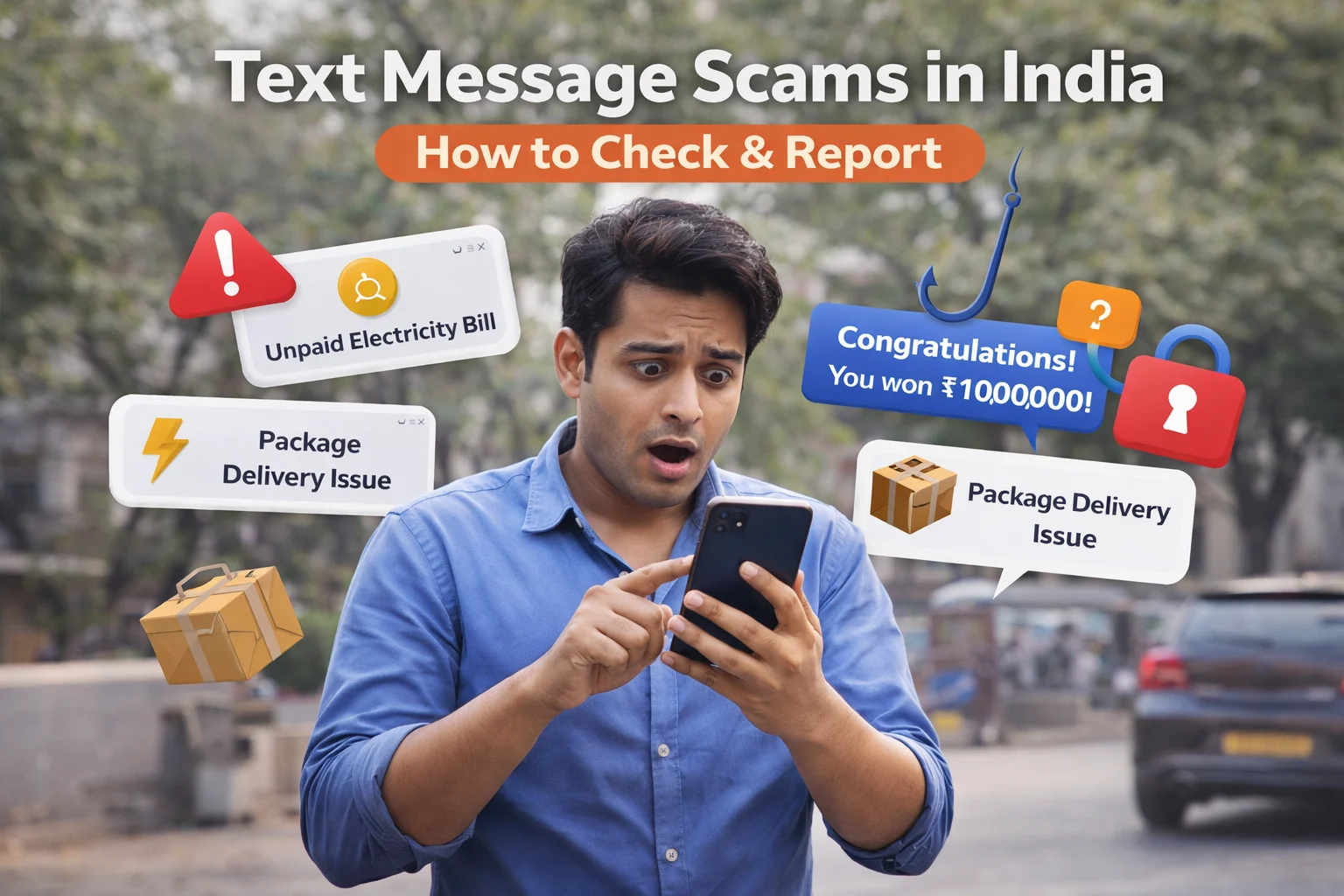
    Text message scams are becoming one of the fastest-growing cyber frauds in India. Every day, thousands of people receive suspicious SMS messages claiming to be from banks, courier companies, electricity departments, government agencies, or job providers.

    These scam messages often contain fake links, urgent warnings, or attractive offers designed to trick users into clicking malicious links or sharing sensitive information.

    With the rapid growth of smartphones and digital payments in India, cybercriminals are increasingly using SMS scams (also known as smishing attacks) to target unsuspecting users.

    According to cybercrime reports, thousands of SMS-related fraud complaints are registered every month in India. These scams can lead to financial loss, identity theft, bank account hacking, and personal data theft.

    In this guide, you will learn:

    • What a text message scam is
    • Why SMS scams are increasing in India
    • 20 common SMS scams circulating today
    • Real scam text message examples
    • How to identify a fake SMS
    • How to report SMS scams in India

    Understanding these scams can help you protect yourself and others from becoming victims of cyber fraud.

    What Is a Text Message Scam?

    A text message scam (also called an SMS scam or smishing attack) is a type of cyber fraud where scammers send fake messages pretending to be from trusted organizations.

    These messages may appear to come from:

    • Banks
    • Delivery companies
    • Government departments
    • Telecom providers
    • Job agencies

    The goal of these messages is simple — to trick users into clicking a malicious link, calling a fake number, or sharing sensitive information.

    Once victims interact with the message, scammers may steal:

    • Bank account details
    • Credit or debit card information
    • OTP codes
    • Login credentials
    • Personal identity data

    In many cases, victims only realize the fraud after money has already been stolen from their accounts.

    Why SMS Scams Are Increasing in India

    SMS scams are growing rapidly because they are easy to execute and difficult for many users to identify.

    Here are some major reasons why these scams are increasing.

    1. Huge Number of Smartphone Users

    India has over 700-800 million smartphone users, making SMS a massive communication channel.

    Cybercriminals target this large user base to reach thousands of potential victims quickly.

    2. People Trust SMS Messages

    Most legitimate notifications from banks, OTP services, and delivery companies are sent through SMS.

    Because people are used to receiving important messages via SMS, they tend to trust them easily.

    Scammers exploit this trust.

    3. Urgency Tactics

    Fraudsters create panic situations in their messages.

    For example:

    • Electricity will be disconnected
    • Bank account will be blocked
    • SIM card will be deactivated

    This pressure forces users to react quickly without verifying the message.

    4. Fake Shortened URLs

    Many scam messages contain shortened links that hide the real website address.

    Once clicked, these links may lead to:

    • Fake banking pages
    • Malware downloads
    • Phishing websites

    5. Easy Bulk Messaging

    Scammers can send thousands of SMS messages using bulk messaging tools, making SMS scams highly scalable.

    SMS Scam Statistics in India

    The cases of cyber fraud are increasing rapidly in the country.

    Some reports have shown that:

    • Every year, millions of cybercrime cases are reported in India.
    • One of the common types of SMS phishing is Smishing.
    • The number of cases may increase as people are not reporting the cases of scams and frauds.

    Due to the increasing use of digital transactions such as UPI, cyber fraudsters are developing more and more types of SMS scams.ques.

    20 Common Text Message Scams in India

    Below are some of the most common SMS scams currently circulating in India.

    1. Electricity Bill Disconnection Scam

    Victims receive messages claiming their electricity connection will be disconnected due to unpaid bills.

    Example message:

    “Dear customer, your electricity will be disconnected tonight due to pending bill. Contact support immediately.”

    Scammers then ask victims to download apps or pay through fake UPI accounts.


    2. Bank KYC Update Scam

    Fraudsters send SMS messages pretending to be from banks asking users to update their KYC details.

    Example:

    “Your bank account will be blocked if KYC is not updated today. Click the link below.”

    The link usually leads to a fake banking website.


    3. Courier Delivery Scam

    Victims receive SMS messages saying their parcel delivery is pending.

    Example:

    “Your parcel is waiting for address confirmation. Click here to reschedule delivery.”

    The link may steal personal information or install malware.


    4. Lottery Winning Scam

    These messages claim the user has won a lottery prize.

    Example:

    “Congratulations! You have won ₹25 lakh in our lucky draw.”

    Victims are asked to pay processing fees or taxes.


    5. Job Offer SMS Scam

    Fraudsters send fake job offers promising high income.

    Example:

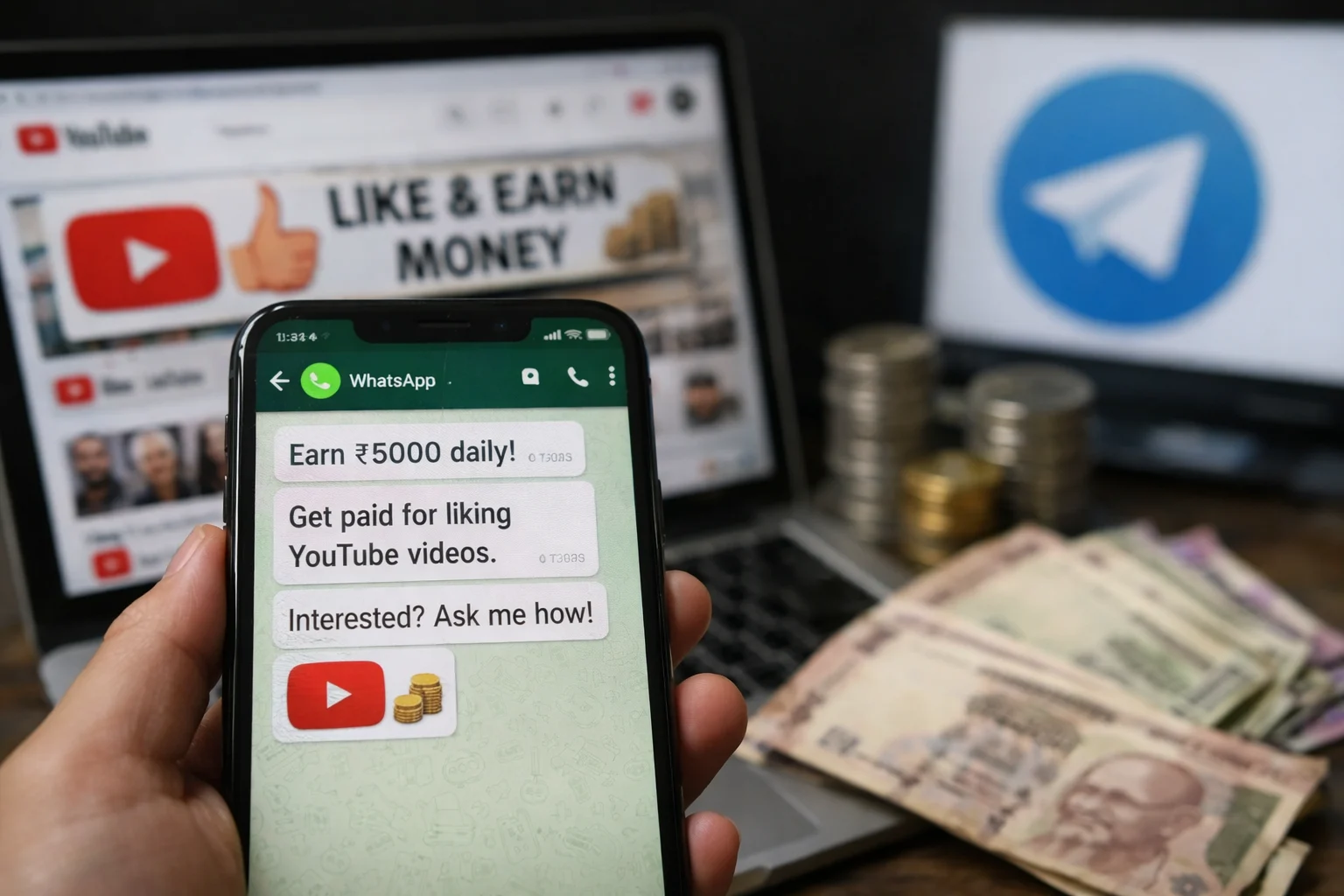
    “Work from home and earn ₹5000 daily. Limited vacancies available.”

    After responding, victims may be asked to pay registration fees.


    6. OTP Verification Scam

    Scammers send fake OTP messages and then call victims pretending to be bank officials.

    They try to trick victims into sharing OTP codes.


    7. Loan Approval Scam

    These messages offer instant personal loans without verification.

    Example:

    “Get personal loan up to ₹5 lakh instantly. Apply now.”

    After applying, scammers demand upfront fees.


    8. Fake UPI Payment Alert

    Victims receive messages claiming they have received money.

    Example:

    “You received ₹10,000 in your UPI account. Click here to claim.”

    The link leads to phishing websites.


    9. SIM Card Block Scam

    Users receive messages claiming their SIM will be blocked.

    Example:

    “Your SIM will be deactivated within 24 hours. Contact support immediately.”

    Victims are tricked into sharing OTPs.


    10. Income Tax Refund Scam

    Fraudsters pretend to be from the income tax department.

    Example:

    “You are eligible for an income tax refund of ₹15,000.”

    The link leads to fake government websites.


    11. Insurance Policy Bonus Scam

    Victims receive SMS messages claiming they have an insurance bonus pending.


    12. Google Account Security Alert Scam

    Messages warn users that their Google account has been compromised.


    13. ATM Card Block Scam

    Users receive messages claiming their ATM card will be blocked unless verified.


    14. WhatsApp Verification Scam

    Victims receive SMS asking them to verify their WhatsApp account.


    15. Investment Opportunity Scam

    These scams promote fake stock market or crypto investment opportunities.


    16. Scholarship Scam

    Students receive fake scholarship approval messages.


    17. Government Scheme Scam

    Fraudsters send SMS claiming eligibility for government schemes.


    18. Fake Recharge Offer Scam

    These messages promise free mobile recharge.


    19. Delivery Address Verification Scam

    Victims receive messages asking to confirm delivery addresses.


    20. Account Suspension Scam

    Messages claim the user’s account will be suspended unless verified immediately.

    Real SMS Scam Message Examples

    Here are some examples of scam text messages commonly used by fraudsters.

    Example 1

    “Dear user, your bank account will be blocked today. Update KYC immediately.”

    Example 2

    “Your electricity service will be disconnected tonight. Call customer support.”

    Example 3

    “Congratulations! You have won ₹10 lakh in our lucky draw.”

    Example 4

    “Your parcel delivery failed. Click here to reschedule delivery.”

    If you receive messages like these, always verify them before taking action.

    How to Identify a Scam Text Message

    You can often identify scam SMS messages by looking for these warning signs.

    Suspicious Links

    Scam messages often contain strange or shortened URLs.

    Urgent Threats

    Many scam messages create panic by threatening account suspension.

    Unknown Numbers

    Many scam messages are sent from random or unverified numbers.

    Spelling or Grammar Errors

    Poor language or spelling mistakes are common in scam messages.

    Requests for Sensitive Information

    Banks and government departments never ask for passwords or OTP through SMS links.

    What To Do If You Receive a Scam SMS

    If you receive a suspicious message, follow these steps.

    Do not click any links.

    Never open links from unknown SMS messages.

    Do not call unknown numbers.

    Scammers may try to manipulate you during calls.

    Block the sender.

    Most smartphones allow you to block spam messages.

    Report the message.

    Reporting helps authorities track scam activities.

    How to Report Scam Text Messages in India

    If you receive a scam SMS, you can report it through the following methods.

    Report to Cybercrime Portal

    You can file a complaint on the official cybercrime reporting portal.

    Forward Spam SMS to 1909

    You can forward suspicious SMS messages to 1909 to report spam.

    Contact Your Bank

    If the scam involves bank accounts or UPI payments, contact your bank immediately.

    Easily Check Any Suspicious SMS with ScamDekho

    Paste the message, link, or screenshot into ScamDekho.in. India’s free scam checker. It analyzes for fraud signs, phishing URLs, urgency tactics, and common Indian scam patterns.

    Use it to:

    • Verify suspicious texts instantly
    • Scan images/screenshots of messages
    • Get alerts on new fraud trends

    Awareness + tools like ScamDekho = your best defense.

    Final Thoughts

    Text message scams have risen sharply in India, and scam artists are always looking for ways to deceive people via text messages.

    The best way to avoid these scams is to always be careful, verify these messages, and not share any information via SMS links or unknown numbers.

    If you ever come across any suspicious message, always take your time to verify it first.

    We can minimize the effects of these scams by being aware of them, thus protecting many people from becoming victims.

  • How to Check If a UPI Payment Screenshot Is Real or Fake (Free Method)

    How to Check If a UPI Payment Screenshot Is Real or Fake (Free Method)

    Fake UPI payment screenshot scams are silently destroying small businesses across India. Every day, shopkeepers, freelancers, OLX sellers, and delivery agents are handing over goods and services for free — simply because they trusted a screenshot instead of checking their bank account. According to government data tabled in Parliament, UPI fraud incidents in India crossed 10.64 lakh cases with losses reaching ₹805 crore in FY26 alone.

    This scam does not target only big businesses — even a roadside chai stall owner, a vegetable vendor, or a student selling on OLX can become a victim. If you accept UPI payments in any form, this is the most important article you will read today.

    The Scale of UPI Fraud in India

    One out of every five families in India where a person uses UPI has been victims of fraud at least once in the past three years, according to a LocalCircles survey conducted among 32,000-plus citizens across 365 districts in India.

    An extremely worrying trend is the 51 percent of UPI fraud victims who never filed any complaint regarding the fraud they were victims of, which means the scale of the issue is much higher than what is being reported.

    The NPCI reported 6.32 lakh UPI fraud cases until September 2024, which is likely to rise to 1.1 million by the end of the financial year.

    What Is a Fake UPI Payment Screenshot Scam?

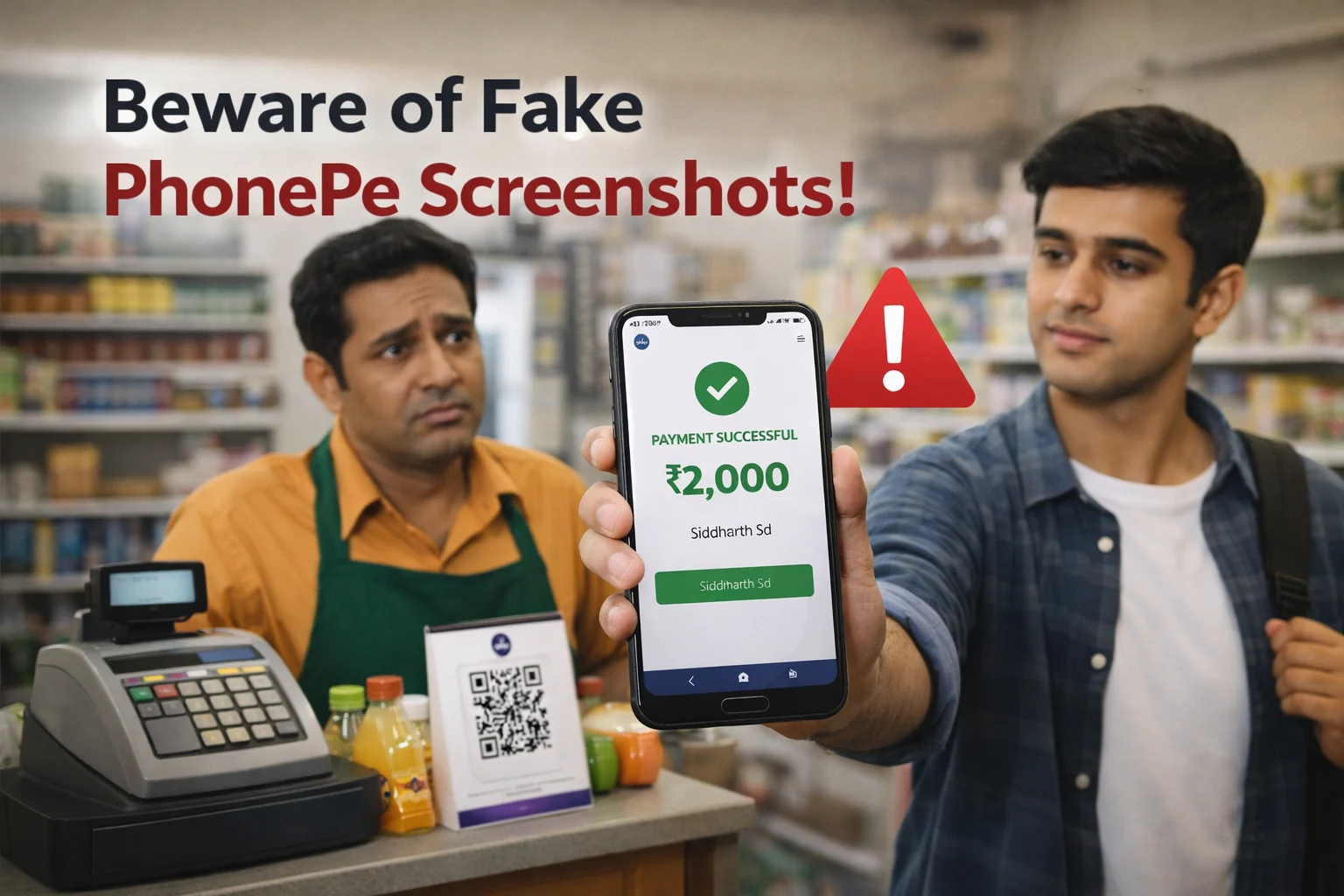
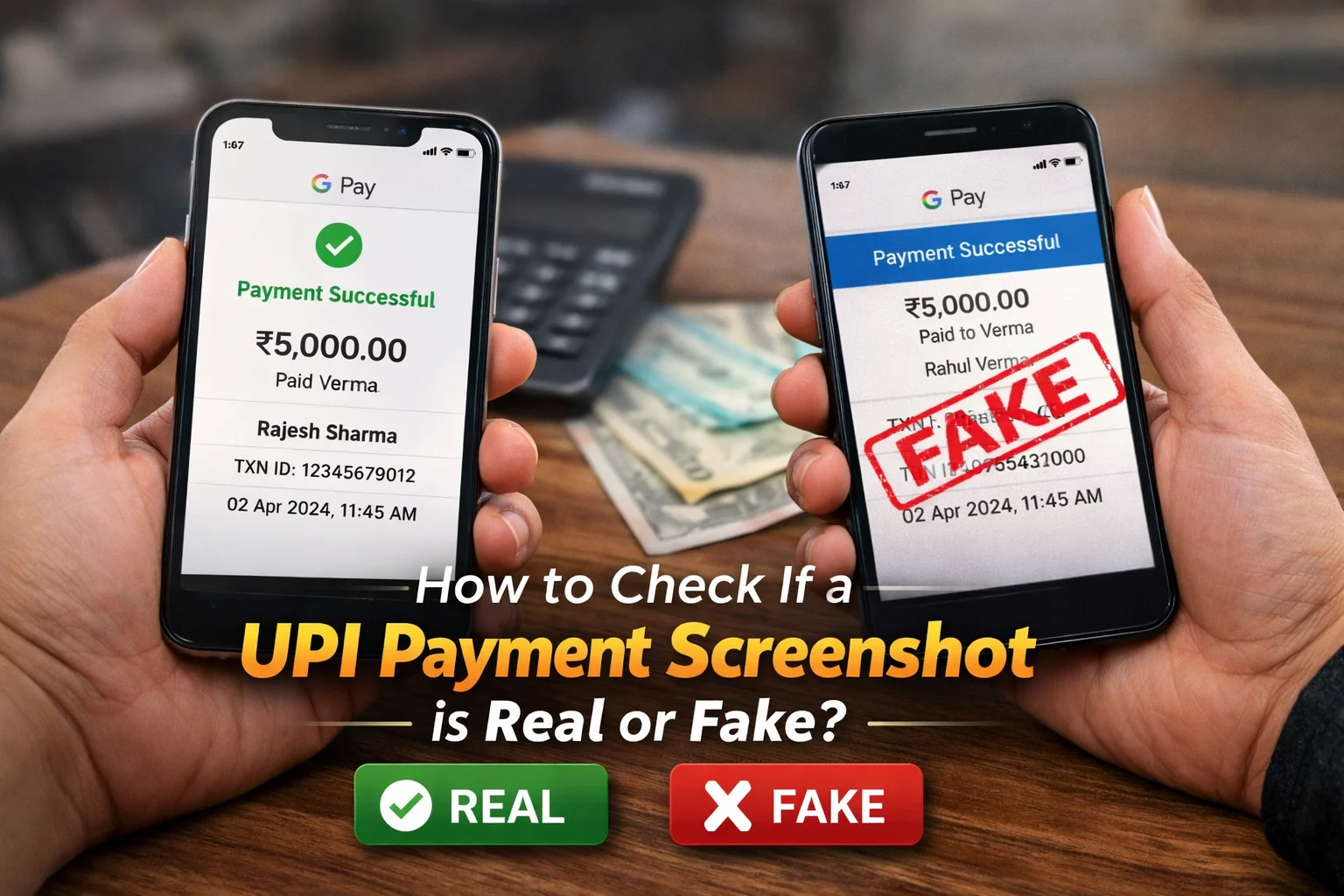
    A UPI payment screenshot scam is when a fraudster alters or makes a screenshot of a payment confirmation to look like money has been sent. The screenshot can include information such as the amount, transaction number, date, and app logo.

    Scammers use tools such as:

    • Screenshot editing apps
    • Websites that generate fake payments
    • FAKE UPI apps (APK files)
    • Fake SMS confirmations

    These make it possible for them to create a payment success screenshot without actually sending the money.

    Once they show the screenshot, they quickly take the product or service before the seller verifies the payment.

    Many real-life cases have been reported where criminals used fake digital payment confirmations to cheat shopkeepers and businesses.

    Must Visit: Fake Job Offer Letter Scam India 2026 — Verify Any Company Free

    Why This Scam Works So Easily

    The reason why the fake screenshot scam is so successful is that people believe visual proof rather than the confirmation of the transaction.

    The following are the reasons why people become victims of the scam:

    1. Busy Environment

    In shops, petrol stations, and restaurants, employees are usually busy. They just take a quick look at the screenshot and think that the payment has been made.

    2. Trust in Digital Payments

    Since UPI transactions are usually completed instantly, people think that the screenshot is genuine.

    3. Lack of Awareness

    Most people do not know that screenshots can be edited or created easily.

    4. Delayed Notifications

    Sometimes, bank notifications take time to arrive, and scammers take advantage of this.

    Due to these reasons, fake payment scams are becoming popular in India.

    Real Cases That Made Headlines

    In Sanand, Gujarat, two fraudsters created a fake Paytm app to create a false payment confirmation. They ordered an iPhone 16 from an electronics showroom in the locality, displayed the fake payment confirmation on WhatsApp, received the iPhone, and escaped. The store realized that the payment was never made – the police arrested the fraudsters in a matter of hours, but the store had already incurred the loss.

    In Indore, Madhya Pradesh, two individuals approached petrol pumps, claiming they required cash immediately for medical emergencies. They promised to pay using PhonePe and displayed a fake payment confirmation screenshot after taking the money.

    In September 2024, a group of fraudsters used UPI to cheat Bajaj Electronics, a Hyderabad-based electronics retailer, out of ₹4 crore. The fraudsters would visit the electronics showroom, choose their products, pay for them using UPI, and then raise chargeback complaints – resulting in the payment reversal after the delivery of the products.

    Free Method to Check If a UPI Payment Screenshot Is Real

    The golden rule of UPI payment verification is this:

    Never trust a screenshot. Always check the payment in your own UPI app or bank account.

    Here are the most authentic ways to check if a payment is genuine.

    1. Check Your UPI App Transaction History

    The easiest way to confirm a payment is to check your UPI app’s transaction history.

    Open your payment app such as:

    • Google Pay
    • PhonePe
    • Paytm
    • BHIM

    Then go to:

    Profile → Transactions → Payment History

    If the payment is real, it will appear there immediately.

    If the transaction is not visible, the payment did not happen. A genuine transfer always appears in your bank or UPI app records.

    2. Verify the UPI Transaction ID

    Each genuine UPI payment has a unique transaction ID or reference number.

    You should check if the transaction ID in the screenshot matches your transaction history.

    Indicators of a fake transaction ID are:

    • The ID is not reflected in your payment history
    • The ID format looks fishy
    • The reference number is not present at all

    If the transaction ID does not match your bank or UPI app accounts, the payment is probably fake.

    3. Check the Receiver Name

    UPI systems also show the registered name of the receiver before the completion of the transaction.

    If a person claims to have sent money to you, check the following:

    • Is the screenshot showing your correct name?
    • Is it showing your business name?

    If the “Paid to” name does not match your details, the screenshot may be fake.

    4. Look for Screenshot Editing Signs

    Many fake screenshots contain small editing mistakes.

    Look carefully for these signs:

    • Blurry bank or app logo
    • Misaligned text
    • Different font styles
    • Wrong date or time
    • Cropped screen edges

    These are common indicators of edited or fake payment screenshots.

    5. Wait for Bank Credit Confirmation

    UPI transfers usually happen within seconds.

    Before handing over goods or services, wait for one of these confirmations:

    • Bank SMS notification
    • UPI app notification
    • Updated account balance

    If the money does not appear in your bank account, do not trust the screenshot.

    6. Beware of Fake Payment Apps

    Some scammers download fake UPI apps in APK form.

    These apps will display a fake payment success screenshot but will not send any money.

    In some cases of fraud, scammers have used such apps to cheat petrol pumps and restaurants.

    Always check your own phone and bank statements, not the sender’s screen.

    Fake UPI Payment Apps & Screenshot Generators Used by Fraudsters

    One of the biggest reasons why fake UPI payment scams are increasing is the easy availability of fake payment generator tools and modified UPI apps online.

    These tools copy the design of popular payment apps like Google Pay, PhonePe, Paytm, or BHIM and display a fake Payment Successful screen — even when no real transaction has taken place.

    A fraudster can simply enter a custom receiver name, amount, fake transaction ID, and date — and the tool instantly generates a realistic looking payment confirmation screen.

    However, no money is ever transferred to any bank account.

    Cybercrime authorities have warned that hundreds of such fake payment tools and modified APK files are being circulated on Telegram channels and dark web forums — specifically designed to cheat shopkeepers, petrol pump owners, and small business owners.

    How These Tools Trick Victims

    These fake apps work by simulating the visual interface of real UPI apps — without connecting to any banking system at all.

    Here is how the scam plays out:

    • The fraudster selects a product or service from your shop
    • Instead of making a real payment, they open a fake payment tool
    • They enter your name and the correct amount to make it look authentic
    • They show you the fake success screen
    • They collect the product and leave before you verify

    Since most people trust what they see on a screen, the scam succeeds almost every time.

    Remember — no legitimate payment tool ever needs to be shown to the seller. If a buyer is showing you their screen instead of waiting for your confirmation, that is your first red flag.

    Real Payment vs Fake Screenshot (Quick Comparison)

    FeatureReal UPI PaymentFake Screenshot
    Appears in your UPI historyYesNo
    Bank balance updatesYesNo
    Transaction ID verifiedYesOften fake
    Receiver name correctYesSometimes wrong
    Notification receivedYesUsually missing

    Remember:

    No credit in your bank = No payment.

    What To Do If Someone Shows a Fake Payment Screenshot

    If you suspect a fake UPI payment:

    1. Do not hand over the product immediately
    2. Ask the customer to wait until the payment appears in your account
    3. Ask them to retry the payment if needed
    4. Take note of their phone number and details

    If fraud has already happened, report it immediately.

    Also Read: Fake Electricity Bill Disconnection Scam — How It Works and How to Stay Safe

    How to Report a UPI Scam in India

    If you become a victim of UPI fraud, you should act quickly.

    You can report the incident through these methods:

    1. Call Cybercrime Helpline
    Dial 1930 to report financial fraud.

    2. File Complaint Online
    Visit the official cybercrime portal
    https://cybercrime.gov.in/

    3. Contact Your Bank or UPI App
    Report the transaction through:

    • Google Pay support
    • PhonePe support
    • Paytm support
    • Your bank

    Quick reporting increases the chance of recovering your money.

    How ScamDekho Helps You Stay Safe

    ScamDekho is designed to help users identify and verify suspicious links, image/screenshot, and online text message scams.

    If you receive:

    • A suspicious payment link
    • A fraud message
    • A fake UPI request

    You can check it instantly on ScamDekho before taking action.

    This helps users stay protected from:

    • Payment fraud
    • Phishing links
    • Fake websites
    • OTP scams

    The more people verify suspicious activities, the harder it becomes for scammers to succeed.

    Final Thoughts

    The screenshot scam of fake UPI payment proof is becoming increasingly common in India. Scammers bank on the fact that people believe in screenshot proof rather than checking payments.

    The reality is simple:

    Screenshot proof is not payment proof.

    Remember these rules:

    • Check your UPI payment history
    • Check the transaction ID
    • Check the bank credit
    • Never trust someone else’s phone screen

    It is very easy to protect yourself from this scam by being alert and checking payments.

    If you ever receive suspicious payment proof, check it first on ScamDekho and do not become the next victim.

  • Fake Electricity Bill Disconnection Scam — How It Works and How to Stay Safe

    Fake Electricity Bill Disconnection Scam — How It Works and How to Stay Safe

    One of the most common cyber scams in India is electricity bill scams. Every day, thousands of people receive fake messages or calls from scammers saying that their electricity bill is unpaid and that their electricity supply will be disconnected immediately.

    These messages look very genuine and create a sense of urgency among people. Due to this, people pay the money immediately. However, this money is transferred to the scammer instead of going to the electricity department.

    There have been many cyber crime cases that have revealed how dangerous this electricity bill scam is. In some such cases, people have lost thousands or even lakhs of rupees by interacting with fake electricity department officials or by installing fake apps.

    Since electricity supply is one of the basic needs for people, they will definitely take immediate action if they receive any information about electricity disconnection.

    In this guide, we will learn about how this fake electricity bill scam is done, how we can identify this scam, and how we can verify this using ScamDekho.

    What Is the Fake Electricity Bill Disconnection Scam?

    The Electricity Bill Disconnection Scam is a type of cyber fraud in which scammers pose as representatives of the Electricity Boards and send notifications to the victims that their bills have not been paid.

    These fraud messages usually say something like:

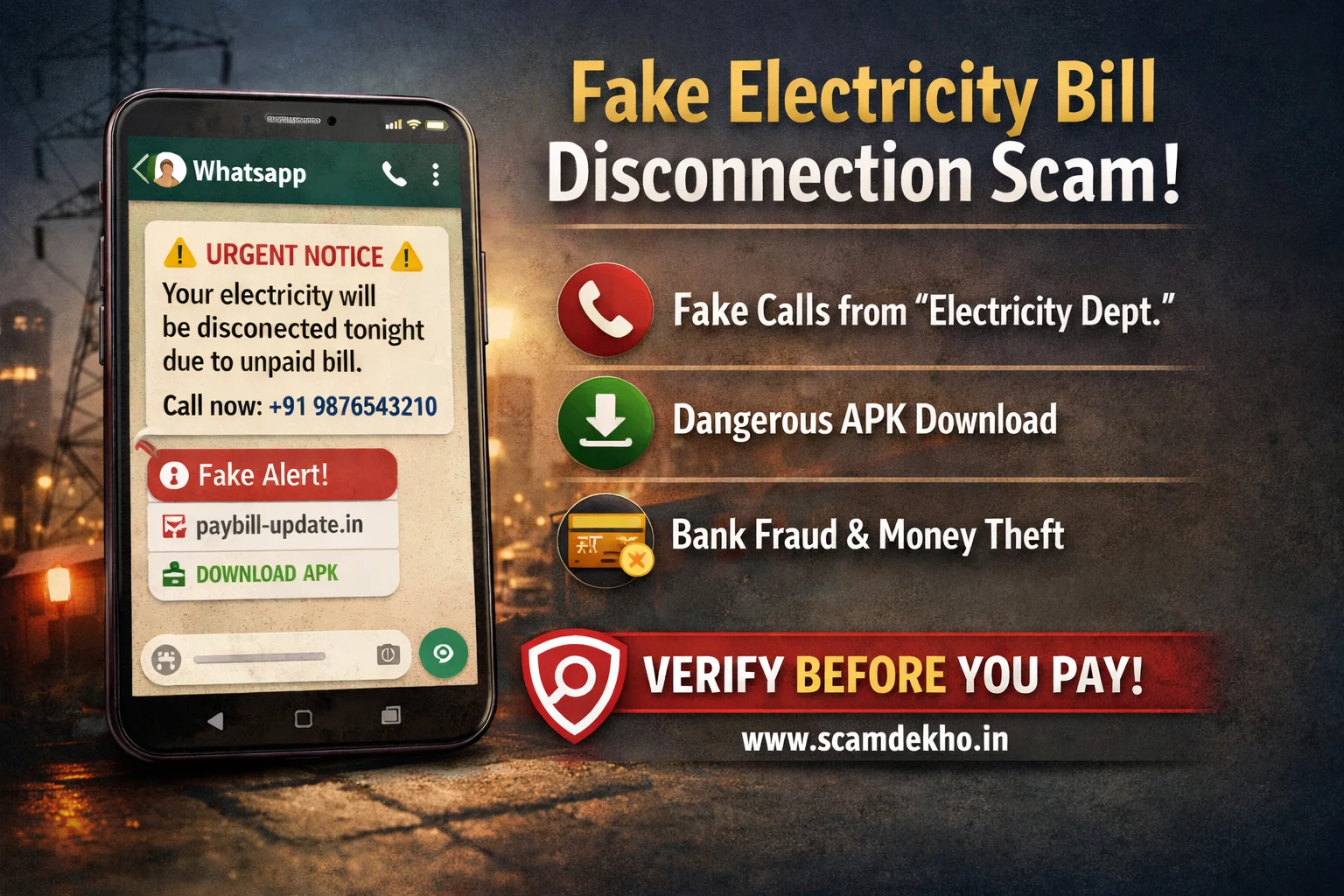
    “Dear customer, your electricity connection will be disconnected tonight due to an unpaid bill. Please contact our officer immediately.”

    The message usually contains:

    • A mobile number
    • A suspicious payment link
    • A request to download an app

    The goal is to make the victim panic and take immediate action.

    As it is common for Electricity Companies to send SMS notifications regarding bills, scammers use this mode of communication to send their messages.

    How the Fake Electricity Bill Scam Works

    Cybercriminals usually follow a simple but effective process.

    1. Fake Electricity Bill Message

    The scam begins with an SMS or WhatsApp message claiming that your electricity bill is pending.

    The message often includes threatening lines like:

    • “Your electricity will be disconnected tonight.”
    • “Bill not updated in system.”
    • “Contact electricity officer immediately.”

    Sometimes scammers even include fake electricity department logos to make the message look legitimate.

    2. Fake Customer Support Call

    If the victim calls the number provided in the message, a scammer answers pretending to be an electricity department officer.

    They try to create panic and urgency, saying things like:

    • Your electricity will be disconnected in 30 minutes
    • Your bill update failed in the system
    • You must update payment immediately

    The fraudster may then ask for payment through UPI, wallet transfer, or bank details.

    3. APK or Remote Access App Trap

    In many cases, scammers send a link or APK file on WhatsApp and ask the victim to install it.

    They claim the app is needed for:

    • Bill update
    • Complaint registration
    • Payment verification

    However, the app actually gives remote access to the scammer, allowing them to control the victim’s phone.

    4. Bank Fraud and Money Theft

    Once the scammer gains access to the device, they can:

    • Read OTP messages
    • Access banking apps
    • Change passwords
    • Transfer money from your account

    In many reported cases, victims lost ₹1 lakh to ₹15 lakh through such scams.

    Real Examples of Electricity Bill Scam in India

    Reports of cybercrimes highlight the extent to which this fraud has spread.

    • A resident of Delhi lost ₹9 lakhs to scammers, who posed as electricity department officials and gained remote access to the victim’s phone.
    • Another case has seen two people lose over ₹16 lakhs due to the installation of malicious APK files sent by scammers.
    • Many consumers in India are still receiving messages that claim that their electricity supply will be disconnected if they do not make immediate payment.

    These incidents show how dangerous the scam can be if people do not verify messages properly.

    Check: BC / EBC Scholarship Fake Portals — Official Warning And How to Stay Safe

    Signs That an Electricity Bill Message Is a Scam

    Some of the common red flags are listed below:

    1. Message from Personal Mobile Number

    It is not expected for electricity companies to send messages from a personal mobile number.

    2. Threat of Disconnection

    Threats of immediate disconnection of electricity are common in scams, but not from real electricity departments.

    3. Suspicious Links and APK Files

    It is not expected for electricity companies to send APK files through WhatsApp.

    4. Request for OTP and Bank Details

    It is not expected for electricity companies to ask for:

    • OTP
    • UPI PIN
    • Debit card details

    5. Payment to Personal UPI ID

    It is not expected for electricity companies to ask for payment to a personal UPI ID.

    How to Check If an Electricity Bill Message Is Fake Using ScamDekho

    If you receive a suspicious electricity bill message, you can verify it easily using ScamDekho.

    Step 1 – Open your browser and visit scamdekho.in

    Step 2 – On the home page of the website, you will see the option of Check Scam or Scan Now

    Step 3 – Copy the suspicious electricity bill message that you have received via WhatsApp or SMS

    Step 4 – Now, paste the copied message in the input box of the website

    Step 5 – If you have already received the electricity bill, then click on the ‘Upload Image’ button and upload the image of the electricity bill directly

    Step 6 – Now, ScamDekho will check the bill and inform you whether it is genuine or not

    Step 7 – Click on ‘Check Now’ and wait for a few seconds to get the result

    Step 8 – Now, the website will show you the result, whether it is ‘Safe’ or ‘Scam’

    Step 9 – If it shows that it is a ‘Scam’ message, then click on ‘Report This Scam’ so that others can also be warned

    Step 10 – Share the result with your family and neighbours on WhatsApp to protect them as well

    Also Read: Latest Online Scams in India (2026): New Fraud Trends You Must Know

    What To Do If You Receive a Fake Electricity Bill Message

    If you receive such a message, follow these safety steps.

    1. Do Not Panic

    Scammers generally depend on your fear and pressure to take action immediately.

    2. Verify on the Official Website

    Always verify your electricity bill through the official website or app of your electricity provider.

    3. Do Not Install Unknown Apps

    Do not download the APK files received through WhatsApp or SMS.

    4. Never Share OTP or PIN

    No electricity provider will ask for your sensitive financial information.

    5. Report the Scam

    If you suspect fraud, report it immediately:

    • National Cyber Crime Helpline: 1930
    • Cyber Crime Portal: cybercrime.gov.in

    Tips to Stay Safe From Utility Scams

    Here are some simple tips to protect yourself.

    ✔ Pay Electricity Bills only through official apps or websites
    ✔ Never believe threats of urgent disconnection
    ✔ Do not click unknown payment links
    ✔ Install apps only through Google Play Store or Apple App Store
    ✔ Verify unknown links or messages using Scam Dekho

    The hackers are using the element of scare to trick people, so it is important to remain calm and verify the information.

    Final Thoughts

    The scam of fake electricity bills being disconnected is becoming popular in India, and people are falling prey to this scam through messages, WhatsApp, and phone calls. Scammers are posing as electricity department employees and are demanding payment of these bills.

    However, the good news is that this scam can be avoided if you take some precautions.

    • Never trust urgent payment messages.
    • Verify your bills through official channels.
    • Be cautious of suspicious messages and check ScamDekho.

    Awareness is the best defense against cybercrimes. With your help, cyber scammers won’t be able to exploit innocent users.

  • Top 7 Phone And SMS Scams in India (2026) — Do Not Fall for These Tricks

    Top 7 Phone And SMS Scams in India (2026) — Do Not Fall for These Tricks

    Mobile phones have changed the way we live. Today, a single phone can handle calls, messages, banking, shopping, and so much more.

    But this convenience has a dark side.

    In 2026, scammers in India are more active than ever before. They are using fake calls, misleading SMS messages, OTP tricks, and impersonation tactics to rob people of their money and personal information.

    The biggest problem is that most people do not even know they have been scammed until it is too late. They check their bank account and the money is already gone. The scammer’s number is switched off. And there is no way to undo the damage.

    This is why knowing about these scams is so important.

    You do not need to be a tech expert to protect yourself. You just need to know what to watch out for.

    In this guide, we will cover the top 7 phone and SMS scams that are targeting Indians right now. We will explain how each scam works, what warning signs to look for, and what you can do to stay safe.

    Read it. Share it. And make sure your family knows about it too.

    1. OTP Scam Calls & Messages

    OTP fraud is one of the most common phone scams in India right now.

    What happens:

    You get a call from someone who says they are from your bank, courier company, or telecom company. They sound serious and worried. They say something like — “Your account will be blocked soon” or “There is a problem with your SIM.”

    Right after that, an OTP comes on your phone.

    Now they ask you to share that OTP with them. They say it is just for “verification.”

    But here is the truth —

    That person is a fraudster. The OTP is the key to your bank account or your online profile. The moment you share it, they get inside.ount or change your password.

    How to stay safe:

    1. Never share your OTP with anyone — not even someone who sounds like a bank employee.
    2. Real banks never ask for your OTP on a call. This is a strict rule.
    3. If you feel something is wrong, just hang up. Then call your bank directly using the number on their official website or the back of your debit card.

    Remember: An OTP is like your ATM PIN. It is private. It is only for you.

    2. Fake Bank SMS Phishing

    Fake SMS scams are growing fast in India. These are called smishing — a mix of SMS and phishing.

    What these messages look like:

    You get an SMS that says something like —

    “Your account will be frozen. Click here to update KYC.” “Suspicious transaction detected. Verify immediately.”

    The message looks real. It feels urgent. And it has a link.sites that look like official bank portals.

    What happens when you click:

    That link takes you to a fake website. It looks exactly like your bank’s official site — same logo, same colors, same design.

    You type in your username and password.

    And just like that — the scammer now has your login details. Your account is in their hands.

    How to spot a fake SMS:

    1. Shortened links — like bit.ly/xyz123. Real banks never send these.
    2. Panic language — words like “immediately,” “urgent,” “will be frozen.” This is done to stop you from thinking clearly.
    3. Unknown number — the sender is not a saved contact or a known bank ID.

    Before you click any link, ask yourself:

    Did I ask for this message? Is this link from an official source? Does something feel off?

    3. UPI Collect Request Scam

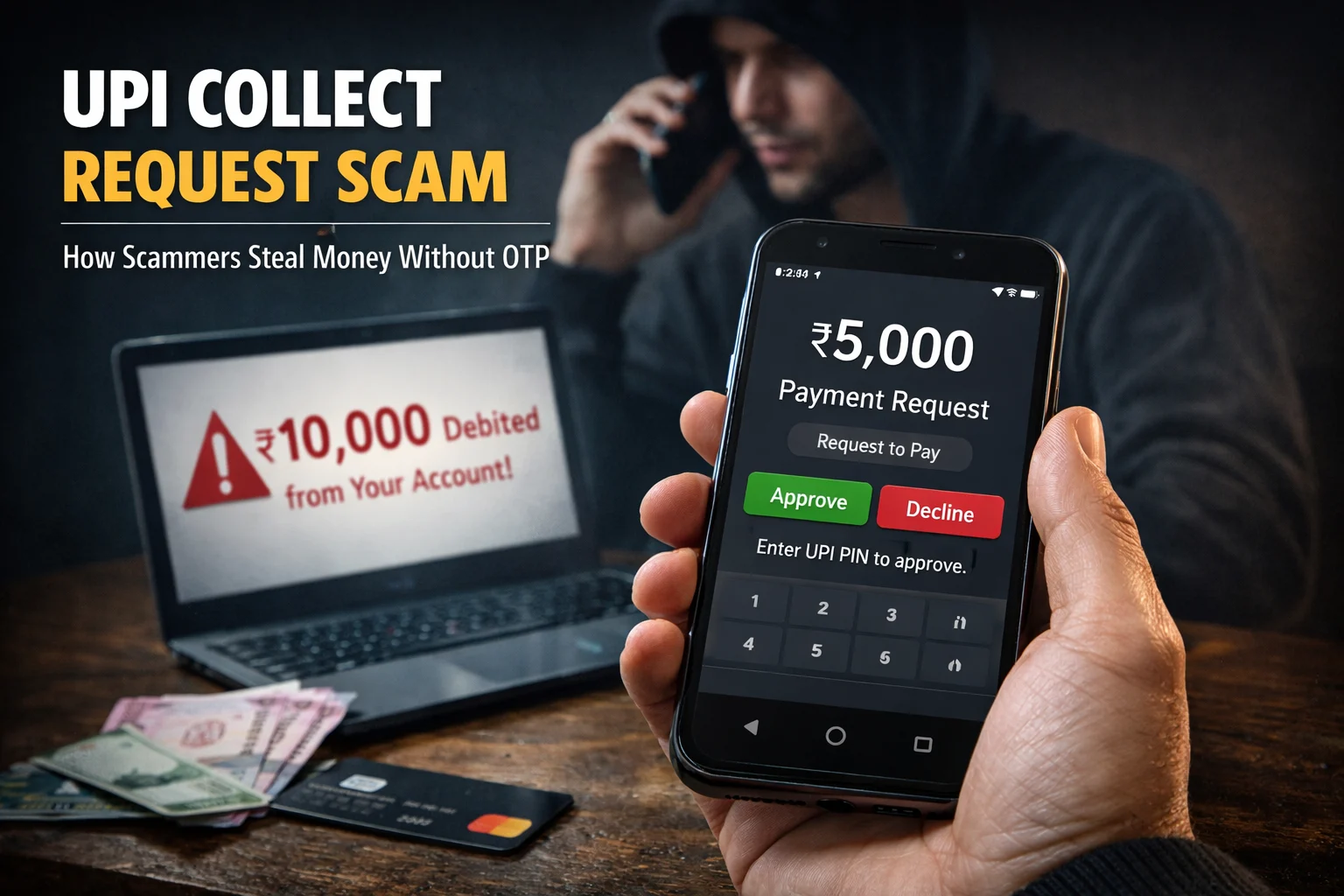
    UPI scams are one of the most common financial frauds in India.

    How scammers trick victims:

    • They send a “collect request” on your UPI app.
    • They say they are sending money.
    • Victims enter UPI PIN thinking they are receiving money.money.

    Remember: You do not need to enter your UPI PIN to receive money.

    Entering your PIN approves payment, meaning money is sent to the scammer.

    Safety tips:

    • Check payment requests carefully.
    • Don’t approve unknown collect requests.
    • Check sender information.

    4. Lottery & Prize Winning SMS

    “Congratulations! You have won ₹25,00,000!”

    If you’ve ever received such a message, it’s almost certainly a scam.

    How it works:

    • You’re told you won a lottery or lucky draw.
    • You’re asked to pay a “processing fee” or “tax.”
    • Once paid, the scammer disappears.

    No legitimate lottery asks for money before releasing winnings.

    Warning signs:

    • International numbers.
    • Poor grammar.
    • Unrealistic prize amounts.

    If it sounds too good to be true, it probably is.

    5. Fake Customer Care & Support Calls

    Scammers usually pose as customer service personnel from banks, online shopping sites, or telecom operators.

    Their tactics:

    • They will say there is a refund due.
    • They will say there is suspicious activity in your account.
    • They will ask you to download a remote access tool such as screen sharing software.

    Their goal: Once installed, they can view your screen and steal your banking information.

    Protect yourself:

    • Never install apps suggested by unknown callers.
    • Only contact support using official website numbers.
    • Do not share card details or CVV.

    6. SIM Swap Scam

    SIM swap fraud is extremely risky because it enables the fraudster to intercept your OTPs.

    How it happens:

    • The fraudster collects your personal information.
    • They ask for a copy of your SIM card from your telecom company.
    • Your SIM card becomes useless.
    • They gain access to your bank accounts through OTP verification.

    What to do:

    • If your mobile phone suddenly goes out of network, inform your telecom company immediately.
    • Set up SMS notifications for your bank transactions.
    • Protect your Aadhaar and ID information.

    7. Loan App & Instant Credit Scams

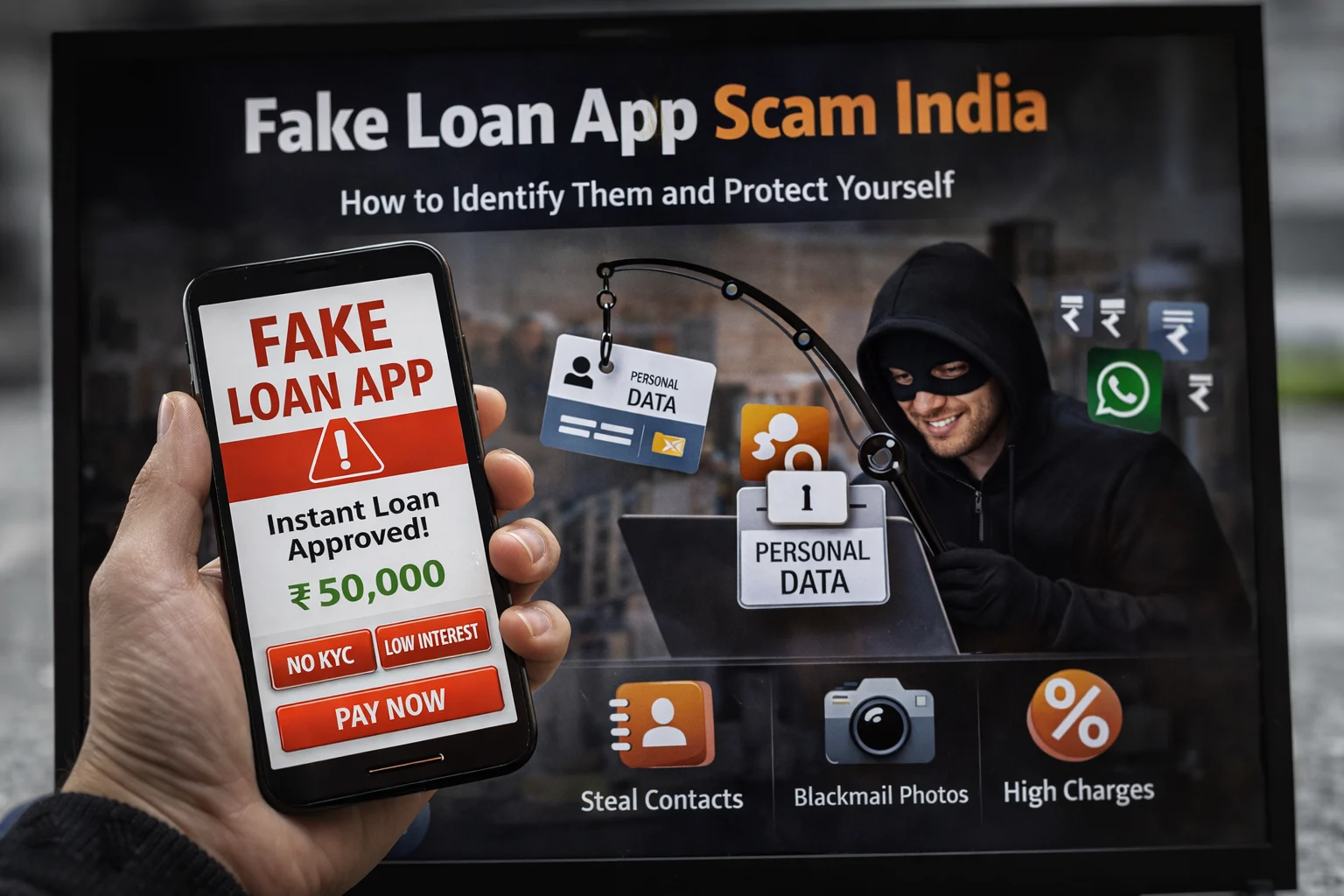
    Fake loan apps are trapping thousands of people.

    How these scams operate:

    • You download a loan app that promises instant approval.
    • The app requests access to your contacts and gallery.
    • If you don’t pay on time, the fraudsters threaten to share your photos or contacts.

    These apps use harassment and blackmail tactics.

    How to stay safe:

    • You download apps only from the official app store.
    • You read reviews before installing an app.
    • You avoid apps that request unnecessary permissions.

    How to Identify a Phone or SMS Scam

    Here are common patterns across most scams:

    • Urgency (“Act now or account blocked”)
    • Fear (“Legal action will be taken”)
    • Greed (“You won a prize”)
    • Requests for OTP, PIN, or payment
    • Suspicious links

    Scammers rely on panic and emotional reactions. Always pause and verify.

    What To Do If You Receive a Scam Call or SMS

    1. Do not respond or click links.
    2. Block the number.
    3. Report suspicious messages.
    4. Inform your bank if you shared sensitive information.
    5. Call the national cybercrime helpline: 1930 (India).

    Quick action increases the chances of preventing financial loss.

    How to Protect Yourself from Phone & SMS Scams

    1. Enable two-factor authentication.
    2. Use official banking apps only.
    3. Do not share personal details over phone.
    4. Avoid clicking unknown links.
    5. Keep your mobile software updated.
    6. Educate family members, especially elderly people.

    Cybercriminals often target senior citizens who may not recognize scam tactics.

    Final Thoughts

    In 2026, phone and SMS scams are becoming smarter. Scammers are always inventing new ways of betrayal, from OTP scams to bank messages, UPI scams, and lottery scams.

    The best part? Most scams have predictable patterns.

    If you stay alert, verify links, and never share OTP or PIN details, you can avoid becoming a victim.

    Always remember these tips:

    • Do not fall for urgent financial messages.
    • Do not share OTP information.
    • Do not click on suspicious links.

    Digital awareness is your strongest shield against cyber fraud.

  • LPG Cylinder Scam on WhatsApp: Thousands of Indians Are Losing Money Without Even Realising It

    LPG Cylinder Scam on WhatsApp: Thousands of Indians Are Losing Money Without Even Realising It

    Cooking gas is one of the most important requirements for the Indian public. There are millions of families that rely on LPG cylinders for their cooking requirements. But the cybercriminals have started exploiting the need for LPG cylinders by operating a new scam of delivering LPG cylinders.

    These cybercriminals are swindling people by demanding advance payments for the booking of fake LPG cylinders.

    Recently, the cybercrime departments of many states in India have sent messages warning the public about the fake LPG booking links that are being circulated online, especially during the period when the public is concerned about the shortage of LPG cylinders.

    If you are a user of LPG cylinders provided by Indane, Bharat Gas, or HP Gas, it is important for you to know about the new scam of delivering LPG cylinders.

    What Is the LPG Cylinder Delivery Scam?

    The LPG cylinder delivery scam is a cybercrime where the scammers pose as gas distributors or customer care executives. They send messages to the users claiming to deliver the gas cylinders immediately or additional cylinders if the user pays in advance.

    Victims usually receive these messages through:

    • WhatsApp
    • SMS
    • Facebook ads
    • Fake Google search results
    • Fraudulent websites

    The messages often create panic by claiming:

    • Gas supply is limited
    • Your gas connection will be blocked
    • Subsidy or KYC verification is pending
    • Emergency booking is required

    Cybercriminals use urgency to pressure people into clicking malicious links or transferring money.

    Authorities have warned that scammers are exploiting public panic about gas shortages and delivery delays to spread fake booking ads online.

    Why This LPG Scam Is Increasing in India

    There are many reasons why LPG scams are increasing rapidly. These are as follows:

    1. High Dependency on LPG

    All households in India depend on LPG gas cylinders. This is why LPG is a favorite among scammers.

    1. Online Booking Trend

    Most LPG gas bookings are done online. This is why phishing websites are emerging.

    1. Panic During Supply Rumors

    As soon as rumors about gas supply cut-off emerge, people try to find gas supply services. This is why LPG gas scams are on the rise.

    1. Virality on Social Media

    Scams are easily circulated on social media platforms like WhatsApp and Facebook.

    According to cyber crime agencies, fraudsters are developing fake LPG gas websites. They are sending links to these websites on WhatsApp, asking users to pay online for faster service.

    How the LPG Cylinder Delivery Scam Works (Step-by-Step)

    Understanding the scam process can help you avoid becoming a victim.

    Step 1: Fraudulent Message or Ad

    Victims receive a message like:

    • “Urgent LPG cylinder delivery available”
    • “Book gas instantly — limited stock”
    • “Complete KYC or your connection will be blocked”

    The message usually contains:

    • A suspicious link
    • A fake booking website
    • A fake customer care number

    Step 2: Fake LPG Booking Website

    When the user clicks the link, they are taken to a fake website that looks exactly like an official gas company website.

    These websites often copy the branding of:

    • Indane Gas
    • Bharat Gas
    • HP Gas

    The page asks users to fill in details such as:

    • Name
    • Address
    • Phone number
    • Gas consumer number

    Step 3: Advance Payment Trap

    After entering details, the site asks the victim to pay money for:

    • Priority delivery
    • Emergency booking
    • Additional gas cylinder

    Payments are usually requested via:

    • UPI
    • Debit card
    • Net banking
    • Wallets

    Once payment is made, the fraudsters disappear.

    Step 4: Data Theft and Bank Fraud

    In some cases, scammers also steal:

    • Bank account details
    • OTPs
    • UPI PIN

    This allows them to drain money directly from the victim’s account.

    The Most Dangerous Version — APK Malware Scam

    A more advanced version of this scam involves malicious APK files sent on WhatsApp.

    Here is how it works:

    1. Scammer contacts the victim pretending to be a gas company employee.
    2. They claim your gas connection needs verification or KYC update.
    3. They send a mobile application file (.APK) on WhatsApp.
    4. The victim installs the app.
    5. The app secretly accesses:
      • SMS messages
      • OTPs
      • banking notifications
      • phone data

    Within minutes, fraudsters can empty the victim’s bank account.

    Cybercrime authorities warn that no gas company ever sends APK files on WhatsApp.

    7 Warning Signs of an LPG Delivery Scam

    If you notice any of these signs, the message is likely fraudulent.

    1. “Pay Now, Get Gas Tomorrow”

    Legitimate gas agencies never require advance payments for emergency bookings.

    2. Fake Customer Care Numbers

    Scammers often publish fake helpline numbers on fraudulent websites.

    3. Suspicious WhatsApp Messages

    Gas companies usually do not communicate through random WhatsApp numbers.

    4. Too-Good-To-Be-True Offers

    Offers like:

    • Extra cylinder supply
    • Discount gas delivery
    • Instant booking without waiting

    are usually scams.

    5. Fake Google Ads

    Some scammers run fake ads so their websites appear on top of search results.

    6. APK File Downloads

    Any message asking you to install an unknown APK file is a major red flag.

    7. Urgent Threat Messages

    Messages like:

    • “Connection will be suspended”
    • “Subsidy blocked”
    • “Last chance for booking”

    are often used to scare victims.

    Also Read: Fake UPI Payment Screenshot Scam — How Shopkeepers Are Getting Fooled

    How to Check Suspicious LPG Links or Messages

    If you receive a suspicious LPG booking link, follow these steps before clicking.

    1. Check the Website URL Carefully

    Official LPG websites include:

    • indane.co.in
    • ebharatgas.com
    • hindustanpetroleum.com

    Fake websites often contain:

    • spelling mistakes
    • extra characters
    • unusual domain endings

    Example of fake domains:

    • indane-gas-booking.in
    • bharatgas-delivery.online

    2. Check Website Security

    Look for these signs:

    • HTTPS security lock icon
    • Official company domain
    • Verified contact details

    If the site looks poorly designed or asks for UPI PIN, it is likely a scam.

    3. Search the Website on Google

    Before making any payment:

    1. Copy the website link
    2. Search it on Google
    3. Add the word “scam”

    Example:

    bharatgas-booking-online.com scam

    If other users reported fraud, avoid it.

    4. Verify Through Official Apps

    Always use official LPG booking apps such as:

    • IndianOil ONE
    • HPPay
    • Hello BPCL

    These apps are available on the Google Play Store and Apple App Store.

    How to Check And Report LPG Scams on ScamDekho Online

    Step 1 – Open your browser and visit scamdekho.in

    Step 2 – On the homepage, find the “Check Scam” or “Scan Now” box

    Step 3 – Copy the suspicious WhatsApp message or link you received and paste it in the input box

    Step 4 – Hit the Check Scam button and wait a few seconds

    Step 5 – ScamDekho will show you the result — whether the link is Safe or a known Scam

    Step 6 – If it is a scam, click Report This Scam so others get warned too

    Step 7 – Share the result with your family and friends on WhatsApp to protect them as well

    Pro Tip: Whenever you receive any suspicious LPG message, always check it on ScamDekho before clicking anything.

    What to Do If You Get Scammed

    If you accidentally made a payment to a fake LPG booking website, act immediately.

    Step 1: Call Cybercrime Helpline

    Dial: 1930

    This is India’s official cybercrime emergency number.

    Step 2: File Online Complaint

    Visit:

    https://cybercrime.gov.in

    Submit:

    • payment details
    • screenshots
    • scam link
    • WhatsApp number

    Step 3: Inform Your Bank

    Contact your bank immediately to:

    • freeze the transaction
    • block suspicious activity

    The faster you report, the higher the chances of recovering money.

    Authorities say reporting cyber fraud within the first few hours significantly increases recovery chances.

    Official LPG Booking Methods

    Always book LPG cylinders through official channels only.

    CompanyOfficial AppWebsite
    Indane GasIndianOil ONEhttps://iocl.com/
    Bharat GasHello BPCLhttps://my.ebharatgas.com/
    HP GasHP PAY/HP GAS SAATHIhttps://myhpgas.in/

    Never trust random links shared on WhatsApp.

    Check: Latest Online Scams in India (2026): New Fraud Trends You Must Know

    Final Warning

    The cybercriminals are always coming up with innovative ideas to take advantage of unsuspecting internet users. The LPG cylinder delivery scam is a dangerous fraud because it involves a basic necessity for every household – cooking gas.

    Scammers rely on:

    • panic
    • urgency
    • fake branding
    • fraudulent websites

    Remember these three golden rules:

    • Never click on LPG Booking links
    • Never pay advance money for gas delivery
    • Never download APK files on WhatsApp

    If you receive a suspicious message, check it on ScamDekho right away and inform others.

    Being vigilant is the key to stopping cybercriminals.

  • BC/EBC Scholarship Fake Portal Warning 2026 — How to Stay Safe in India

    BC/EBC Scholarship Fake Portal Warning 2026 — How to Stay Safe in India

    Scholarships for Backward Class (BC) and Economically Backward Class (EBC) students are intended to encourage educational pursuits and avoid financial difficulties. Various government portals, such as the National Scholarship Portal (NSP) and state government social welfare department portals, offer scholarships to students.

    But the popularity of these scholarship schemes has also led scammers to target these schemes. Scammers are developing fake scholarship portals, links, and phishing websites that mimic government portals. The motive of these scammers is to obtain personal information, money, and bank account details from students and their parents.

    Over the last few years, several scholarship fraud cases and fake scholarship portals have been reported in India.

    This article will guide you on how scholarship scams are conducted, how they are identified, and how you can avoid them.

    What Are BC / EBC Scholarship Fake Portals?

    A fake scholarship portal is a fraudulent website or application that pretends to be an official government scholarship platform.

    These fake portals often:

    • Use names similar to government schemes
    • Copy the design of real scholarship portals
    • Ask students to submit personal documents
    • Demand registration or processing fees

    The objective is usually to collect sensitive information like:

    • Aadhaar numbers
    • Bank account details
    • Student documents
    • OTPs for financial transactions

    Scammers may later use this information for identity theft, financial fraud, or illegal transactions.

    Why Scholarship Scams Are Increasing

    Scholarship scams are on the rise due to the growing use of online government schemes. Students use Google, social media, or messaging apps to search for scholarships. Therefore, they become victims of scholarship scams.

    According to reports, scholarship scams trick students with the promise of a scholarship or guaranteed approval, asking them to pay fees or share their bank details.

    During the scholarship season, which is from February to June, scholarship scams promise quick “scholarships” from fake portals or agents.

    Authorities have found cases of massive scholarship scams involving fake educational institutions and fake students claiming their scholarships.

    Real Scholarship Scam Cases in India

    Scholarship scams have been reported in various states in India. These cases demonstrate the severity of the problem.

    1. ₹144 Crore Minority Scholarship Scam

    The Central Bureau of Investigation (CBI) has registered a case regarding the benefits received by 830 fake institutions under the minority scholarship scheme, resulting in a loss of more than ₹144 crore for the government.

    2. Fake Applicants in Scholarship Schemes

    During an investigation, it was discovered that there were over 6.7 lakh fake applicants in the minority scholarship scheme. This is an example of how fake identities are misused for fraudulent purposes.

    3. Fake Educational Institutions

    In some cases, the scammers even opened fake colleges and uploaded documents to receive scholarships for the students.

    4. Scholarship Phone and QR Code Fraud

    Parents of the students have been tricked by the scammers, who claimed to be education officials asking them to scan the QR codes to receive the scholarship amount, leading to bank withdrawals.

    The above cases are examples of how scholarship schemes are frequently targeted by cybercriminals.

    Check: Fake Offer Letter Check Online Free in India – Step-by-Step Verification Guide (2026)

    How Fake BC / EBC Scholarship Portals Work

    Most scholarship scams follow a similar pattern.

    Step 1: Creating Fake Websites

    Scammers create websites with names similar to official portals, such as:

    • scholarship-india-apply.com
    • bc-scholarship-portal.xyz
    • nsp-registration-online.info

    These sites often look professional and include fake government logos.

    Step 2: Promoting the Portal

    Fraudsters promote these portals through:

    • WhatsApp groups
    • Telegram channels
    • Instagram reels
    • Fake YouTube videos

    The posts usually claim:

    • “₹50,000 scholarship for all students”
    • “Apply before the last date today”
    • “100% guaranteed approval”

    Step 3: Collecting Data or Fees

    Once students visit the site, they are asked to:

    • Upload Aadhaar card
    • Enter bank account details
    • Pay a small “processing fee”

    Some websites also request OTP verification, which scammers use to access bank accounts.

    Signs That a Scholarship Portal Is Fake

    Students should watch for these red flags when applying online.

    1. Suspicious Domain Names

    Government scholarship portals usually end with:

    • .gov.in
    • .nic.in

    If the website uses domains like .xyz, .online, or .info, it may be fraudulent.

    2. Asking for Application Fees

    Most government scholarships are completely free to apply.

    If a website asks for a processing fee or registration charge, it may be a scam.

    Experts warn students to avoid platforms asking for upfront payments for scholarship approvals.

    3. “Guaranteed Scholarship” Claims

    No government scholarship guarantees approval.

    Fake portals often promise:

    • Guaranteed selection
    • Instant approval
    • Scholarship without eligibility checks

    4. Contact Only Through WhatsApp

    Fake portals often provide only:

    • WhatsApp numbers
    • Gmail addresses

    Official portals usually have government emails and helpline numbers.

    5. Urgent Deadlines

    Scammers create pressure using messages like:

    • “Apply today or lose the opportunity”
    • “Limited seats left”

    This is designed to make students submit information quickly.

    Official Scholarship Portals Students Should Use

    To avoid fraud, students should apply only through official government portals.

    Some trusted platforms include:

    • National Scholarship Portal (NSP) – scholarships.gov.in
    • State government scholarship portals
    • Welfare department websites

    For example, Bihar students applying for BC/EBC scholarships use the official Post-Matric Scholarship portal managed by the government.

    These portals handle applications and payments through Direct Benefit Transfer (DBT), which sends scholarship money directly to the student’s bank account.

    How Students Can Stay Safe from Scholarship Scams

    Follow these safety tips before applying for any scholarship online.

    1. Verify the Website

    Always check the URL carefully. Official government portals will usually have secure domains ending in .gov.in.

    2. Avoid Unknown Links

    Never click scholarship links shared through:

    • WhatsApp forwards
    • Telegram channels
    • Random social media posts

    3. Do Not Pay Registration Fees

    Government scholarships generally do not charge application fees.

    If someone asks for payment to “process” a scholarship, it is likely a scam.

    4. Protect Personal Documents

    Do not upload documents like:

    • Aadhaar card
    • Bank passbook
    • PAN card

    Unless you are certain the website is legitimate.

    5. Verify Through College or Government Sources

    Students can confirm scholarship information through:

    • College administration offices
    • Official government websites
    • Education department announcements

    Also Read: Fake UPI Payment Screenshot Scam — How Shopkeepers Are Getting Fooled

    What To Do If You Find a Fake Scholarship Portal

    If you encounter a suspicious scholarship website:

    1. Do not enter any personal information
    2. Take screenshots of the website
    3. Report it to the Cyber Crime Portal (cybercrime.gov.in)
    4. Call the cybercrime helpline 1930
    5. Warn other students and classmates

    Reporting these scams helps authorities shut down fake websites faster.

    Conclusion

    BC and EBC scholarships are providing financial assistance to millions of students across India. However, scammers are misusing these schemes by creating fake portals, phishing sites, and even by making fake calls.

    In recent times, investigations have revealed fake institutions, fake documents, and crores of rupees spent on scholarship scams. This shows the gravity of the problem.

    Students should be careful while filling up forms online.

    Remember these simple rules:

    • Apply through official government sites only
    • Do not pay any fees for scholarship forms
    • Do not click on unknown links on social media
    • Keep your personal and banking info secure

    Awareness and verification are the best ways to avoid scholarship scams.

  • Fake UPI Payment Screenshot Scam: Complete Guide for Indian Shopkeepers

    Fake UPI Payment Screenshot Scam: Complete Guide for Indian Shopkeepers

    In March 2026, a kirana store owner in Ghaziabad handed over ₹2,400 worth of groceries after a customer showed a “Payment Successful” screen on his PhonePe app. Three hours later, when the shopkeeper checked his bank account during closing, the money had never arrived. He had lost an entire day’s profit to a 30-second trick.

    This isn’t an isolated story. The same scam plays out thousands of times every day across India — in busy markets, at petrol pumps during rush hour, at chai stalls during evening tea time. Scammers have refined this into an assembly line operation, and the people paying the price are small business owners working on thin margins.

    I’ve spent the last year collecting scam reports through ScamDekho and talking to shopkeepers across India. What I’ve learned is that this scam is not a technology problem — it’s a training problem. The fix doesn’t require new apps or fancy tools. It requires changing one habit: never trust a customer’s phone.

    This guide is for you if you accept UPI payments in any capacity. By the end, you’ll have a complete playbook: how the scam works, real police cases, staff training scripts you can use tomorrow morning, and the exact steps to take if you’ve already been victimized.

    Disclaimer: This article is for educational and awareness purposes only. It is not legal advice. Individual fraud cases have unique circumstances — consult your bank, local police, and a qualified lawyer for case-specific guidance. Fraud patterns and laws evolve continuously; always verify current guidance with official sources like the Reserve Bank of India and NPCI.

    The True Scale: UPI Fraud in India by the Numbers

    Before we get to prevention, let me show you why this matters. These aren’t scary internet numbers — they’re official government data.

    Union Minister of State for Finance Pankaj Chaudhary informed the Lok Sabha in December 2025 that India saw UPI-related fraud worth ₹805 crore across 10.64 lakh incidents in just the first 8 months of FY26. FY24-25 recorded ₹981 crore in losses, and FY23-24 saw ₹1,087 crore, as reported by Free Press Journal.

    A LocalCircles survey of 32,000+ respondents across 365 Indian districts, published in June 2025, found that 1 in 5 Indian families using UPI had experienced fraud at least once in the past three years. Worse, 51% of victims never reported the fraud — meaning real numbers are significantly higher.

    According to NPCI’s official data, UPI processed 21.7 billion transactions in January 2026 alone — the highest ever recorded. With scale of that magnitude, even a tiny fraud percentage translates to thousands of crores lost annually.

    And here’s what’s rarely discussed: small businesses bear the brunt. Unlike banks that can absorb fraud losses, a kirana store owner who loses ₹5,000 to a fake screenshot has lost his entire weekly profit margin.

    How the Fake UPI Payment Screenshot Scam Actually Works

    The scam follows a disturbingly consistent 5-step playbook. Understanding each step helps you recognize it in the moment.

    Step 1: The Target Selection

    Scammers specifically target businesses where payment verification is likely to be skipped:

    • High-volume, low-margin shops (kirana stores, vegetable vendors)
    • Busy rush-hour environments (petrol pumps at 8-9 AM, chai stalls at evening tea)
    • Small staff, no owner present (staff less likely to question customers)
    • Elder shopkeepers unfamiliar with UPI mechanics

    Step 2: The Normal Customer Act

    The scammer behaves like any other customer. They browse, select products, ask prices, and show no suspicious behavior. This is critical — by the time payment happens, you’ve already built mental trust.

    Step 3: The Fake Payment

    Here’s where it gets interesting. Scammers have three methods:

    Method A — Pre-edited screenshot: They’ve already prepared a screenshot with a PhonePe/GPay/Paytm success screen. They quickly modify the amount using a photo editor on their phone (takes 15 seconds) and show it.

    Method B — Screenshot generator website: Browser-based tools where they type your name, amount, and UPI ID — the site generates a realistic fake confirmation screen.

    Method C — Fake payment app (APK): A full fake UPI app installed on their phone that mimics real payment flows. See our guide on fake UPI payment apps in India for the full breakdown.

    Step 4: The Pressure Play

    This is the psychological core of the scam. The scammer uses urgency:

    • “Bhai jaldi karo, line mein log khade hain”
    • “Network slow hai, SMS 2 minute mein aa jayega”
    • “Mujhe hospital jaana hai, patient serious hai”
    • “Main regular customer hoon, roz aata hoon”

    Some throw in fake familiarity — “Sharma uncle ki dukaan se hamesha lete hain” — to create false trust.

    Step 5: The Disappearance

    They leave with the goods. By the time you check your bank account during closing, they’re untraceable. Without CCTV footage or a phone number, local police can do little.

    Real Police Cases: Fake UPI Screenshot Scams in India

    Abstract scams become real when you hear specific cases. These are documented with names, dates, and sources.

    1. Bengaluru, Rajajinagar (February 2026)

    A mobile shop owner was cheated of ₹76,000 by a gang using a fake payment app. The scam targeted an expensive smartphone purchase. Karnataka police is still tracking suspects. Source: Asianet News coverage.

    2. Indore, Madhya Pradesh (May 2024)

    Kanadia Police arrested Dheeraj Goyal and Suyash Parmar after they defrauded over 29 shopkeepers and petrol pump workers. The duo had purchased a duplicate PhonePe app from a Telegram channel. The first victim, petrol pump employee Nitin Patidar, lost ₹6,000 during a transaction where the scammers claimed “patient admitted in hospital.” Police caught them via CCTV and scooter tracking. Source: Free Press Journal.

    3. Arunachal Pradesh, Ruksin (July 2025)

    Raj Thapa and Boge Sonar were convicted in East Siang district for using a fake PhonePe app against a local shop. Both received two-month prison sentences. The case was investigated by SI Igel Lollen and originally registered in October 2024. Source: India Today NE.

    4. Hyderabad, Vanasthalipuram (2022, ongoing pattern)

    Cyberabad police arrested two individuals for running a Paytm “spoof app” with pre-fill capability for shopkeeper details, amount, and notifications. This was one of India’s first documented cases — the pattern has only grown since. Source: News9 Live.

    5. Gujarat Diwali Alert (October 2025)

    Cybercrime officer Hardik Makadia issued public warnings about coordinated fake PhonePe and Paytm frauds targeting sweet shops during Diwali 2025. The alert specifically warned small traders across Gujarat. Source: Gujarat Samachar.

    6. Kerala Police Advisory (July 2025)

    Ottapalam police issued statewide warnings to merchants about rising fake app fraud, reporting multiple incidents across Kerala where fraudsters used counterfeit PhonePe, Google Pay, and Paytm versions. Source: Kerala Kaumudi.

    What connects every case? The shopkeeper trusted a screen on the customer’s phone without verifying credit on their own side.

    Check: Fake payment screenshot

    The 4 Types of UPI Scams Shopkeepers Face

    Understanding the variations helps you identify the scam quickly.

    1. Fake Screenshot Scam (Most Common)

    The classic edited screenshot or app-generated fake confirmation. No money moves. Requires only a basic photo editor or generator website.

    2. Overpayment “Honest Mistake” Scam

    Scammer makes a real UPI payment of an inflated amount (e.g., ₹5,000 instead of ₹500). Then immediately panics, asks for ₹4,500 back in cash, and leaves. A few days later, they file a chargeback with their bank — reversing the original ₹5,000 transfer. You lose the product AND the cash you returned.

    Rule: Never return cash for a digital overpayment. Direct them to raise a refund request in their own UPI app.

    3. Chargeback Fraud

    Scammer makes a genuine UPI payment, collects the product, then raises a dispute claiming the payment was unauthorized. Bank reverses the payment. You lose both goods and money.

    Rule: Keep CCTV footage, delivery receipts, and digital payment records for at least 90 days for all high-value transactions.

    4. QR Code Swap Scam

    Scammer pastes their own QR code sticker over your original one. Customers scan and pay — money goes to the scammer’s account. You never see a single transaction even though customers say they paid.

    Rule: Physically inspect your QR code every morning. Scan it yourself to verify the UPI ID and registered name displayed.

    Shopkeeper Warning Signs: The Red Flags Every Merchant Must Know

    If any of these happen during a transaction, pause and verify before releasing goods:

    • Customer is showing you their phone screen but you haven’t received a bank SMS
    • Customer says “payment will reflect later” or “SMS thoda late aata hai”
    • Customer is visibly in a hurry or creating urgency
    • Customer’s payment sound came from their phone, not your SoundBox
    • Payment screenshot looks slightly blurry, misaligned, or has font inconsistencies
    • Customer requests cash refund for “excess payment” or “wrong amount”
    • Your QR code sticker appears newer, moved, or pasted over another layer
    • Customer is showing a screenshot instead of the live transaction history in their app

    Remember one rule above all: If the money is not visible in your account, no payment has happened. Period.

    Industry-Specific Prevention: Tailored Guidance by Shop Type

    Different businesses face different risk patterns. Here’s specific guidance by industry.

    For Kirana Stores and Vegetable Vendors

    • Biggest risk: Rush-hour high-volume transactions
    • Fix: Keep a dedicated staff member whose only job during rush hours is payment verification
    • Signage: Hindi + English sign saying “Payment verify hone ke baad hi samaan milega / Goods given only after payment confirmation”

    For Petrol Pumps

    • Biggest risk: Customers with fuel already in tank pressure staff to accept screenshot
    • Fix: Make verification mandatory BEFORE pump nozzle is activated, not after. Train staff to say “Verification ho gaya, ab fuel bhara ja raha hai”
    • Escalation: Keep local police helpline on speed dial for every cashier

    For Mobile and Electronics Shops

    • Biggest risk: High-value items (phones, laptops) are prime targets
    • Fix: For any transaction above ₹5,000, wait for SoundBox announcement + bank SMS + UPI app notification — all three
    • Additional: Mandatory ID verification for purchases above ₹25,000

    For Restaurants and Cafes

    • Biggest risk: Payment happens AFTER the meal, when refusing service is awkward
    • Fix: Have customers pay and wait at counter for confirmation before exit
    • Additional: Use a QR code stand that makes the display visible to the cashier

    For Delivery Businesses

    • Biggest risk: Delivery agent in field cannot verify payment at time of drop-off
    • Fix: Mandatory Cash-on-Delivery OR prepayment verified in your business dashboard before dispatch
    • Tool: Enable webhook notifications on your payment gateway for real-time alerts to the delivery agent’s app

    Ready-to-Use Staff Training Script

    Here’s an actual dialogue script you can use during staff briefings. Tested with real shopkeepers.

    Scenario 1: Customer Shows Screenshot During Rush Hour

    Scammer says: “Bhai jaldi karo, yeh dekho payment ho gaya”

    Your staff’s response:

    “Sir/Madam, 30 second rukiye please, mera SoundBox/phone check karta hoon. Company ka rule hai — screenshot se confirm nahi hota, hamari app se hota hai.”

    Important: The phrase “company ka rule hai” deflects anger from your staff to the shop policy.

    Scenario 2: Customer Creates Urgency

    Scammer says: “Network slow hai, SMS thodi der mein aa jayega, main baad mein dekhta hoon”

    Your staff’s response:

    “Koi baat nahi sir, aap paas khade rahiye, saath mein hum verify kar lete hain. UPI ka rule hai — payment 30 second mein reflect hota hai.”

    Scenario 3: Customer Claims Regular Customer Status

    Scammer says: “Main yahan ka purana customer hoon, uncle ji jaante hain mujhe”

    Your staff’s response:

    “Sir, uncle ji ki bhi yahi policy hai — har payment verify hota hai. Uncle ji se call karke pooch lete hain.”

    Then actually call the owner. Real regulars won’t object; scammers will flee.

    Scenario 4: Customer Requests Cash Refund for Overpayment

    Scammer says: “Galti se ₹5,000 bhej diya, ₹500 kaat ke ₹4,500 cash de do”

    Your staff’s response:

    “Sir, cash wapas nahi kar sakte — company ka rule hai. Aap apne UPI app mein refund request raise kariye, hum refund kar denge.”

    Train your staff that this line alone prevents the most common chargeback frauds.

    Shop Signage Templates You Can Print Today

    Visible signage reduces fraud attempts significantly. Scammers avoid shops where policies are publicly displayed. Print these on A4 and display prominently.

    Sign 1 (Hindi + English, for counter):

    ध्यान दें | ATTENTION

    “स्क्रीनशॉट से पेमेंट कन्फर्म नहीं होती”

    “Screenshots are not payment proof”

    हम केवल अपने बैंक खाते में पैसा आने के बाद ही सामान देते हैं।

    We only release goods after payment is confirmed in our bank account.

    Sign 2 (for petrol pumps/fuel stations):

    ADVANCE PAYMENT VERIFICATION REQUIRED

    पहले पेमेंट कन्फर्म, फिर फ्यूल

    Payment must appear in our system BEFORE nozzle activation.

    Sign 3 (for mobile/electronics shops):

    For transactions above ₹5,000:

    We verify via: SoundBox announcement + Bank SMS + UPI app notification.

    This takes 30 seconds — thank you for your patience.

    What To Do If You’ve Already Been Scammed

    The first hour is critical. Follow this exact sequence:

    Step 1: Don’t confront the scammer if they’re still around. Note their appearance, vehicle number if visible, direction of exit.

    Step 2: Call 1930 immediately. This is the National Cyber Crime Helpline operated by the Indian Cyber Crime Coordination Centre (I4C). Faster reporting = higher chance of freezing the scammer’s account before money moves through mule accounts.

    Step 3: File complaint at cybercrime.gov.in. Upload:

    • The fake screenshot (if you have it)
    • CCTV footage timestamp and file
    • Any phone number or UPI ID visible
    • Invoice or receipt of the goods handed over

    Step 4: File a written complaint with your bank. Required within the timelines specified by RBI’s “Customer Protection – Limiting Liability of Customers in Unauthorised Electronic Banking Transactions” circular for any recourse.

    Step 5: File a local police FIR. Under Section 420 of the Indian Penal Code (cheating) and Section 66D of the IT Act, 2000 (cheating by personation using a computer resource), fake UPI payment fraud is a cognisable criminal offense.

    Step 6: Preserve all digital evidence — don’t delete WhatsApp chats, messages, or screenshots the scammer showed. This is evidence.

    Disclaimer: Recovery outcomes vary based on how fast you report, what evidence exists, and how the scammer moved money. No guarantees. For case-specific legal advice, consult a qualified lawyer.

    Building a Long-Term Defense: The 3-Layer Approach

    One-time vigilance isn’t enough. Build a system.

    Layer 1: Technology

    • Use a UPI SoundBox from your payment provider (Paytm, PhonePe, BHIM) — audio alerts from your own device, not the customer’s
    • Enable bank SMS alerts on your registered mobile
    • Install two phones at the counter if possible — one for customer-facing QR, one for your verification

    Layer 2: Process

    • Morning checklist: QR code physical inspection, SoundBox battery check, bank balance note
    • Every transaction rule: No credit in your system = no goods out
    • Evening reconciliation: Match day’s physical cash + digital payments against inventory moved

    Layer 3: People

    • Weekly 10-minute staff briefings (use the scripts above)
    • Cross-train all staff — don’t let fraud prevention depend on one experienced cashier
    • Reward staff who catch suspicious transactions — even false alarms

    Beyond Prevention: If You’re Hit, Help Others

    One overlooked piece: report even if you don’t expect recovery. Every filed complaint on cybercrime.gov.in helps build the database that police use to identify scam patterns and catch repeat offenders. The Indore gang caught in May 2024 was identified only because petrol pump employee Nitin Patidar took the time to file an FIR.

    Share this guide with fellow shopkeepers in your area — local WhatsApp business groups, market associations, fuel station federations. Awareness is still India’s strongest defense against a fraud that costs our economy crores every month.

  • Fake Offer Letters in the Name of Google, Amazon And Infosys — Real Examples

    Fake Offer Letters in the Name of Google, Amazon And Infosys — Real Examples

    Online job scams are rising at a rapid rate in India. Every year, thousands of job seekers receive fake job offer letters claiming to be from top companies like Google, Amazon, and Infosys. These are mostly job scams targeting freshers and those actively searching for jobs.

    The scammers send job offer letters that are professionally designed and come through emails or social media like WhatsApp, Telegram, or other job portals. The job offer letters seem genuine at first glance. They are designed to resemble actual job offer letters from companies. However, the real purpose of these job offer letters is very simple: to scam people of their money or other details.

    In this article, we will see actual examples of job offer letter scams, how job offer letter scams are conducted, and how you can protect yourself from job offer letter scams.

    Why Fake Offer Letter Scams Are Increasing

    Job fraud has become an important concern as most job seekers are desperate to find employment as soon as possible. Scammers take advantage of the desperation of the job seekers.

    They often impersonate well-known companies such as:

    • Google
    • Amazon
    • Infosys

    These companies have a good reputation in the market. Therefore, most people will trust emails that claim to be from these companies.

    Once the victim believes that they have been sent the email from the company, they will be asked to fill out an application form and upload their resume.

    Real Example 1: Fake Google Offer Letter Scam

    Scammers frequently use the name of Google to send fake job offers.

    How the scam works

    1. Victims receive an email claiming to be from Google HR.
    2. They are told they have been selected without an interview or after a fake online test.
    3. A professional-looking PDF offer letter is attached.
    4. The victim is asked to pay ₹5,000 – ₹25,000 for training or security deposit.

    Red flags in fake Google offer letters

    • Email comes from Gmail or random domains
    • HR contact through Telegram or WhatsApp
    • Request for payment before joining
    • Unrealistic salary for freshers

    Remember: Google never asks candidates to pay money during hiring.

    Real Example 2: Amazon Job Offer Letter Scam

    Another common fraud involves fake offer letters pretending to be from Amazon.

    How victims are targeted

    Scammers post fake job ads on platforms like:

    • Telegram groups
    • WhatsApp job groups
    • Fake job portals

    Once someone applies, they receive a fake Amazon appointment letter.

    What the scam message usually says

    • “Congratulations! You are selected for Amazon Warehouse Executive.”
    • “Immediate joining available.”
    • “Pay security deposit for ID card and training.”

    Victims are asked to transfer money through:

    • UPI
    • Paytm
    • Bank transfer

    After payment, the recruiter disappears.

    Real Example 3: Infosys Fake Recruitment Letter

    Many scams also misuse the name of Infosys.

    Typical process

    1. Candidate receives a call claiming to be from Infosys HR.
    2. They conduct a fake telephonic interview.
    3. Within hours, a PDF offer letter is sent.
    4. The candidate is asked to pay document verification or onboarding fees.

    Major warning signs

    • HR email not from @infosys.com
    • Interview done only through Telegram chat
    • Payment requested for background verification

    Infosys has repeatedly warned job seekers that they never charge recruitment fees.

    Also Check: Is This Link Safe? How to Check a Suspicious URL Before Clicking

    Common Signs of Fake Offer Letters

    If you get an offer of a job, check the above warning signs carefully.

    1. Payment Request

    Real companies will never ask for money during the hiring process.

    The scammers may ask for:

    • Security deposit
    • Training fee
    • Laptop charges
    • Background verification fee

    This is the biggest warning sign.

    2. Suspicious Email Address

    Real companies use official domains such as:

    • @google.com
    • @amazon.com
    • @infosys.com

    Fake recruiters usually use emails like:

    3. No Proper Interview

    Many victims report receiving offers:

    • Without interview
    • After a very short online test
    • After a Telegram chat

    This is not how genuine companies hire employees.

    4. Urgent Payment Pressure

    Scammers create panic with messages like:

    • “Offer valid for 24 hours.”
    • “Submit payment immediately to secure your position.”

    Real recruiters never pressure candidates like this.

    Why These Scams Look So Real

    Scammers today are using advanced technology to make these fake offer letters appear legitimate.

    They often include:

    • Company logos
    • Fake HR signatures
    • Employee ID numbers
    • Office addresses
    • Salary breakdowns

    These fake documents are now being made to include QR codes and official layouts.

    Check: Common digital banking fraud types growing in India (avoid these mistakes)

    How to Verify a Job Offer

    Before trusting any job offer, follow these steps.

    1. Verify the company’s official website

    You should check whether the company has listed the job on its official careers page or not.

    2. Verify the recruiter

    You should check whether the HR person is from a legitimate company or not by searching on LinkedIn.

    3. Check the email domain

    Recruiters from legitimate companies should always use company domains.

    4. Contact the company directly

    You can verify the legitimacy of recruitment emails by contacting the company’s official HR department.

    5. Verify Your Offer Letter Online

    You can use ScamDekho to verify whether your job offer letter is fake or genuine within minutes.

    What To Do If You Receive a Fake Offer Letter

    If you suspect a scam:

    Do NOT pay any money

    Never transfer funds for job offers.

    Report the scam

    You can report online job scams on:

    • National Cyber Crime Portal
    • Local cyber police station

    Inform others

    Sharing information about scams helps prevent others from becoming victims.

    Tips to Stay Safe From Job Scams

    Follow these simple safety tips:

    ✔ Never pay for job offers
    ✔ Avoid recruiters contacting you via Telegram
    ✔ Always verify company email domains
    ✔ Never share sensitive documents quickly
    ✔ Search online if others reported the same scam

    Being cautious will help you avoid financial loss and identity theft.

    Conclusion

    Fake job offer scams with company names like Google, Amazon, and Infosys are becoming very common. These job offer scams are a way for scammers to dupe innocent job seekers by promising high-paying job opportunities and asking for fake payments.

    It is very important to understand that genuine companies never demand money for the recruitment process. If you receive a job offer letter, take some time to verify it.

    The best way to avoid job offer scams is to be alert and knowledgeable.

    FAQs (For SEO + Featured Snippet)

    1. How do fake job offer letter scams work?

    Scammers send fake job offer letters pretending to be from big companies like Google, Amazon, or Infosys. They usually ask victims to pay training fees, security deposits, or document verification charges before joining.


    2. Do companies like Google or Amazon charge recruitment fees?

    No. Companies like Google, Amazon, and Infosys never ask candidates to pay money for recruitment, interviews, or onboarding.


    3. How can I verify if a job offer is real?

    You can verify a job offer by checking the company’s official website, confirming the recruiter’s email domain, and contacting the company’s HR department directly.


    4. What should I do if I receive a fake job offer letter?

    Do not pay any money. Report the scam to the National Cyber Crime Portal and warn others about the fraudulent recruiter.


    5. Why do scammers use big company names?

    Scammers use well-known company names because people trust these brands, making it easier to trick job seekers into believing the offer is real.

  • Is This Link Safe? How to Check a Suspicious URL Before Clicking

    Is This Link Safe? How to Check a Suspicious URL Before Clicking

    The internet has made life simpler and easier in many ways, from doing our daily shopping and banking to communicating with our friends and colleagues. However, with the ease of the internet comes the possibility of being scammed by cybercriminals. One of the most common ways cybercriminals deceive people is by sending malicious or phishing links through emails, text messages, social media, and messaging apps.

    For many people, the question they often ask themselves is, “Is the link I have received safe enough for me to click on?” However, clicking on the wrong link can result in many critical problems for the victim, including the installation of viruses, stealing of passwords, financial scams, and identity thefts.

    Therefore, the importance of knowing how to check the safety of the link before clicking is critical. In this guide, we will discuss how suspicious links work, the signs of suspicious links, and the safest ways of checking the safety of the link online.

    Why It Is Important to Check Link Safety

    Cybercriminals often use fake or manipulated links to lure unsuspecting victims into visiting dangerous sites. These sites may look legitimate and harmless but are actually designed to steal sensitive information or harm your device.

    When an individual is not careful enough to verify the authenticity of the link before clicking on it, they are unknowingly putting themselves at risk of facing various cyber threats such as:

    • Phishing attacks that result in stolen login credentials
    • Malware downloads that result in damaged devices
    • Fake payment pages that result in stolen banking information
    • Identity theft due to stolen personal information

    “The fastest way is to use ScamDekho’s URL Checker. Just paste the link and it will instantly tell you if the URL is malicious, phishing, or safe.”

    Common Ways Scammers Send Dangerous Links

    Suspicious links can appear in many places online. Understanding where they usually appear can help you stay cautious.

    1. Phishing Emails

    Scammers usually send emails that seem to come from banks, courier services, or popular brands. They usually contain a link asking you to verify your account or claim your reward.

    If you click on the link, it will redirect you to a fake page that seems legitimate but is actually set to steal your login credentials.

    2. SMS and Messaging App Links

    Many scams nowadays are being spread through SMS messages, WhatsApp, or Telegram. Scammers usually send messages saying that you have won a prize, your refund is ready, or that you need to update your account.

    These messages usually contain suspicious links that redirect you to phishing pages.

    3. Social Media Links

    Scammers usually post fake offers of freebies, jobs, or investment opportunities on social media. They usually contain links that might redirect you to malicious pages.

    It is always better to check the safety of the URL before clicking on it if it is shared by an unknown user on social media.

    Also Read: Top 7 Phone And SMS Scams You Should Never Ignore

    Warning Signs That a Link Might Be Dangerous

    Not all suspicious links look obviously fake. Some scammers create links that appear very similar to legitimate websites. However, there are a few common warning signs you should look for.

    1. Misspelled Domain Names

    Most of these fake links usually resemble popular websites but with slight misspellings.

    For example:

    • paypaI.com instead of paypal.com
    • amaz0n-support.com instead of amazon.com

    This technique is commonly used in phishing scams.

    2. Shortened URLs

    Scammers usually use link shorteners like bit.ly or tinyurl to shorten their URLs. This usually conceals the true nature of the link. Even though not all shortened links are suspect, scammers usually use this trick to conceal their true intentions.

    3. Urgent or Threatening Messages

    Most scammers use this trick to trick unsuspecting Internet users into clicking on their links. The messages usually contain:

    • “Your account will be suspended today.”
    • “Verify your bank details immediately.”
    • “Claim your reward before it expires.”

    Such messages often contain phishing links designed to steal your information.

    4. Unknown or Suspicious Domains

    Most of these links usually lead to websites that you have never heard of. You should use a malicious link checker or phishing link checker to verify its authenticity.

    How to Check If a Link Is Safe

    If you are unsure about a link, do not click it immediately. There are several ways to check link safety online before opening it.

    1. Hover Over the Link

    If you are using a computer, you can hover over the link without clicking on the link. You will get the real URL of the link. If the URL is not related to the sender, you do not need to open the link.

    2. Use an Online Link Scanner

    A link scanner checks the URL of the link and determines whether the link is safe or not. The scanner checks the link using various antivirus programs and determines whether the link contains any viruses or not.

    3. Check the Website Domain

    You need to carefully look at the domain name of the link. Legitimate businesses always have their domain name the same as their company name.

    If the domain name contains strange characters, extra words, or extensions, the website may not be real.

    4. Use a Phishing Link Checker

    A phishing link checker checks the URL of the link and determines whether the link is safe or not. If the link contains any viruses, the tool will alert you before opening the link.

    This step is very important when you receive the link from an unknown person.

    Best Tools to Check URL Safety

    When you receive a suspicious link, using a trusted link scanner or phishing link checker can help you verify whether the URL is safe or malicious. Here are two reliable ways to check link safety online.

    1. Google Safe Browsing

    Google has a security tool that enables users to check the safety of a website before clicking on the link. This tool scans the website for malware, phishing, and other harmful content.

    Since Google scans the internet for malware and other harmful content, it can easily identify dangerous websites.

    Once the tool identifies the website in the Google threat database, it will alert users before clicking on the website.

    2. ScamDekho Link Checker

    Another tool that can help users check the safety of a website before clicking on it is the ScamDekho scam checker tool. This tool will help users identify whether a website is a scam site or a spam site.

    This tool will scan the website and highlight the risks involved in clicking on the website. This will help users avoid the website and protect themselves from the various scams that exist on the internet.

    What to Do If You Accidentally Click a Suspicious Link

    Sometimes people accidentally click dangerous links before realizing the risk. If this happens, it is important to act quickly.

    Here are a few steps you should take:

    1. Disconnect from the internet temporarily to prevent malware from communicating with external servers.
    2. Run a full security scan on your device using antivirus software.
    3. Change important passwords, especially for email, banking, or social media accounts.
    4. Monitor your financial accounts for any unusual transactions.
    5. Report the suspicious link to cybersecurity platforms or scam reporting websites.

    Taking quick action can reduce the potential damage caused by malicious links.

    Tips to Stay Safe From Malicious Links

    Preventing link-based scams is easier when you follow some basic online safety habits.

    • Always verify unknown links before clicking them.
    • Avoid opening links from unknown senders.
    • Use antivirus software and keep it updated.
    • Enable two-factor authentication for important accounts.
    • Stay informed about the latest online scams.

    These simple precautions can significantly reduce the risk of falling victim to phishing attacks and online fraud.

    Conclusion

    Every year, the number of sophisticated online scams is on the rise, and the most frequently used tool for this purpose is malicious links. It is always a good idea to ask yourself a question before clicking on any unknown link: “Is the link I am clicking on safe?”

    By learning how to check the safety of a link using a link scanner, a phishing link checker, and other such security tools, you can safeguard your personal information from falling into the wrong hands.

    Being cautious about unknown links, checking for their authenticity, and making people aware of the various kinds of online scams is the most effective way to create a safe internet for all users.

    FAQs

    How can I check if a link is safe?

    You can check link safety by using a trusted website ScamDekho. This tool analyze URLs for malware, phishing attempts, and suspicious activity before you open them.

    What happens if I click a malicious link?

    Clicking a malicious link can lead to phishing websites, malware downloads, or stolen personal information. In some cases, attackers may gain access to your accounts or device.

    Can a link hack my phone or computer?

    Yes, some links may lead to malicious websites that attempt to install malware or trick users into downloading harmful software. Always verify suspicious links before opening them.

    How do I identify a phishing link?

    Phishing links often contain misspelled domains, shortened URLs, or urgent messages asking you to verify accounts or claim rewards. Always verify such links before clicking.

  • What Is a Digital Arrest Scam And How to Protect Yourself

    What Is a Digital Arrest Scam And How to Protect Yourself

    In recent years, cybercriminals in India have evolved beyond fake lottery calls and phishing emails. A new and more psychological scam is spreading fast — the Digital Arrest Scam.

    Victims are not physically arrested. Instead, they are mentally trapped.

    Scammers pretend to be police officers, CBI officials, cybercrime officers, or even representatives of agencies like the Central Bureau of Investigation. They accuse victims of serious crimes such as money laundering, parcel drug trafficking, or Aadhaar misuse. Then they demand money to “avoid arrest.”

    The fear feels real. The pressure feels urgent. And that’s exactly how the scam works.

    Let’s understand what a digital arrest scam is, how it operates, and most importantly — how you can protect yourself and your family.

    What Is a Digital Arrest Scam?

    A Digital Arrest Scam is a type of cyber fraud in which scammers:

    • Impersonate law enforcement officials
    • Accuse you of being part of a serious crime
    • Claim a warrant has been issued in your name
    • Threaten to arrest you immediately
    • Ask for money to “verify,” “settle,” or “bail” you out

    The victim is usually kept on a non-stop video or phone call for hours. During this time, scammers:

    • Keep them from contacting loved ones
    • Watch their every move
    • Spread fear
    • Make them make immediate bank transfers

    It’s like house arrest – but all from a phone or computer.

    No arrest. No warrant. Just mind games.

    How Does a Digital Arrest Scam Work?

    Let’s break it down step by step.

    1. The Scary Call

    You receive a call from someone claiming to be from:

    • Cyber Crime Cell
    • Police Department
    • CBI
    • Customs Department
    • Telecom Regulatory Authority

    They may even spoof official-looking numbers.

    They say something like:

    “Your Aadhaar number is linked to a money laundering case.”
    “A parcel containing illegal items has been sent in your name.”
    “There is a warrant issued against you.”

    Most people panic at this stage.

    2. Fake Proof & Video Call Pressure

    To make it convincing, scammers may:

    • Share fake FIR copies
    • Show forged ID cards
    • Send fake arrest warrants
    • Conduct video calls in rooms that look like police stations

    Some even use logos of agencies like Telecom Regulatory Authority of India.

    They create authority. They create fear.

    And they create urgency.

    3. Isolation Tactic

    Victims are told:

    • “Do not disconnect this call.”
    • “Do not inform anyone.”
    • “This is confidential national security matter.”

    They may even threaten:

    “If you tell anyone, we will arrest your entire family.”

    This isolation increases emotional vulnerability.

    4. The Money Demand

    Finally comes the demand:

    • “Transfer money for verification.”
    • “Pay security deposit to avoid arrest.”
    • “Send funds to prove innocence.”
    • “Move your money to a safe government account.”

    Victims are often told the money will be refunded after investigation.

    Why Is This Scam So Dangerous?

    Unlike normal scams, digital arrest fraud:

    • Targets educated professionals
    • Uses psychological intimidation
    • Exploits fear of legal trouble
    • Drains life savings

    Many victims are:

    • Working professionals
    • Senior citizens
    • Students
    • Business owners

    Even tech-savvy people fall victim because fear overrides logic.

    Real Red Flags of a Digital Arrest Scam

    Here are clear warning signs:

    1. Immediate Arrest Threat Over Phone

    Real police do not call to threaten arrest.

    Legal procedures involve:

    • Written notice
    • Official summons
    • Physical verification

    No legitimate authority demands money to cancel arrest.

    2. Demand for Confidentiality

    If someone says:

    “Don’t tell your family.”

    It is almost certainly a scam.

    Real investigations do not require secrecy from your own family.

    3. Payment Through UPI or Bank Transfer

    Government agencies never:

    • Ask for UPI transfers
    • Ask for gift cards
    • Ask for crypto
    • Ask for payment to personal accounts

    If money is demanded digitally, it’s fraud.

    4. Long Continuous Video Monitoring

    Some victims are forced to stay on video call for hours.

    No real police officer will:

    • Monitor you on WhatsApp
    • Ask you to show your surroundings
    • Keep you on video for 5–6 hours

    That is psychological control, not law enforcement.

    Also Read: Fake Offer Letter Check Online Free in India – Step-by-Step Verification Guide (2026)

    Psychological Tricks Used in Digital Arrest Scams

    Scammers are trained in manipulation.

    They use:

    Authority Bias

    People obey uniforms and official tone.

    Fear of Social Shame

    The idea of arrest or criminal record scares victims.

    Urgency Pressure

    “You have 30 minutes to comply.”

    Isolation

    Preventing victims from thinking clearly.

    These tactics reduce rational thinking.

    What To Do If You Receive Such a Call

    If you ever get a digital arrest threat:

    1. Stay Calm

    Fear is their biggest weapon.

    2. Disconnect Immediately

    Real authorities will never object to you disconnecting.

    3. Do Not Share Personal Details

    Never share:

    • Aadhaar number
    • PAN details
    • Bank OTP
    • Debit card details

    4. Verify Independently

    Search official numbers on government websites.
    Call the police station directly.

    5. Report Immediately

    In India, report cyber fraud at:

    • National Cyber Crime Portal
    • Helpline number 1930

    Early reporting increases chances of fund recovery.

    How to Protect Yourself & Your Family

    Digital arrest scams spread because awareness is low. Here’s how to stay protected:

    Educate Parents & Elders

    Senior citizens are primary targets.

    Enable Bank Alerts

    Instant SMS alerts help detect suspicious transfers.

    Never Stay on Fear-Based Calls

    If someone pressures you emotionally, disconnect.

    Verify Through Trusted Scam Checking Platforms

    Before trusting suspicious calls, verify through reliable scam detection tools that analyze risk indicators.

    Discuss Openly at Home

    Make it a family rule:

    “No money transfers under pressure without discussion.”

    What If You Already Sent Money?

    Act immediately.

    1. Call 1930 (India Cybercrime Helpline).
    2. Inform your bank within minutes.
    3. File complaint on the National Cyber Crime Portal.
    4. Preserve screenshots and call recordings.

    The faster you act, the higher the chance of freezing funds.

    Why Digital Arrest Scams Are Increasing in India

    The Indian digital boom has opened doors for scammers:

    • UPI adoption
    • Aadhaar linking
    • Increased online banking
    • Remote workforce

    Cybercriminals now use:

    • Voice cloning technology
    • Deepfake video rig
    • International call masking

    This is the most believable scam yet.

    Must visit: Top 7 Phone And SMS Scams You Should Never Ignore

    Important Truth You Must Remember

    No legitimate Indian authority:

    • Conducts arrests over video call
    • Demands money to avoid arrest
    • Asks for confidential fund transfers
    • Threatens secrecy

    If money is involved, it is fraud.

    Final Thoughts

    A Digital Arrest Scam is not about legal action.

    It is about psychological manipulation.

    Scammers don’t need weapons.
    They use fear.
    They use urgency.
    They use authority.

    And they rely on victims reacting emotionally.

    The best defense is awareness.

    If you ever receive such a call:

    Pause.
    Disconnect.
    Verify.
    Report.

    And most importantly — talk to someone you trust before taking any action.

    Staying informed today can save lakhs tomorrow.