Author: Himanshu Mishra

  • Fake Rent Agreement Scam India: How Fraudsters Take Advance and Disappear

    Fake Rent Agreement Scam India: How Fraudsters Take Advance and Disappear

    Real Case: Shriram Natarajan, a 44-year-old Mumbai resident, was browsing for a 2BHK flat on the NoBroker app when he found a listing in his own housing society at ₹47,000 per month. He contacted the “landlord,” paid an advance, and only later discovered the account the money went to was linked to a petrol pump in Bhopal. The real flat owner had no idea their listing was being used to run a scam. Shriram lost ₹2.8 lakh.

    This case isn’t an exception. It’s the pattern.

    If you’re currently house hunting in Delhi, Bangalore, Mumbai, Pune, or anywhere else in India, this blog could save you lakhs.

    Why Rent Scams Have Gotten Much Worse Recently

    Finding a flat in any Indian metro today is already stressful. Demand is high, good flats get taken fast, and brokers push you to “decide quickly or lose it.” Scammers have studied this pressure very closely. They know that when someone is desperate to find a flat near their office, or moving from another city, or relocating for a new job, they’re not thinking straight. That’s exactly when they strike.

    The rental fraud problem in India has also gone digital in a much more sophisticated way. Scammers no longer just post obviously fake ads. They copy real listings from 99acres, NoBroker, and MagicBricks, replace the contact number with their own, and wait for calls. They use AI-generated face overlays on video calls. They send fake e-stamp certificates that look completely official. In late 2025, Bengaluru police registered an FIR where a victim was pulled into a private Telegram chat, guided step by step through a payment process, and lost ₹6.25 lakh. The “landlord” was never real.

    Understanding exactly how these scams work is the first step to not becoming the next case.

    The 6 Most Common Fake Rent Scams in India Right Now

    1. The Fake Listing / Token Money Trap

    This is the most common scam and it targets people who are searching on their own. No broker, just scrolling through apps late at night.

    Here’s how it plays out: You find a beautifully photographed 2BHK at a rent that’s 25–30% below what similar flats in the area cost. You message the “owner.” They respond quickly, seem friendly, answer your questions confidently. They say the flat is getting a lot of interest and they need a small token amount, usually ₹5,000 to ₹20,000, to “block it for you” before others book it.

    You pay. They disappear.

    Sometimes the flat doesn’t exist at all. Other times, it’s a real flat that’s already occupied. The scammer just copied the listing, photos and all, from another platform and replaced the contact number.

    Red flag: Any landlord or agent asking for money before you’ve physically visited the property is running a scam.

    2. The Fake Visiting Pass Fee

    This one is increasingly common in Bangalore and Hyderabad, where rental markets are extremely competitive.

    The “landlord” tells you that the flat is part of a gated society that requires a “visiting pass” or “entry fee” to see the property. They ask you to pay ₹2,000–₹3,000 as a refundable deposit to arrange the visit. You pay, you never hear from them again.

    No legitimate housing society in India charges a potential tenant a fee to visit a property. If someone tells you this, hang up.

    3. The Fake Army Officer / Government Employee Landlord Scam (Landlords Beware Too)

    This one doesn’t target tenants. It targets landlords. And it’s especially cruel because it exploits the trust and respect people naturally have for defence personnel.

    A gang in Noida was recently found to be systematically running this scam on 99acres, MagicBricks, and OLX. Here’s how it works:

    A person posing as an Army officer or senior government employee contacts a landlord whose flat is listed. They say they’re being transferred suddenly and need to move in next month with their family. They’re very polite, very professional. They say they’re willing to pay the full security deposit plus two or three months’ rent in advance, whatever the landlord wants.

    The “tenant” then sends a QR code to the landlord saying “please scan this to receive the advance payment.” The moment the landlord scans and enters their UPI PIN, money is debited from the landlord’s account, not credited. The scammer disappears.

    Elderly landlords are targeted most frequently because they are less familiar with how UPI and QR codes actually work.

    Remember: Scanning a QR code and entering your PIN means you are sending money. You never scan a QR code to receive money.

    4. The Illegal Sublet Scam

    This one is very sneaky because the person you’re dealing with is actually living in the flat. They’re just not the owner.

    The actual tenant of a property poses as the landlord, shows you the flat, and collects a security deposit or advance rent from you. Sometimes they do this to multiple people simultaneously, collecting deposits from 3 to 4 different people for the same flat.

    When you arrive on move-in day and find someone else living there, or the real landlord shows up, there’s nothing you can do. The fake “landlord” has switched off their phone.

    A real case from NoBroker: A man posed as a NoBroker agent, showed a flat to a prospective tenant, and collected ₹50,000 as a “pre-deposit.” He turned out to be the tenant illegally subletting the flat. The actual owner had no idea any of this was happening.

    5. The Fake E-Stamp / Fake Rent Agreement Scam

    This is the most sophisticated scam on this list, and it’s growing fast since the 2025 update to the Model Tenancy Act made digital rent agreements more common.

    Here’s what happens: You’ve found a flat, you like it, you’ve met the “landlord” (or so you think). They say they’ll get the rent agreement registered digitally and ask you to pay stamp duty and registration charges upfront, usually ₹5,000 to ₹15,000. This sounds completely normal because digital stamp duty and e-registration are genuinely real things now.

    A few days later, they send you a PDF agreement with an official-looking e-stamp number, a proper format, and both signatures. It looks 100% legitimate. But the e-stamp number is either fake or belongs to an entirely different transaction filed years ago. You’ve paid for nothing, and you have no legal protection.

    Most people never check the e-stamp number on the government portal. Scammers know this.

    How to verify: Every genuine e-stamp certificate issued in India can be verified on the Stock Holding Corporation of India (SHCIL) portal at shcilestamp.com or the respective state’s stamp verification portal. Always verify the certificate number before handing over any money.

    6. The Catena Homes Model: Large-Scale Organised Fraud

    In late 2025, Bangalore saw one of the largest organised rental scams in recent memory. A company called Catena Homes was arrested for defrauding over 400 tenants of more than ₹50 crore.

    Their method was disturbingly professional: they rented high-end apartments from genuine landlords, then sub-leased the same flats to multiple tenants for lump-sum “lease” amounts ranging from ₹10 lakh to ₹29 lakh per person, promising 2–3 years of rent-free stay. They had a proper office, a proper website, professional staff, and legal-looking agreements.

    This is now called the “lease company” scam. Be extremely cautious about any company asking for a large upfront lump sum in exchange for a multi-year rent-free period.

    How to Verify Before You Pay: A Practical Checklist for Indian Tenants

    This is the part most blogs skip. The actual “how to check.” Here’s what you can do in 2026 before paying a single rupee:

    Step 1: Visit the Property in Person. Always.

    This sounds obvious but it’s the single rule that prevents 90% of rental scams. No exceptions. Do not pay any token money, booking amount, or deposit until your feet have physically been inside the flat and you’ve met the landlord face to face.

    If someone says they’re abroad, on transfer, or “too busy to meet,” that is a scam.

    Step 2: Verify Property Ownership Online

    Every state in India has an official land records portal where you can verify who actually owns a property. Here are the most commonly used ones:

    StatePortal NameWhat to Check
    KarnatakaKaveri Online / BhoomiOwner name, survey number
    MaharashtraIGR MaharashtraRegistration records, ownership
    DelhiDORIS (Delhi Online Registration)Property registration status
    UPUP Bhulekh (upbhulekh.gov.in)Khasra/Khatauni ownership
    TelanganaDharani PortalPattadar passbook, land details
    HaryanaJamabandi PortalRecord of Rights
    Tamil NaduTNREGINETEC, registration documents

    Enter the owner’s name or survey number and confirm that the person showing you the flat is actually the registered owner. This takes 5 minutes and can save you lakhs.

    Also ask to see a recent electricity bill, property tax receipt, or water bill in the landlord’s name. Scammers can fake IDs, but utility bills linked to the property are harder to fake.

    Step 3: Verify Their Identity Through Multiple Means

    Don’t accept just an Aadhaar card or ID on WhatsApp. Ask to see the original property documents. Ask to meet at the property, not at a cafe or via video call only. Talk to neighbours or the building society’s security guard to confirm the person you’re dealing with is actually the owner.

    If someone claiming to be an Army officer is the landlord or tenant, you can request a verification through their unit’s official contact. Real officers won’t be offended by this. Scammers will immediately become defensive.

    Step 4: Verify the Rent Agreement’s E-Stamp

    If you’re given a digitally stamped rent agreement, take the e-stamp certificate number and verify it on:

    • shcilestamp.com (for most states)
    • Your state’s official stamp verification portal

    The portal will tell you the date the stamp was issued, the amount, and what it was issued for. If the stamp was issued for a different transaction, you have a fake agreement.

    Step 5: Never Pay Cash, Never Pay Before the Agreement Is Signed

    All payments, whether token money, security deposit, or advance rent, should go through bank transfer or UPI with a clear transaction record. Never pay in cash for a rental transaction. And never pay before you have a signed, verified rent agreement in hand.

    If the landlord insists on cash only, or wants payment before signing the agreement, walk away. These are not negotiating styles. They are fraud tactics.

    Step 6: Know Your Legal Rights on Security Deposit

    Under the Model Tenancy Act 2021, the maximum security deposit is:

    • 2 months’ rent for residential properties

    However, landlords in cities like Bangalore routinely demand 6–10 months. While not always strictly illegal under state law, a very high deposit significantly increases your risk if something goes wrong. Always negotiate, and always get the deposit terms, including the refund timeline, clearly written in the agreement.

    The Exact Conversation Pattern Scammers Use (So You Can Spot It)

    If you know what the script looks like, you’ll recognize it immediately. Rental scammers almost always follow the same pattern:

    1. They respond immediately and seem very eager. Real landlords are busy. A “landlord” who responds within minutes at odd hours is likely a scammer monitoring multiple listings.
    2. The price is attractive but not ridiculous. It’s not ₹5,000 for a ₹30,000 flat, that would be too obvious. It’s ₹25,000 instead of ₹32,000. Just attractive enough to make you want to act quickly.
    3. They create urgency. “Three other people are coming to see it tomorrow.” “My current tenant is leaving this weekend, I need someone to book it today.” Urgency is their most important tool.
    4. They ask for a small “token” first. Not the full deposit, just a “token to block the flat.” This lowers your psychological resistance because it feels like a small risk.
    5. They go quiet after payment. Sometimes immediately, sometimes after a few more messages to keep you comfortable.
    6. They explain they can’t meet right now. They’re “on transfer,” “out of station,” “at the army base,” or “abroad.” This explains why everything has to be done remotely.

    If you see 3 or more of these in one conversation, stop and do not pay.

    Also Read: Why Is Your Bank Account Frozen Without Warning & How to Get It Back

    I’ve Already Paid. What Do I Do Right Now?

    If you’ve just been scammed, speed matters enormously.

    In the first hour: Call your bank immediately at their 24/7 helpline and report the transaction as fraud. Ask them to flag the transaction or attempt a recall. If the money hasn’t been withdrawn yet from the scammer’s end, there’s a small chance it can be stopped.

    Within 24 hours:

    • File a complaint on cybercrime.gov.in or call the Cyber Crime Helpline 1930
    • File an FIR at your nearest police station. Bring: your bank statement, screenshots of all conversations with the “landlord,” their phone number, UPI ID, and any documents they shared
    • Report the fake listing on the platform (99acres, NoBroker, OLX) so it gets taken down and others are protected

    Know your rights: Under RBI guidelines, if a fraudulent transaction is reported within 3 working days, your liability may be zero. Banks are required by law to investigate. Many victims have successfully recovered funds, but only when they reported quickly. Do not wait.

    Check: KYC Scam in India: Fake Bank Messages That Are Stealing Your Money

    Quick Reference: Red Flags vs. Green Flags

    Red FlagGreen Flag
    Rent is 25–40% below market ratePrice matches area market rates
    Landlord can’t meet in personMeeting happens at the property
    Asks for token money before visitVisit first, payment only after agreement
    Insists on cash payment onlyAccepts traceable bank transfer/UPI
    Sends QR code “to pay you”Gives their UPI ID for you to send normally
    No original property documents shownProperty documents and utility bills in their name
    Creates extreme urgencyPatient and transparent
    Agreement e-stamp can’t be verifiedE-stamp verified on government portal
    Only communicates via WhatsAppOkay with meeting and official channels

    Final Thought

    The reason rental scams work is simple: people are under pressure when they’re house hunting. Deadlines, new jobs, kids’ school admissions, the urgency is real. Scammers use that urgency against you. They want you to act before you think.

    The one habit that protects you from every single rental scam on this list is this: Never pay anyone money before you have physically visited the property, met the landlord in person, verified their ownership documents, and signed a verified rent agreement.

    That’s it. One rule. It sounds simple because it is simple. But in the pressure of house hunting, it’s surprisingly easy to skip. Don’t.

    Frequently Asked Questions

    Q: How do I know if a rental listing on NoBroker or 99acres is fake?

    Fake listings usually have prices that are noticeably lower than the area’s market rate. Reverse image search the photos. If the same images appear on multiple listings or on interior design websites, the listing is fake. Always call and insist on an in-person visit before any payment.

    Q: Can I verify if a rent agreement is real without a lawyer?

    Yes. Check the e-stamp number on shcilestamp.com or your state’s stamp portal. Also check that the agreement has a proper registration number if it’s a lease exceeding 11 months. Unregistered agreements for longer periods are legally weak and often used in scams.

    Q: What is the maximum legal security deposit a landlord can charge?

    The Model Tenancy Act 2021 recommends a maximum of 2 months’ rent for residential properties. Some states have their own rules. In practice, Bangalore landlords ask for 6–10 months, which is legally grey territory. Always negotiate and always get refund terms in writing.

    Q: Someone is asking me to scan a QR code to receive rent advance. Is that legitimate?

    No. This is always a scam. You never scan a QR code to receive money. Scanning a QR code and entering your UPI PIN means you are paying money from your account. If anyone asks you to do this, report them immediately.

    Q: The landlord says they’re in the Army and can’t meet in person. What should I do?

    Treat this with maximum caution. Real Army officers buy and sell property like anyone else and can arrange a meeting or have a family member show the property. If they insist on everything being done remotely and want advance payment, do not pay. The “Army officer” identity is the most commonly used cover story in rental scams across India.

  • OLX & Facebook Marketplace Scam India: Fake Advance Payment Tricks

    OLX & Facebook Marketplace Scam India: Fake Advance Payment Tricks

    Real Case: Ankur Dutta, a 30-year-old from Hyderabad, was trying to sell his motorcycle on OLX. A buyer claiming to be an Army officer contacted him, sent a QR code “to pay,” and the moment Ankur scanned it ₹46,000 was instantly drained from his account. The “buyer” disappeared.

    This is not a rare case. This happens every single day across India.

    What Is the OLX / Facebook Marketplace Advance Payment Scam?

    India’s second-hand goods market is booming. Millions of people every day buy and sell phones, bikes, cars, furniture, and electronics on platforms like OLX, Facebook Marketplace, and Quikr. And scammers know this.

    The fake advance payment scam is a type of fraud where a scammer posing as either a buyer or seller tricks you into paying money upfront through UPI, QR code, or a fake payment link. Once the money leaves your account, they vanish.

    What makes this scam dangerous is how believable it looks. The scammer doesn’t ask for your OTP. They don’t ask for your bank details. They simply use your own trust against you.

    The 5 Most Common Tricks Used on OLX and Facebook Marketplace

    1. The Fake Army/Defence Personnel Scam (Most Common)

    This is India’s most reported OLX scam, documented by Delhi Police, Tamil Nadu Police, and Rajasthan Police.

    How it works:

    A scammer contacts you as a buyer on OLX. They say they are posted in the Indian Army or paramilitary forces and are being transferred to another location, so they urgently need to buy or sell an item. They sound professional and trustworthy.

    • As a seller scam: They agree to buy your item at full price, then say they’ll pay via UPI. They send a “payment request” — which looks like a credit notification — and ask you to enter your UPI PIN to “confirm receipt.” The moment you enter your PIN, money is debited from your account, not credited.
    • As a buyer scam: They post a vehicle, phone, or laptop at a price 30–40% below market rate. They share fake Army ID cards, canteen cards, and even courier receipts. They ask for an advance amount of ₹20,000–₹50,000 to “book” the item. After receiving the money, their phone is switched off permanently.

    Real example: Tamil Nadu Police traced a scam operation to 10 villages in Rajasthan’s Bharatpur district where hundreds of people were running this scheme as a full-time operation.

    2. The QR Code Trap (Seller Gets Robbed)

    This is one of the most technically clever tricks used on OLX.

    How it works:

    You are selling an item. The buyer says they want to pay via Google Pay or PhonePe. They send you a QR code and say: “Scan this to receive the money.”

    What they don’t tell you: In UPI, you scan a QR code to make a payment — not to receive one. When you scan a scammer’s QR code and enter your PIN, you are paying them, not the other way around.

    The scammer often doubles down. After you lose money, they say it was a “mistake” and send another QR code for “double the amount as compensation.” Victims lose money again.

    Rule to remember: You never need to scan a QR code or enter your UPI PIN to receive money. If someone asks you to do this, it is 100% a scam.

    3. The Fake Payment Screenshot Trick

    A scammer buys something from you on OLX or Facebook Marketplace. They send you a fake payment screenshot often a doctored PhonePe, GPay, or Paytm confirmation and ask you to hand over the item or ship it immediately.

    The screenshot looks completely real with transaction IDs, timestamps, and your name. But no money was ever actually sent.

    How to protect yourself: Never hand over any item or ship a product until you can physically see the amount credited in your bank account or UPI app not in a screenshot someone sent you.

    Use tools like ScamDekho’s Fake Payment Screenshot Checker to verify if a payment screenshot is genuine before releasing any goods.

    4. The Courier / Delivery Charge Scam

    This scam mainly targets buyers of vehicles and electronics.

    How it works:

    A seller (usually posing as Army personnel or someone relocating abroad) lists a car, bike, or iPhone at an attractive price. They say they cannot meet in person but will ship the item via courier. They send you:

    • A fake courier booking receipt
    • A fake OLX “escrow” confirmation email
    • Sometimes even a fake tracking number

    Once you pay the item price or “advance booking,” they ask for additional charges — GST fees, insurance, customs duty, or delivery confirmation fees. These fees keep coming. The item never arrives.

    Red flag: No legitimate seller on OLX or Facebook Marketplace ships vehicles or high-value items via courier to a stranger. If they refuse to meet in person, walk away.

    5. The “Payment Upgrade” Scam (New in 2025–26)

    This is a newer scam making waves on Facebook Marketplace India.

    How it works:

    A buyer contacts you, agrees to your price, and says they’ve already paid. You then receive a message — either from a fake email or a WhatsApp message — saying your account needs to be “upgraded to a business account” to receive the funds, and you need to pay a small activation fee of ₹499 or ₹999.

    This fee is the scam. No payment platform in India charges you to receive money. The buyer was never real.

    Why Do So Many People Fall for These Scams?

    Understanding the psychology helps you stay safe:

    1. Authority Bias

    The moment someone says “I am an Army officer,” most people lower their guard. Scammers know this. They show fake ID cards that look completely official and use military language to sound credible. Respect for authority is natural — but it can be exploited.

    2. Artificial Urgency

    “I am getting transferred tomorrow.” “Ten other buyers are waiting.” These lines are designed to stop you from thinking clearly. When you feel rushed, you skip the verification steps. That is exactly what the scammer wants.

    3. Confusion Around UPI

    Many people, especially new UPI users, do not fully understand how payment requests work. A scammer sends a payment request and the victim thinks money is coming in — but approving it actually sends money out. This one gap in knowledge has cost thousands of people their savings.

    4. Prices That Seem Too Good

    A phone worth ₹60,000 listed for ₹35,000 feels like a great deal. But that excitement switches off the part of your brain that asks questions. If the price makes no logical sense, the listing is almost certainly fake.

    How to Verify Before You Pay: Step-by-Step

    Step 1: Reverse image search the product photos

    Copy the product image and search it on Google Images. If the same photo appears on multiple listings or stock photo websites, the seller is using stolen images. Move on.

    Step 2: Check the seller’s profile carefully

    Look at when the account was created. No reviews, no history, and a recently made profile are all red flags. On Facebook Marketplace, a genuine seller usually has friends, old posts, and visible activity on their profile.

    Step 3: Verify identity through a video call

    Anyone can claim to be an Army officer or a government employee. Ask for a video call before any transaction. If they refuse or keep making excuses, do not proceed.

    Step 4: Meet in person for anything above ₹5,000

    Insist on meeting at a public place a busy market, shopping mall, or police station parking lot. No exceptions for high-value items.

    Step 5: Verify payment in your own app

    Open PhonePe, GPay, or Paytm yourself and check your actual balance before handing over anything. Screenshots sent by buyers can be easily faked. Only trust what your own app shows.

    Step 6: Never scan a QR code to receive money

    You only scan QR codes to send money. If a buyer tells you to scan to receive payment, disconnect immediately.

    Real Scam Warning Signs — Quick Checklist

    Use this before any OLX or Facebook Marketplace transaction:

    Warning SignWhat It Means
    Seller/buyer claims to be Army personnelPossible impersonation scam
    Price is 30–50% below market rateBait to attract victims
    Refuses to meet in personAlmost always a scam
    Asks for advance before showing the itemClassic advance payment scam
    Sends QR code “to pay you”QR code trap — you will lose money
    Shares payment screenshot before itemFake screenshot scam
    Asks you to pay extra “GST/insurance/courier” feesCourier fee scam
    Profile is newly created, no reviewsHigh risk account
    Moves conversation to WhatsApp immediatelyAvoiding platform detection

    I Already Paid — What Do I Do Now?

    If you’ve been scammed, act immediately:

    Within 1 hour:

    • Call your bank’s 24/7 helpline and report the fraudulent transaction. Ask them to flag or freeze the transaction.
    • Note down the UPI transaction ID, the scammer’s phone number, and UPI ID.

    Within 24 hours:

    • File a complaint on the National Cyber Crime Reporting Portal: cybercrime.gov.in or call 1930 (Cyber Crime Helpline).
    • File an FIR at your nearest police station. Take your bank statement, screenshots, and chat history.

    Important: As per RBI guidelines, if a fraudulent transaction is reported within 3 days, your liability may be zero. Banks are required to investigate and may refund the amount. Do not delay.

    How OLX and Facebook Are (Trying to) Fight Back

    OLX India has deployed fraud detection algorithms that flag listings with unusually low prices relative to market rate. They also have a Trust & Safety team reachable at +91 9999140999 and allow users to hide their phone numbers in privacy settings while posting ads.

    Facebook Marketplace uses AI-based listing review and has increased enforcement against fake profiles — but with over 1.1 billion monthly users globally, no automated system catches everything.

    The responsibility ultimately lies with the user.

    Final Word: The Rule That Saves You Every Time

    Never pay advance to anyone you haven’t met in person. Never enter your UPI PIN to “receive” money. If the deal is too good to be true, it always is.

    Scammers on OLX and Facebook Marketplace are getting more sophisticated every year. AI-generated fake profile photos, forged government IDs, and scripted conversations make them harder to spot. But the core of every scam is the same: they need you to send money before you’ve verified anything.

    Slow down. Verify. Meet in person.

    Frequently Asked Questions

    Q: Can I get my money back after an OLX scam?

    Yes, if you act fast. Report to your bank within 3 days and file a complaint on cybercrime.gov.in. Banks are required under RBI rules to investigate, and many victims have successfully recovered funds when fraud is reported quickly.

    Q: Is it safe to sell expensive items on OLX?

    Yes, if you follow basic precautions: meet in person, never accept advance payments, and verify payment in your own app before handing over any item.

    Q: How do I report a fake listing on OLX?

    Go to the listing, click the three-dot menu, and select “Report Ad.” You can also email OLX’s safety team. For Facebook Marketplace, use the “Report” button on the listing or the seller’s profile.

    Q: What if the buyer sends me more money than the agreed price?

    This is a classic overpayment scam. They will ask you to refund the “excess.” The original payment is fake or will be reversed — you lose the refund amount. Never refund an overpayment.

    Q: Is the Army officer story always fake?

    Not always, but the specific pattern of urgency + asking for advance payment + refusing in-person meeting is almost always a scam. Real Army personnel buy and sell things like everyone else — they don’t ask strangers for advance payments.

  • UPI QR Code Scam: How Fake QR Scanners Are Stealing Money in India (2026)

    UPI QR Code Scam: How Fake QR Scanners Are Stealing Money in India (2026)

    Quick Answer: A fake UPI QR code scam tricks you into scanning a QR code that sends money to the scammer instead of receiving it. Scammers place fake QR stickers over real ones at shops, temples, and parking lots. Always verify the UPI ID name before confirming any payment.

    What Is a UPI QR Code Scam?

    Most people think scanning a QR code to pay is safe. But there is one thing many Indians don’t know — a QR code can only be used to collect money, not send it to you.

    Scammers exploit this confusion every day.

    In a UPI QR code scam, a fraudster either:

    • Replaces a genuine QR code at a shop or temple with a fake one linked to their own UPI account, or
    • Sends you a QR code on WhatsApp/Telegram saying “scan this to receive your payment”

    When you scan and pay, the money goes directly to the scammer and there is almost no way to reverse a UPI transaction once confirmed.

    According to the Indian Cyber Crime Coordination Centre (I4C), QR code-based fraud is one of the fastest-growing categories of UPI fraud in 2025–2026, with thousands of cases reported across Maharashtra, Delhi, Karnataka, and UP.

    How This Scam Actually Works — Step by Step

    Understanding the exact method helps you spot it before it’s too late.

    Method 1: The Fake Sticker Scam (Shops, Dhabas, Temples)

    1. A scammer visits a shop, restaurant, temple donation box, or parking lot
    2. They paste their own QR code sticker directly over the merchant’s original QR code
    3. You scan what looks like the shopkeeper’s QR code
    4. The payment goes to the scammer’s account
    5. The shopkeeper never receives any money and has no idea

    This happens most commonly at:

    • Small kirana stores and tea stalls
    • Temple donation counters
    • Street food vendors
    • Parking lots and toll booths
    • Petrol pumps in smaller towns

    Real case: In January 2026, a Pune-based sweet shop owner filed a complaint after realizing his QR code had been replaced. Over 3 days, customers paid ₹14,000 to a scammer while the shopkeeper received nothing. He only found out when a customer complained that the payment didn’t go through “again.”

    Method 2: “Scan to Receive Money” on WhatsApp/Telegram

    This is the more dangerous version because it targets individuals directly.

    1. Scammer contacts you — often posing as a buyer on OLX, Quikr, or a part-time job recruiter
    2. They say: “We need to send you ₹5,000. Please scan this QR code to receive the payment.”
    3. You scan the QR code — which actually triggers a payment from your account
    4. You enter your UPI PIN thinking you’re receiving money
    5. Money is deducted from your account, not credited

    Why people fall for it: Most people don’t realize that entering your UPI PIN is always an authorization to pay, never an authorization to receive. Receiving money on UPI requires no PIN whatsoever.

    Method 3: Fake Refund or Cashback QR

    1. You order something online or at a store
    2. Scammer (posing as customer care or the seller) says there was an error and offers a refund
    3. They send a QR code and say “scan this and enter the amount ₹X to get your refund”
    4. You pay instead of receiving

    6 Signs a UPI QR Code Is Fake

    Warning SignWhat to Do
    QR sticker looks newer or slightly misaligned vs. surrounding surfacePeel corner gently — a fake sticker sits on top of the original
    UPI ID name after scanning doesn’t match the business nameDo not pay. Ask the shopkeeper to verify
    Someone sends you a QR code to “receive” moneyRefuse. You never need to scan to receive money
    The QR code is sent via WhatsApp, Telegram, or SMSTreat it as suspicious by default
    You are asked to enter your PIN to get a refund or cashbackStop immediately — this is always a scam
    Payment amount field is pre-filled and you can’t change itRed flag — close the app and verify

    How to Verify a UPI QR Code Before Paying

    Follow these steps every time — especially for amounts above ₹500.

    Step 1: Check the name that appears after scanning

    When you scan any UPI QR code, your app shows the registered name before you confirm. Always read it. If you’re paying a shop called “Sharma General Store” but the name shows “Rahul Kumar” or any personal name, stop and ask.

    Step 2: Check for sticker layering

    At shops and temples, gently check if the QR code is a sticker placed over another surface. Scam QR codes are often printed on plain white sticker paper and look slightly different in texture or color.

    Step 3: Never scan a QR code sent via chat to “receive” money

    No legitimate payment gateway, employer, bank, or government body will ever ask you to scan a QR code to receive money. This is always a scam, without exception.

    Step 4: Use ScamDekho’s UPI QR Checker

    Before paying on an unfamiliar QR code, you can verify it using our UPI QR Checker tool. It checks the UPI ID against known fraud patterns and flags suspicious accounts.

    Step 5: Confirm with the merchant verbally

    For amounts above ₹1,000 at a new shop, just ask the shopkeeper: “Aapka UPI ID kya hai?” and match it to what your app shows after scanning. This takes 5 seconds and can save you thousands.

    Who Is Getting Targeted the Most?

    Based on cybercrime reports filed across India in 2025–2026, the most affected groups are:

    • Small shopkeepers and vendors — whose QR codes get replaced without their knowledge
    • OLX and Quikr sellers — targeted with fake buyer “send money” QR scams
    • Job seekers — told to scan a QR to receive a “registration fee refund” or “advance salary”
    • Devotees at temples and dargahs — where fake QR donation boxes are placed
    • Senior citizens — who are less familiar with how UPI sending vs. receiving works

    What to Do If You Already Got Scammed

    Time is critical. Act within the first 30 minutes if possible.

    Step 1: Call 1930 immediately

    This is India’s National Cyber Crime Helpline. Report the fraud and provide the transaction ID, UPI ID of the scammer, and amount. They can initiate a hold on the fraudster’s account if acted on quickly.

    Step 2: File a complaint at cybercrime.gov.in

    Register a formal complaint online. Download your bank statement showing the transaction as evidence.

    Step 3: Report to your bank

    Call your bank’s fraud helpline and ask them to raise a chargeback or fraud dispute. Success rate is higher if you report within 24 hours.

    Step 4: Report the UPI ID on the app

    In PhonePe, GPay, or Paytm — go to the transaction, tap “Report an issue” and select fraud. This flags the UPI ID and can help prevent others from being scammed.

    Step 5: File an FIR at your local police station

    Even if online complaint is filed, a physical FIR strengthens your case for bank recovery.

    How Shopkeepers Can Protect Their QR Codes

    If you own a business, these steps protect your customers and your revenue:

    • Laminate your QR code — A laminated QR code cannot have a sticker placed over it cleanly. This is the single most effective physical protection.
    • Check your QR code daily — Spend 10 seconds scanning your own QR code every morning to verify it shows your name and UPI ID.
    • Keep a printed backup — Store a backup printout of your original QR code and compare it monthly.
    • Affix QR codes to a flat, painted wall — Avoid placing them on portable stands where they can be swapped easily.
    • Enable SMS alerts on your UPI account — So you immediately know if a customer paid but the money didn’t reach you.

    Check Any Suspicious UPI QR Code Right Now

    If you have received a QR code that seems suspicious — from a WhatsApp message, OLX buyer, or job recruiter — don’t scan it on your payment app. Use ScamDekho’s free tool first.

    Check a Suspicious UPI QR Code →

    You can also check:

    Summary

    UPI QR code scams work because they exploit a simple misunderstanding — most people don’t know that you never need to scan a QR code to receive money, and that entering your UPI PIN always means you are paying.

    The key rules to remember:

    • Always check the name shown after scanning before entering your PIN
    • Never scan a QR code sent via WhatsApp, Telegram, or SMS to “receive” money
    • Shopkeepers should laminate their QR codes and verify them daily
    • If scammed, call 1930 immediately — every minute matters

    Stay alert, verify first, pay second.

    ScamDekho is India’s free platform for detecting online scams, fake payments, and digital fraud. Our tools are used by thousands of Indians every month to verify suspicious QR codes, payment screenshots, offer letters, and URLs.

    Frequently Asked Questions

    Q: Can I get my money back if I was scammed via QR code?

    There is no automatic reversal for UPI payments. However, if you report to 1930 and your bank within a few hours, authorities can freeze the fraudster’s account before they withdraw. Recovery is possible but not guaranteed — act fast.

    Q: Is it safe to scan a QR code at a trusted restaurant or mall?

    Generally yes, but always verify the name shown before paying. Even trusted places can have their QR codes tampered with — this has happened at branded outlets in Delhi and Mumbai.

    Q: What if I scanned a QR code but didn’t enter my PIN — am I safe?

    Yes. A UPI transaction is only completed when you enter your PIN and confirm. If you scanned but closed the app before entering your PIN, no money was deducted.

    Q: Can scammers steal my bank account details through a QR code scan?

    Scanning a QR code alone cannot give anyone access to your account or card details. The risk is only in being tricked into authorizing a payment — not in data theft from the scan itself.

    Q: I received a QR code from my employer for salary. Is this legitimate?

    Legitimate employers never pay salaries via QR code. This is almost certainly a scam. Salary credits happen via NEFT/IMPS bank transfers directly, not UPI QR codes.

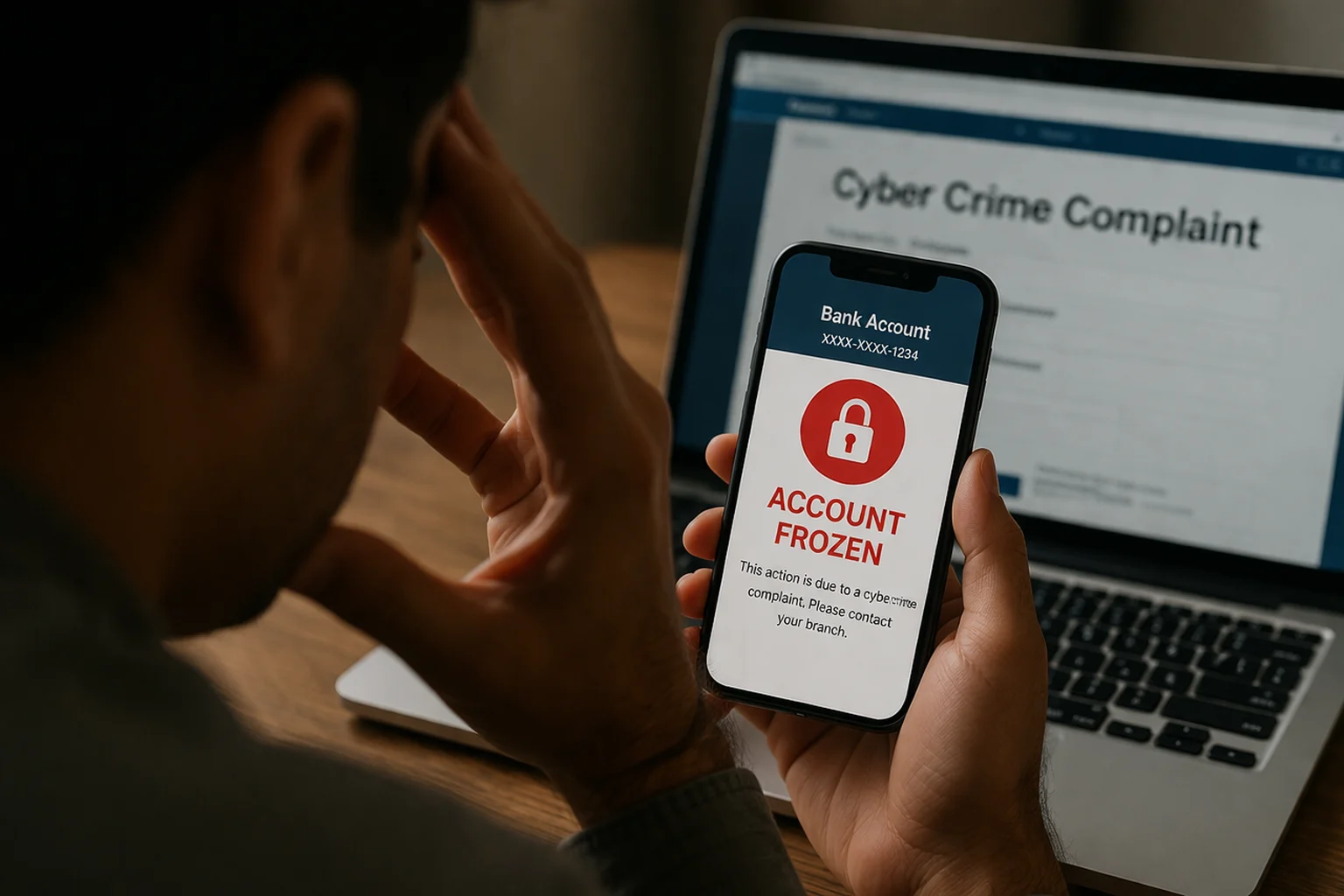
  • Why Is Your Bank Account Frozen Without Warning & How to Get It Back

    Why Is Your Bank Account Frozen Without Warning & How to Get It Back

    Your UPI stops working. Bank app shows “Debit Freeze Applied.” No warning. No reason. Money stuck. EMIs failing.

    You are not alone. Thousands of Indians are facing this right now — and most of them have done nothing wrong.

    This guide tells you exactly what to do, step by step.

    Why Was Your Account Frozen?

    When someone reports a cyber fraud, police trace the money. Every account in that chain gets frozen — including accounts of innocent people.

    Common reasons your account got caught:

    You sold something on OLX and the buyer’s money turned out to be fraud money.

    You did a P2P crypto trade (like selling USDT on Binance) and the buyer used stolen funds.

    Someone asked you to receive and forward money for commission — that money was stolen. You became a money mule without knowing.

    A scammer routed a small amount through your UPI to confuse the money trail.

    Important: The freeze is an investigative measure, not a punishment. But it can continue until the investigating authority lifts it or a court orders otherwise. It will not go away on its own — you have to act.

    What Happens When Your Bank Account Is Frozen in India?

    Debit Freeze (most common):

    • You cannot send money, withdraw cash, or use your debit card
    • But salary and other credits can still come in
    • You just cannot touch any of it

    Complete Freeze (rare):

    • Nothing goes in, nothing comes out
    • Even salary stops

    Your bank will not tell you the full reason. They will just say “law enforcement direction.” You need to dig deeper yourself.

    Step 1: Visit Bank Branch to Check Why Your Account Was Frozen

    Do not waste time calling the helpline. Go to the branch in person with your Aadhaar and PAN.

    Ask for these details in writing:

    • Why was the account frozen?
    • Which police station or cyber cell ordered the freeze?
    • What is the FIR or complaint number?
    • Is it a debit freeze or complete freeze?

    Do not leave without this information. Banks may share basic details like the freezing authority and complaint number, but full details may be limited due to investigation confidentiality. Push for whatever they can share.

    Step 2: Contact the Cyber Cell That Ordered the Freeze

    Now that you know which police station or cyber cell froze your account, contact them.

    • If the cyber cell is in your city: Visit in person. Bring your bank statements, ID proof, and any evidence that your transactions were genuine (invoices, receipts, exchange records).
    • If the cyber cell is in another state: Call them. Send a written letter by speed post. Follow up by email.

    What to tell them:

    “My account has been frozen under complaint number [X]. I am not involved in any fraud. I am attaching my bank statements and transaction records showing that my transactions are legitimate. Please verify and issue an NOC to unfreeze my account.”

    Keep it simple. Keep it polite. Keep it documented.

    Step 3: Submit a Formal Written Representation

    Write a letter to the Investigating Officer (IO) and the SP (Cyber Cell). Include:

    • Your full name, address, and occupation
    • Bank name, branch, account number, and IFSC
    • The complaint/FIR number linked to the freeze
    • A clear statement that you are not involved in the crime
    • Supporting documents (bank statements, invoices, crypto trade records)
    • A request to issue an NOC for de-freezing

    Send this by registered post or speed post. Keep the receipt. This creates a paper trail.

    Step 4: Get the NOC and Submit to Bank

    If the IO is satisfied that you are innocent, they will issue a No Objection Certificate (NOC).

    Take this NOC to your bank branch manager. After verification, your account is usually unfrozen within 3 to 7 working days.

    This is the fastest route. But many IOs take time, especially in inter-state cases.

    Step 5: If the IO Does Not Respond — Go to Court

    If the IO ignores you or refuses the NOC, you have legal options.

    Option A: File application before the Magistrate

    You can file an application before the Magistrate for release or de-freezing of your account. The Magistrate can examine if the freeze was lawful and order it to be lifted.

    Option B: File a Writ Petition in High Court

    File under Article 226 of the Constitution. Argue that the freeze violates your right to livelihood (Article 21) and right to business (Article 19(1)(g)).

    You will need a lawyer for both options. A cyber crime lawyer is ideal.

    What Courts Have Said in 2026

    Several High Courts in India have recently spoken up against the common practice of freezing entire bank accounts and have ruled in favour of innocent account holders.

    • On freezing full accounts: courts have said that if only a small amount of disputed money passed through your account, freezing the whole balance is unfair. Only that specific amount should be held, not everything you have.
    • On police powers: Multiple courts have questioned whether police can freeze accounts on their own without any order from a judge. They have stressed that proper legal process must be followed.
    • On innocent account holders: Courts have made it clear that someone who is not an accused or even a suspect should not have to suffer endlessly just because fraud money moved through their account for a short time.
    • What this means for you: If your full account has been frozen over a small disputed amount and no proper legal procedure was followed, you have the right to challenge it in court. Talk to a lawyer who understands these recent rulings.”

    How Long Does Unfreezing Take?

    RouteEstimated Timeline
    NOC from IO → Bank3 to 7 working days
    Magistrate application2 to 6 weeks
    High Court writ petition1 to 3 months (interim relief possible in days)

    These are approximate timelines. Actual duration varies depending on the case, location, and response from authorities.

    The faster you act, the faster you get your money back.

    Do NOT Do These Things

    • Do not approach middlemen who promise to unfreeze your account for a fee. They are scammers.
    • Do not ignore the freeze. It will not resolve on its own. Ever.
    • Do not open a new account and try to route frozen funds through it. This creates more legal trouble.
    • Do not fight with bank staff. They are following orders. Your fight is with the investigating authority.

    Also Read: KYC Scam in India: Fake Bank Messages That Are Stealing Your Money

    How to Prevent This from Happening

    • Never receive and forward money for strangers. If someone offers you commission to let money flow through your account — say no.
    • Be careful with P2P crypto trades. Verify the buyer. Avoid large trades with unknown parties.
    • Do not share your bank details with anyone. No real employer needs your personal account.
    • Check before you transact. Got a suspicious link, UPI ID, or QR code? Verify it on ScamDekho first. 10 seconds can save you months of trouble.
    • Monitor your account. If you see any unknown credits, report to your bank and call 1930 immediately.

    When Should You Hire a Lawyer?

    • Account frozen for more than 2 weeks and IO not responding
    • Complaint filed in a different state
    • Amount involved is above ₹1 lakh
    • You received a legal notice or summons

    A cyber crime lawyer knows the latest court rulings and can file the right applications fast.

    Conclusion

    The experience of having your bank accounts frozen due to cyber crime can be frustrating and unfair, especially when you have done nothing wrong. However, the good thing is that this problem can be solved if the right process is taken. From calling your bank and cyber cell to obtaining the NOC or going to the court, all these steps are important in unfreezing your accounts.

    The most important thing is to remain calm and avoid any shortcuts that might come your way. The most important thing in all this is that this experience should be taken as a lesson and that one should be careful with online transactions and P2P transactions. The experience of having your accounts frozen is just that—a hurdle that needs to be passed.

    Bank account frozen? Act fast. Follow these steps. Do not wait for it to fix itself.

    Frequently Asked Questions

    Can my account be frozen without any notice?

    Yes. In cybercrime cases, police can freeze accounts without notifying you first. They are expected to inform the Magistrate as per legal procedure. If proper procedure was not followed, the freeze may be legally questionable.

    My account is frozen but I am not accused. Is this legal?

    Courts have ruled this is disproportionate and arbitrary. You have strong grounds to challenge it.

    Can I still receive salary in a frozen account?

    In a debit freeze — yes. Credits come in, but you cannot withdraw. In a complete freeze — nothing moves.

    How do I find which police station froze my account?

    Go to your bank branch and ask. Banks can usually share the freezing authority’s name and complaint reference number, though they may not disclose all investigation details.

    Can I open a new bank account?

    Yes. The freeze is on the specific account, not on you. But do not transfer frozen funds to the new account.

    The complaint is from another state. What do I do?

    This is tricky. Contact the IO by phone and letter. If no response, consult a local lawyer who can file an application before your Magistrate or approach the High Court.

  • Fake Aadhaar PAN Update Scam India 2026: How to Protect Yourself

    Fake Aadhaar PAN Update Scam India 2026: How to Protect Yourself

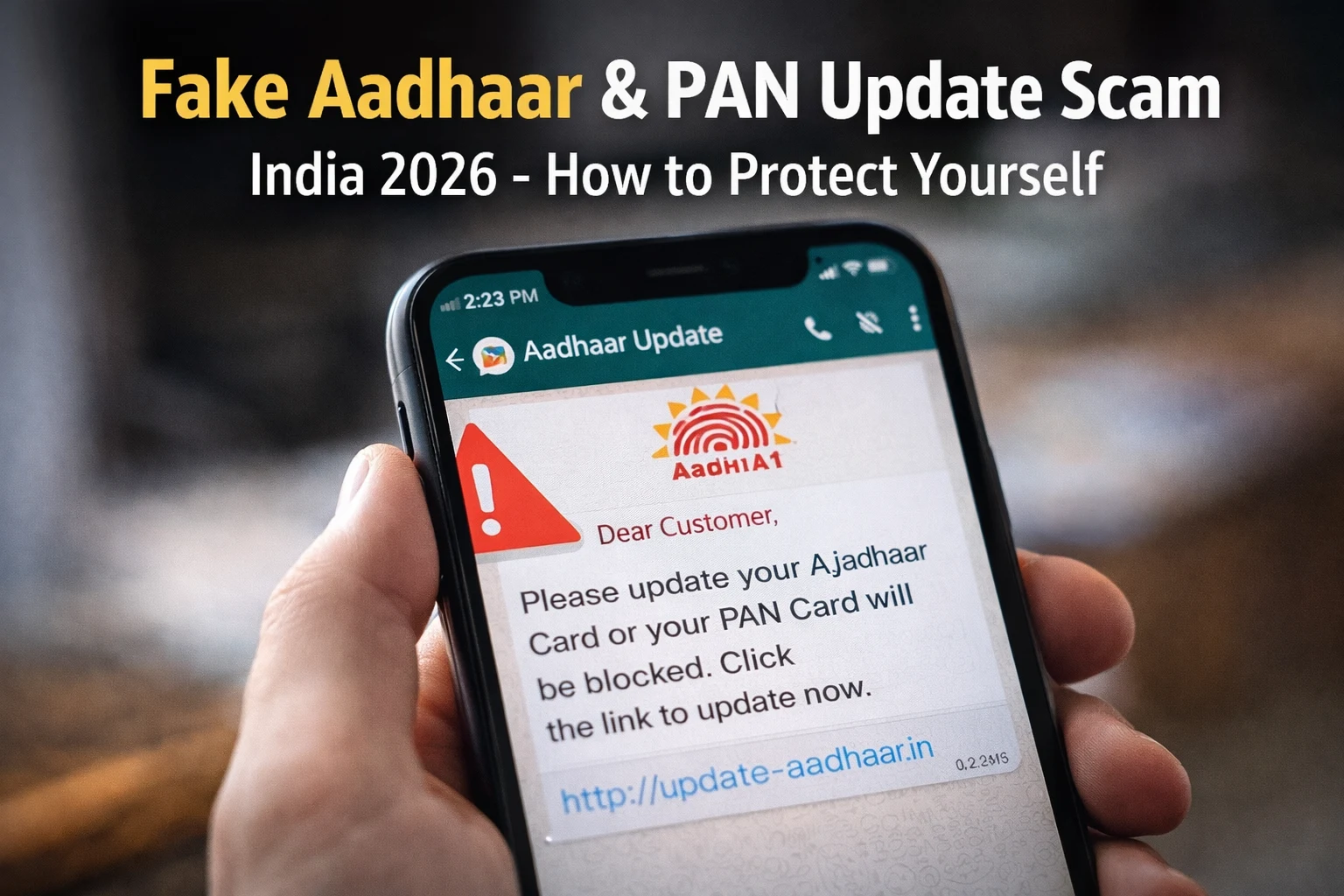
    A WhatsApp message arrives on your phone. It says:

    “Dear Customer, your Aadhaar card details need to be updated immediately. Failure to do so will result in your bank account being blocked. Click here to update now.”

    It looks official. It has the UIDAI logo. The language sounds formal. And you are worried.

    This is exactly what scammers want.

    In January 2026, the Press Information Bureau (PIB) officially confirmed that a message circulating in the name of SBI was completely fake. The message claimed that users must download an APK file to update their Aadhaar or their YONO banking app would be blocked. PIB stated clearly: SBI does not ask customers to update Aadhaar through unsolicited messages or APK downloads. Thousands of people had already received this message before the fact-check was issued.

    This scam — the fake Aadhaar and PAN update scam — is one of the most dangerous and widespread frauds in India right now. Here is everything you need to know to protect yourself.

    How the Fake Aadhaar and PAN Update Scam Works

    Scammers don’t just guess — they have a playbook. Every method they use is carefully designed to make you panic and act fast, before you have a chance to think clearly.

    Method 1: Fake WhatsApp Messages

    You get a WhatsApp message saying your Aadhaar needs to be updated right now or your account will be blocked. There’s a link attached. You click it, and the website looks completely real — same UIDAI logo, same colors, same layout. But the moment you type in your Aadhaar number and OTP, a scammer on the other end is watching. Your details are gone in seconds.

    Method 2: Fake Phone Calls

    Your phone rings. The person on the other end sounds official — they say they’re calling from UIDAI, your bank, or the Income Tax Department. They tell you your Aadhaar is linked to suspicious activity, or that your PAN card has been misused. They sound calm, professional, even concerned. All they need, they say, is your Aadhaar number and OTP to “verify” your identity. The moment you share that OTP, they’re inside your bank account.

    Method 3: Fake APK Files

    A message arrives — sometimes on WhatsApp, sometimes SMS — telling you to download an app to update your Aadhaar. It’s not from the Play Store. It’s an APK file, a raw app file you install directly. Once it’s on your phone, you won’t notice anything different. But quietly, in the background, it’s reading your SMS messages, stealing your OTPs, and giving scammers a window into your banking apps.

    Method 4: Fake Aadhaar Centers

    This one is scarier because it happens in person. In Aligarh, Uttar Pradesh, police busted a network that had created over 5,000 fake Aadhaar cards in just six months. These people set up what looked like legitimate Aadhaar registration centers. They had fake certificates on the walls. They charged a small fee and promised faster service. Thousands of people walked in trusting them completely. It got so serious that UIDAI had to personally audit 47 Jan Seva Kendras across the district.

    What Happens After You Fall for This Scam

    This is not just about losing money in one transaction. The consequences can be much worse.

    Once scammers have your Aadhaar number and OTP, they can open bank accounts in your name, apply for loans you never took, get new SIM cards registered to your identity, perform AePS (Aadhaar Enabled Payment System) transactions to withdraw money directly from your bank account, and use your identity to commit other crimes — leaving you legally exposed.

    UIDAI has confirmed that there have been multiple cases where criminals misused leaked Aadhaar biometric data to withdraw money through AePS by replicating fingerprints using compromised biometric devices.

    Check: Fake Loan App Scam India: How to Identify Them and Protect Yourself

    6 Red Flags to Identify a Fake Aadhaar or PAN Update Scam

    1. Any message asking you to update your Aadhaar via WhatsApp or SMS

    UIDAI has said this clearly and repeatedly — it never asks you to submit documents or update your Aadhaar through WhatsApp or email. Full stop. If you need to update anything, the only places to do it are myaadhaar.uidai.gov.in, the mAadhaar app, or by visiting an Aadhaar Seva Kendra in person. Anything else is a scam.

    2. A link in a message that looks like UIDAI’s website

    Before you click anything, look at the URL closely. The only real UIDAI website is uidai.gov.in. Scammers create sites like uidai-update.in or aadhaar-verify.com that look identical at first glance. One extra word, one hyphen, one dot out of place — and it’s fake. When in doubt, don’t click. Open your browser and type the address yourself.

    3. Someone on the phone asking for your OTP

    This is the simplest rule to remember. No government agency, no bank, no legitimate organization will ever ask for your OTP over a call. Not once, not ever. The moment someone asks for your OTP — hang up. Don’t explain, don’t argue, just hang up.

    4. A message warning your account will be blocked unless you act immediately

    That panic you feel when you read those words? That’s exactly what the scammer is counting on. Real banks and UIDAI don’t send threatening WhatsApp messages with countdown timers. They send formal notices through proper channels. If a message is designed to scare you into acting fast, slow down instead.

    5. A request to download an APK file

    If someone sends you an app file through WhatsApp or SMS and asks you to install it, do not touch it. Legitimate apps are on the Google Play Store or Apple App Store — that’s it. An APK file sent through a chat message is almost always malware, and once it’s installed, you may not even know it’s there.

    6. Anyone offering to update your Aadhaar for a fee

    Basic Aadhaar updates online are completely free. UIDAI offers this directly on their website. So if a person, a shop, or a “center” is charging you money to update your Aadhaar through some unofficial process, they are scamming you. Pay nothing, share nothing, and walk away.

    Know More: SIM Swap Scam India: What It Is, Warning Signs and How to Stay Safe

    How to Verify Your Aadhaar Safely — Official Methods Only

    If you genuinely need to update or verify your Aadhaar, use only these official channels:

    • Online: Visit myaadhaar.uidai.gov.in — this is the only official portal. Do not trust any other website.
    • App: Download the mAadhaar app from the Google Play Store or Apple App Store. Do not install any APK sent via message.
    • In person: Visit your nearest Aadhaar Seva Kendra or post office that is officially authorized by UIDAI.
    • To verify if your Aadhaar is being misused: Go to the UIDAI Authentication History page on uidai.gov.in. Enter your Aadhaar number and OTP to check all recent authentication activity. If you see any activity you did not initiate, report it immediately.
    • To lock your Aadhaar biometrics: You can lock your fingerprint and iris data on the mAadhaar app or the UIDAI website. This prevents anyone from using your biometrics for AePS transactions without your permission.

    How to Verify Your PAN Card

    For PAN-related fraud or verification, use only these official sources:

    The official Income Tax Department portal is incometax.gov.in. You can verify your PAN status, check if your PAN is linked to your Aadhaar, and report misuse directly on this site.

    The official NSDL portal for PAN services is tin.tin.nsdl.com.

    If someone calls claiming your PAN is linked to illegal activity, do not share any details. Hang up and call the Income Tax helpline at 1800-180-1961 to verify.

    If You’ve Already Shared Your Details, Do This Right Now

    First — don’t panic. Panicking is what the scammer is counting on, and it won’t help you here. What will help you is moving fast and in the right order.

    Step 1: Lock your Aadhaar biometrics

    Do this before anything else. Open the mAadhaar app or go to uidai.gov.in and lock your fingerprint and iris data immediately. Once locked, nobody can use your biometrics to withdraw money from your account through AePS — even if they already have your Aadhaar number. This one step can stop a lot of damage before it starts.

    Step 2: Call your bank

    Call your bank’s customer care right after. Don’t visit the branch, don’t send an email — call, because it’s faster. Tell them exactly what happened and ask them to flag your account for suspicious activity and block any new UPI registrations linked to your number.

    Step 3: Call 1930

    This is India’s Cyber Crime helpline and it exists exactly for situations like this. The sooner you call, the better your chances of recovering any money that was taken. Have the details ready — what you shared, with whom, and when.

    Step 4: File a complaint at cybercrime.gov.in

    Go to cybercrime.gov.in and file a written complaint. Include everything — the phone number that contacted you, the exact message you received, any links you clicked, and screenshots if you have them. The more detail you provide, the stronger your case.

    Step 5: Visit your nearest cyber cell

    Take printed copies of everything — screenshots, messages, call logs — and go to your nearest cyber cell police station to file a formal report. This creates an official record that can protect you legally if the scammer has done something in your name.

    Step 6: Check your credit report

    Go to cibil.com and pull your credit report. Look carefully for any loans, credit cards, or accounts you didn’t open. If you find anything suspicious, dispute it immediately. Catching this early is the difference between a small problem and a years-long legal headache.

    You can also check any suspicious link, UPI ID, or message on ScamDekho for free before acting on it.

    FAQ

    Can someone steal money just with my Aadhaar number?

    Your Aadhaar number alone is not enough to steal money. However, if someone has your Aadhaar number plus your OTP plus access to your biometrics, they can perform AePS transactions to withdraw cash directly from your bank account. Never share your OTP with anyone.

    Does UIDAI ever call or message asking for Aadhaar updates?

    No. UIDAI never calls, messages, or emails you asking for documents or OTPs to update your Aadhaar. Any such communication is a scam.

    How do I check if my Aadhaar is being misused?

    Go to uidai.gov.in, go to the Authentication History section, enter your Aadhaar number, and verify with OTP. You will see all recent authentication activity. If anything looks unfamiliar, lock your biometrics and report to UIDAI immediately.

    Is it safe to share my Aadhaar photocopy?

    When sharing a photocopy of your Aadhaar, always write “For KYC only at [name of organization] — date” on it. Use a masked Aadhaar where only the last 4 digits are visible. Download masked Aadhaar from myaadhaar.uidai.gov.in.

    What should I do if I receive a suspicious Aadhaar update message?

    Do not click any links. Do not call any number given in the message. Do not download any files. Report the message to cybercrime.gov.in or call 1930. You can also report it to UIDAI at help@uidai.gov.in or call 1947.

    Can my PAN be misused without my knowledge?

    Yes. If a scammer has your PAN number and other personal details, they can apply for loans or open accounts in your name. Check your credit report at cibil.com every few months to catch any unauthorized activity early.

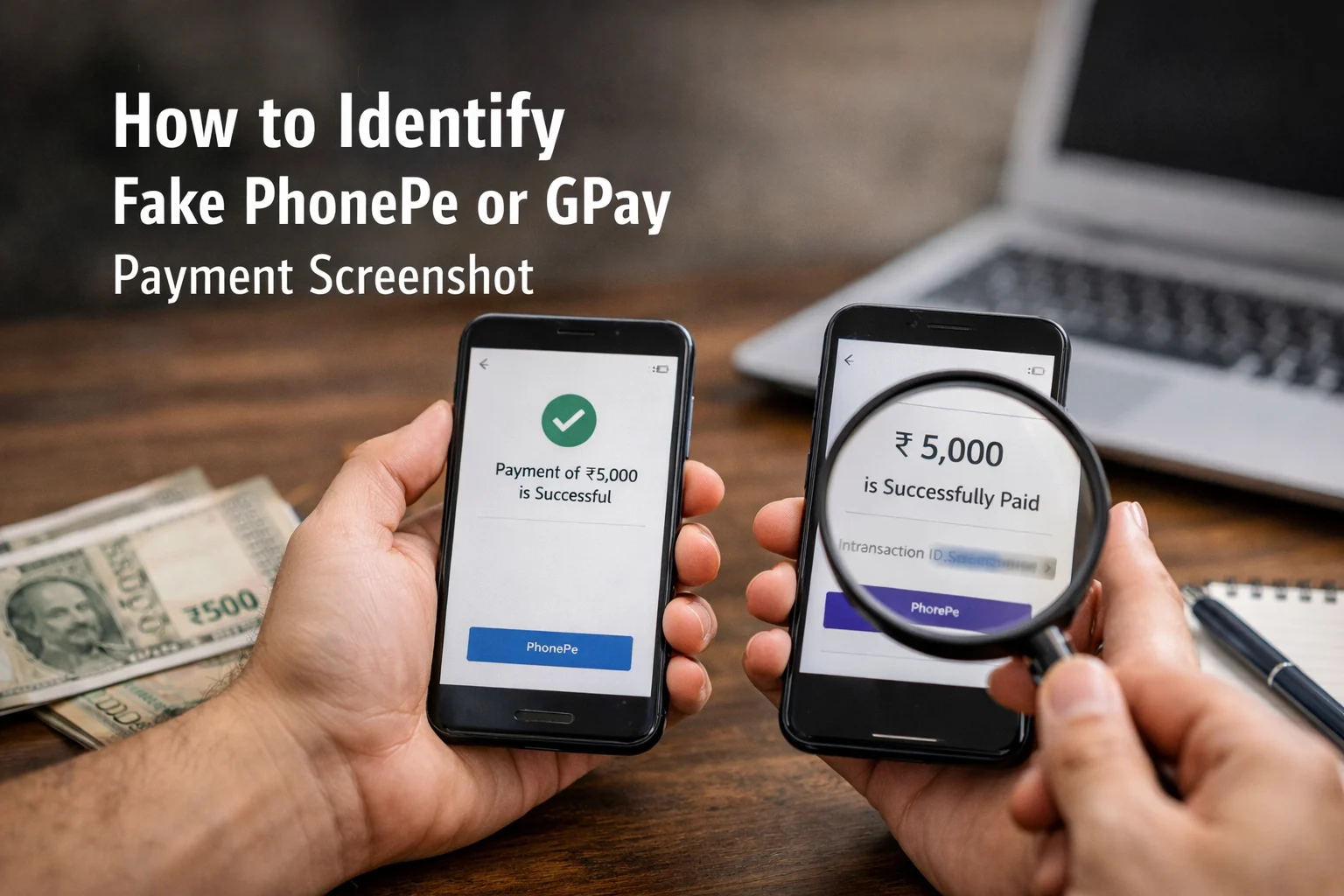
  • Fake PhonePe Screenshot: 7 Ways to Catch It Before You Lose Money

    Fake PhonePe Screenshot: 7 Ways to Catch It Before You Lose Money

    A man checked into a luxury hotel in Gurugram in October 2025. He stayed for four months. He paid nothing.

    Every week, he sent fake PhonePe screenshots to the hotel manager on WhatsApp — 16 fake payment confirmations totalling over ₹6 lakh. The hotel staff trusted each one. When the accounts were finally checked in February 2026, the bank showed zero credit.

    The man had learned how to use a fake PhonePe app from a YouTube video.

    This is not an isolated case. According to government data presented in Parliament, UPI fraud cases in India crossed 10.64 lakh incidents in FY26 alone, with total losses reaching ₹805 crore. Shopkeepers, petrol pump owners, grocery stores, and small businesses are the primary targets.

    The good news: once you know what to look for, fake screenshots are surprisingly easy to catch.

    How Does the Fake PhonePe or GPay Screenshot Scam Work?

    Scammers use two main methods:

    Method 1: Edited Screenshots The scammer takes a real payment screenshot and edits it using photo editing apps — changing the amount, name, or transaction ID. These are often done quickly and contain small mistakes.

    Method 2: Fake UPI Apps (More Dangerous) Scammers install modified APK files — fake versions of PhonePe, GPay, or Paytm downloaded from unofficial websites. These apps look identical to the real ones. They even play a payment success sound. But they never connect to any bank. No money is ever sent.

    In Indore, Madhya Pradesh, two people visited multiple petrol pumps claiming they needed emergency cash. They showed fake PhonePe payment screens and walked away with money. The scam was repeated across several outlets before they were caught.

    Both methods have one thing in common: they exploit your trust in what you see on a screen.

    Check: How to Report a Cyber Crime in India

    7 Ways to Identify a Fake PhonePe or GPay Payment Screenshot

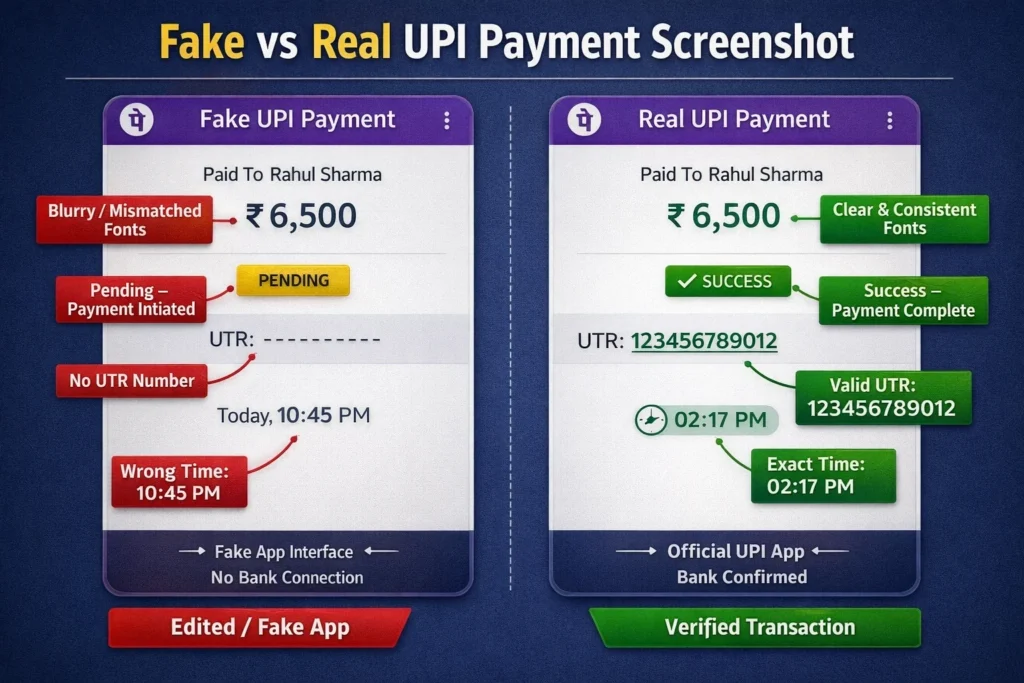
    Fake vs real UPI payment screenshot comparison showing how to identify fake PhonePe or Google Pay transactions

    1. Always Check Your Own App — Not Their Screen

    This is the only rule that matters.

    Open your PhonePe, GPay, or Paytm app and go to your transaction history. If the payment happened, it will appear there immediately. UPI payments are instant — there is no delay.

    If you do not see the payment in your own app, the money has not arrived. Full stop.

    Never accept a screenshot as proof. A screenshot only shows what was on their phone — not what happened in the banking system.

    If you are unsure about any UPI ID or payment, check it on ScamDekho for free, no login required.

    2. Ask for the UTR Number

    Every real UPI payment generates a UTR (Unique Transaction Reference) number — a 12-digit code assigned by the bank when a transaction is completed.

    Ask the customer: “Can you show me the transaction details page with the UTR number?”

    A real customer can pull this up in two seconds by tapping on the payment in their app. A scammer almost never has this — because no real transaction occurred, no UTR was generated.

    To verify: Open your own UPI app → Transaction History → Find the payment → Check if the UTR matches.

    3. Look for These Red Flags in the Screenshot

    If someone shows you a screenshot, check carefully:

    • Font inconsistency — Is the font for the amount the same as the font for the date and name? Editing apps often use slightly different fonts.
    • Blurry edges — Look around the numbers and text. Edited text often has slightly blurry or pixelated edges.
    • Wrong timestamp — Does the time on the screenshot match when the customer arrived? A screenshot from an hour ago is suspicious.
    • “Pending” status — Some fake screenshots show “Payment Initiated” or “Processing” — this is not a completed payment.
    • Receiver name mismatch — The “Paid to” name should match your registered UPI name exactly. If it shows a different name or is blank, it is fake.

    4. Tap the Screen — Does It React?

    This works when someone shows you their phone directly instead of a screenshot.

    Ask them to tap on the payment notification. A real payment on a live app will respond — it will open the transaction details or show interactive elements.

    A fake screenshot is just an image. When tapped, it will either do nothing or open the phone’s photo gallery. This immediately reveals it is not the real app.

    5. Check the Soundbox — But Don’t Rely On It Alone

    Many shopkeepers use UPI soundboxes. These are helpful — but not foolproof.

    Some advanced fake UPI apps can trigger a payment confirmation sound on the customer’s phone that resembles a soundbox alert. There have also been cases where network delays caused soundbox notifications to fire even when a real payment failed.

    Use the soundbox as a first alert — but always confirm in your own app before handing over goods.

    6. Never Accept “I’ll Show You the Bank SMS”

    Scammers have also been found using fake SMS notifications that mimic official bank messages — copying the exact sender ID format used by banks.

    The only valid proof is what appears in your own UPI app or bank account. SMS from the customer’s phone is not your proof.

    7. For Large Payments — Always Call Your Bank

    For transactions above ₹5,000, call your bank’s customer care or check net banking before completing the sale. This takes 60 seconds and can save you thousands.

    What to Do If You Already Accepted a Fake Payment

    Act fast. Here is what to do immediately:

    Step 1: Note down everything Write down the customer’s name, phone number, vehicle number if visible, and the time of the transaction.

    Step 2: Call 1930 immediately This is India’s official Cyber Crime helpline. Early reporting significantly increases the chances of recovery.

    Step 3: File a complaint online Visit cybercrime.gov.in and file a complaint under “Financial Fraud.” Attach any screenshots, CCTV footage, or communication you have.

    Step 4: Visit your nearest Cyber Cell Bring all evidence — your transaction history, the fake screenshot if you saved it, and any customer details.

    Step 5: Inform your bank If the scammer also has your UPI ID or account details, inform your bank immediately to flag suspicious activity.

    How to Protect Your Shop Going Forward

    These simple habits will protect you from almost every fake UPI screenshot scam:

    • Put up a sign at your counter: “Payment confirmed only after bank credit — screenshots not accepted”
    • Always verify in your own app before handing over goods or cash
    • Train every staff member — not just yourself — to follow this rule
    • Use a soundbox but treat it as an alert, not final confirmation
    • For large transactions, wait for the bank SMS to arrive on your own phone

    FAQ

    Can a fake PhonePe screenshot look exactly like a real one?

    Yes. Fake UPI apps are designed to copy the exact colors, fonts, animations, and sounds of real apps. Without checking your own transaction history, it is very difficult to tell the difference just by looking.

    Is using a fake payment screenshot illegal in India?

    Yes. Using a fake payment screenshot to obtain goods or services is treated as cheating and fraud under Indian law — including IPC Section 420 and relevant provisions of the IT Act. The Gurugram hotel case led to a criminal arrest.

    What is a UTR number and how do I verify it?

    UTR stands for Unique Transaction Reference. It is a 12-digit number generated for every real UPI payment. To verify: open your UPI app → transaction history → tap on the transaction → look for the UTR or reference number. If no matching UTR exists in your records, the payment did not happen.

    Can fake apps trigger the payment sound on my soundbox?

    Some advanced fake apps can play a payment confirmation sound. Always verify in your own app regardless of what sound plays.

    What should I do if a customer gets aggressive when I ask to verify?

    A genuine customer will never object to you taking 30 seconds to verify a payment. Aggression or excessive urgency is itself a red flag. Politely but firmly wait for confirmation before completing the transaction.

    How do I report a fake UPI payment scam in India?

    Call 1930 immediately or visit cybercrime.gov.in. You can also visit your nearest cyber cell police station with all evidence.

  • Fake Offer Letter Detection: How to Verify a Job Offer Letter Online Using Company Details

    Fake Offer Letter Detection: How to Verify a Job Offer Letter Online Using Company Details

    Fake job offer scams are growing at a rapid pace in India, targeting freshers, job seekers, and those interested in work-from-home jobs. With the advent of online job portals and work-from-home jobs, scammers have developed new techniques to dupe people with the help of fake job offer letters, which resemble original job offer letters.

    In many cases, job seekers receive job offer letters without undergoing the interview process. Even in some cases, the job seeker is asked to pay the registration fees before joining the company. Unfortunately, the job seeker comes to know about the scam only after losing the money and divulging their personal details.

    This is where fake offer letter detection becomes extremely important. Learning the techniques to check the authenticity of the job offer letter can help you stay away from these scams and take safe steps towards your career.

    In this article, we will guide you through the simple steps to be followed to check the authenticity of the job offer letter.

    Why Fake Offer Letter Detection Is Important Before Accepting Any Job Offer

    The time of accepting a job offer is the most exciting time for anyone. However, this is also the time scammers take advantage of your emotional state of mind, such as the need for urgency or the excitement of landing a job. Thus, you can easily fall into a trap that can cause you significant financial and personal damages.

    The following are the reasons why verifying your offer letter is essential:

    1. Prevent Financial Loss

    The scammers often ask for money in the name of security deposits, verification of your documents, or even training. Once they receive the money, they simply vanish into thin air. Thus, it is essential to verify your offer letter to avoid such financial damages.

    2. Protect Personal Information

    The scammers often ask for your personal information in the name of the company. They can ask for your Aadhaar card, PAN card, or even your bank account information. Thus, it is essential to verify your offer letter to avoid such damages.

    3. Avoid Career Setbacks

    The scammers often lure you into believing in a fake job offer. Thus, you can easily waste weeks or even months of your life on a fake job offer. Thus, it is essential to verify your offer letter to avoid such damages.

    4. Stay Safe from Legal Trouble

    The scammers often use your information for doing illegal activities. Thus, it is essential to verify your offer letter to stay safe from legal troubles. Understanding the detection of a fake offer letter can help you stay safe from such damages.

    Step 1: Check the Company’s Official Website & Domain for Fake Offer Letter Detection

    The first and most basic step is to verify whether the company actually exists and whether the communication is coming from the official domain.

    What You Should Do:

    • Visit the company’s official website
    • Check if the domain name matches the email sender
    • Look for pages like “Careers,” “About Us,” and “Contact”

    Example:

    If the company is “ABC Pvt Ltd,” their official email should look like: hr@abc.com

    Red Flags:

    • Email from Gmail/Yahoo/Outlook
    • Slightly modified domain (e.g., abc-careers.net)
    • No official website or incomplete website

    A genuine company always uses a professional domain. This step alone can help you eliminate many fake offers.

    Step 2: Verify HR Email Address (Red Flag Guide for Fake Offer Letter Detection)

    Scammers often create email addresses that look similar to real ones. At first glance, they may seem legitimate, but small differences can reveal the truth.

    Legitimate Email Format:

    • hr@company.com
    • careers@company.com

    Warning Signs:

    • Extra letters or numbers (hr.company123@gmail.com)
    • Misspelled domain names
    • Use of free email services

    Pro Tip:

    Carefully read the email address letter by letter. Even a small spelling mistake can indicate fraud.

    This step is critical because most fake job scams start with email communication.

    Step 3: Search the Company on Google & LinkedIn to Detect Fake Offer Letters

    Before trusting any job offer, always research the company online.

    What to Check:

    • Google search results
    • LinkedIn company profile
    • Employee profiles
    • Reviews on platforms like Glassdoor

    Signs of a Genuine Company:

    • Active website
    • Verified LinkedIn page
    • Real employees listed

    Red Flags:

    • No online presence
    • Recently created LinkedIn page with no activity
    • No employee profiles

    If a company doesn’t exist online, it’s highly suspicious. Most real companies maintain a digital presence.

    Step 4: Cross-Check Offer Letter Format & Details Carefully

    A genuine offer letter follows a proper structure and contains specific details. Fake ones often have errors or missing information.

    A Real Offer Letter Includes:

    • Company logo and address
    • Candidate name and job role
    • Salary structure
    • Joining date
    • Terms and conditions
    • HR contact details

    Red Flags:

    • Poor grammar or spelling mistakes
    • No official letterhead
    • Unrealistic salary offers
    • No contact information
    • Asking for payment

    Example:

    If you’re offered ₹50,000/month for a basic role without an interview, it’s likely a scam.

    This step helps you quickly identify inconsistencies and perform a basic fake offer letter check.

    Step 5: Contact the Company Directly to Confirm Offer Letter Authenticity

    This is the most reliable way to verify an offer letter.

    What You Should Do:

    • Visit the official website
    • Find the official contact number or email
    • Ask the company to confirm your offer letter

    What Happens Next:

    • If the offer is real → they will confirm
    • If fake → they will deny and may warn you

    Pro Tip:

    Never rely only on the contact details mentioned in the offer letter. Always use official sources.

    This step gives you 100% clarity and removes all doubts.

    Common Mistakes People Make During Fake Offer Letter Detection

    Many people fall for scams because of simple mistakes. Avoiding these can save you from fraud.

    1. Trusting Without Verification

    Just because an offer letter looks professional doesn’t mean it’s real.

    2. Paying Money for Job Confirmation

    No genuine company asks for money.

    3. Ignoring Email Red Flags

    Small domain differences are often ignored.

    4. Skipping Company Research

    Not checking LinkedIn or Google is a big mistake.

    5. Acting in Urgency

    Scammers create pressure to make quick decisions.

    Always take your time and verify everything properly.

    Also Read: Fake Offer Letters in the Name of Google, Amazon And Infosys — Real Examples

    What to Do If the Offer Letter Is Fake (Action Guide)

    If you realize that your offer letter is fake, don’t panic. Take the following steps:

    1. Stop Communication

    Immediately stop replying to emails or messages.

    2. Do Not Pay Any Money

    Avoid any financial transactions.

    3. Report the Scam

    You can report it on India’s cybercrime portal.

    4. Save Proof

    Keep emails, screenshots, and documents as evidence.

    5. Inform Others

    Warn friends and family to prevent further scams.

    Taking quick action can help prevent further damage.

    Extra Tips for Safe Job Hunting in India

    To stay safe while applying for jobs, follow these additional tips:

    • Apply only through trusted job portals
    • Avoid unknown WhatsApp job offers
    • Never share OTPs or banking details
    • Verify recruiters before responding
    • Trust your instincts—if it feels suspicious, it probably is

    Being cautious is the best defense against scams.

    Conclusion

    However, these fake job scams are becoming very sophisticated. Still, it is possible to identify them by performing simple checks and being aware of them.

    Detection of fake offer letters is an essential skill for every job seeker in today’s competitive world. Not only will it save your hard-earned money, but it will also save your precious information and career.

    Remember these three points:

    • Real companies will not ask for any money
    • Real companies will conduct interviews
    • Verification is better than regret

    Being aware and making smart decisions is very important for a bright career.

  • Mule Account Scam India: Your Bank Account Used for Fraud

    Mule Account Scam India: Your Bank Account Used for Fraud

    A stranger offers you ₹5,000. All you have to do is let them use your bank account for a few transactions. No hacking. No effort. Just easy money.

    Weeks later, your bank account is frozen. Police call you in for questioning. A cybercrime case is filed. And suddenly, you are not a victim. You are an accused.

    This is not a hypothetical situation. This is happening to thousands of Indians right now.

    It is called a mule account scam. And according to the India Fraud Report 2026, it is the number one fraud threat facing Indian businesses and individuals today.

    What Is a Mule Account?

    A mule account is a bank account that is used to receive and transfer money obtained through fraud. The account holder may or may not know that their account is being used for criminal activity.

    Scammers need these accounts because they cannot use their own. If stolen money goes directly into a scammer’s personal account, police can trace it immediately. So they route it through someone else’s account first. Sometimes through five or ten accounts in a chain. By the time the money reaches its final destination, the trail is so complex that tracking it becomes extremely difficult.

    The person whose account is used is called a “money mule.” In many cases, this person is an ordinary citizen who was either tricked into lending their account or knowingly rented it out for a small commission.

    Either way, the law treats you as part of the crime.

    How Big Is This Problem in India?

    The numbers are staggering.

    The India Fraud Report 2026, released on March 27, 2026, found that 48 percent of Indian enterprises now identify mule networks as the most difficult fraud threat to detect and control. This ranks higher than phishing, identity theft, account takeovers, and social engineering.

    Banking sector fraud losses have reached ₹36,014 crore according to the RBI Annual Report 2024-25.

    In just the last few weeks, multiple major mule account cases have been busted across the country.

    In Karimnagar, Telangana, police uncovered a mule account network that routed ₹137 crore through just 8 bank accounts. Thirteen people were arrested, including two bank employees who helped open the accounts. The accused had been luring innocent people by offering a 2 percent commission on deposits.

    In Mangaluru, police busted a USDT pipeline scam where over 70 mule bank accounts were used to route cybercrime money from India to China. The total amount involved was ₹85 crore. The stolen money was converted to Tether (USDT), a cryptocurrency, and transferred abroad. Only ₹13.43 crore could be frozen.

    In just three months — December 2025 to February 2026 — Karnataka police alone picked up 68 people running mule account networks. Behind those arrests? A staggering 869 bank accounts tied to nearly 8,800 cybercrime cases. And that is just one state. The reality is, this is not some scattered, small-time fraud. It is a full-blown industry, running like clockwork across every corner of India.

    How Do Scammers Recruit Mule Account Holders?

    Scammers have refined their recruitment methods to target specific groups of people. Understanding how they approach victims is the first step toward protecting yourself.

    1. The “Easy Money” Job Offer

    This is the most common method. You receive a message on WhatsApp, Telegram, or even a direct phone call. Someone offers you a simple deal: let them deposit money into your account and transfer it forward. You keep a commission, usually 1 to 5 percent per transaction.

    It sounds harmless. But every rupee passing through your account is stolen money from a fraud victim somewhere in India.

    2. The Fake Part-Time Job

    Some scammers disguise mule recruitment as a legitimate job. They post advertisements for “payment processing executives” or “finance assistants” on job portals. The job description involves receiving payments into your personal account and forwarding them to other accounts. No office. No interview. Just your bank details.

    By the time you realize the job is fake, your account has already processed lakhs of rupees in fraudulent transactions.

    3. Direct Purchase of Bank Accounts

    An investigation published in March 2026 revealed that a nationwide network is openly buying bank accounts from individuals for prices ranging from ₹5,000 to ₹3.5 lakh. The racket spans states like Madhya Pradesh, Bihar, and West Bengal.

    Agents approach people directly, especially in rural and semi-urban areas. They collect personal details, Aadhaar cards, PAN cards, and bank passbooks. In some cases, they even open new accounts in the victim’s name without fully disclosing the purpose.

    These accounts are then used to route money from phishing scams, investment frauds, digital arrest schemes, and other cybercrimes. Once the money enters, it is quickly withdrawn or moved through multiple layers, making recovery nearly impossible.

    4. Targeting Students and Unemployed Youth

    Students looking for pocket money and unemployed youth are prime targets. Scammers approach them on college campuses, through social media, or via local contacts. The pitch is always the same: “Just let some money come into your account. No risk. Easy cash.”

    Many of these young people do not understand that they are participating in money laundering. By the time police come knocking, the scammer is gone. The student is left holding the legal responsibility.

    What Happens When Your Account Is Used as a Mule?

    The consequences are severe and often come without warning.

    1. Your Bank Account Gets Frozen

    This is usually the first sign. When a fraud victim reports a cybercrime and police trace the money trail, every account in the chain gets flagged. Your account is frozen, meaning you cannot withdraw, transfer, or access your own money.

    Under Section 106 of the Bharatiya Nagarik Suraksha Sanhita (BNSS), 2023, police can seize or freeze any bank account suspected of being connected to a crime. The freeze can happen even if you are not directly accused. If the stolen money simply passed through your account, it can be locked.

    2. Police Investigation and Questioning

    Once your account is flagged, you will likely receive a call or notice from the cyber crime cell. You will be asked to explain every transaction, where the money came from, why you received it, and where it went.

    If your answers do not match the records, or if the investigating officer finds evidence that you knowingly participated, you could be arrested.

    3. Criminal Charges

    Depending on the case, mule account holders can be charged under multiple laws.

    Under the Bharatiya Nyaya Sanhita (BNS), 2023, Section 318 deals with cheating and dishonestly inducing delivery of property. If your account was used to move fraud money, this section applies.

    Section 111 of the BNS covers organized crime, which now explicitly includes cybercrimes and economic offences. If police can show that you were part of a network, even as a small link, you could face charges under this section. The penalties include life imprisonment for serious cases.

    Under the Information Technology Act, 2000, Sections 66C and 66D deal with identity theft and online cheating. These sections are commonly invoked in cybercrime investigations involving mule accounts.

    If the money was routed internationally or converted to cryptocurrency, the Prevention of Money Laundering Act (PMLA) may also apply.

    4. The Impact on Innocent People

    Here is the harsh reality. Your account can be frozen even if you had no idea it was being used for fraud. A 2025 judgment from the Delhi High Court noted that bank accounts of individuals who are neither accused nor suspects can still be frozen during cybercrime investigations.

    The court called blanket freezing of such accounts “arbitrary, disproportionate, and violative of Articles 19(1)(g) and 21 of the Constitution.” But despite such rulings, freezes continue to happen because the process moves faster than the legal safeguards.

    Merchants who accepted a payment from a fraud victim’s compromised account have had their accounts frozen. Freelancers who received a payment from a client whose account was later linked to a fraud chain have been caught up in investigations. Small business owners have lost access to their working capital for months.

    The investigation may eventually clear you. But the financial and emotional damage during that period can be devastating.

    How to Know If Someone Is Trying to Make You a Mule

    Scammers use specific language and patterns to recruit mule account holders. If you hear any of the following, treat it as a warning.

    “Just use your bank account for some transactions. You will get commission.”

    “We need your account to process client payments. This is a part-time job.”

    “Let me deposit some money in your account. Just transfer it where I tell you.”

    “Give me your bank details, Aadhaar, and PAN. I will open an account for business.”

    “No skills needed. No experience required. Just receive and send money.”

    “You will earn ₹500 to ₹5,000 per transaction. Easy work from home.”

    Any offer that asks you to receive money into your personal account and transfer it elsewhere without a clear, documented business reason is a mule recruitment attempt. No exceptions.

    What to Do If Your Bank Account Has Been Frozen

    If your account has already been frozen due to a cybercrime investigation, do not panic. There are legal steps you can take.

    Step 1: Find Out Why the Account Was Frozen

    Contact your bank immediately. Ask for the written reason for the freeze, the name of the authority that issued the order, and the FIR number or complaint number linked to the case. Under the law, you have the right to be informed of the reason for the freeze and the authority behind it.

    Step 2: Contact the Investigating Officer

    Reach out to the cyber crime cell handling the case. Provide all documents that prove your transactions were legitimate. This includes business invoices, employment records, contracts, or any other proof that the money entering your account was from a lawful source.

    Step 3: Submit a Representation to the Magistrate

    Under Section 106(3) of the BNSS, police are required to report any account seizure to the jurisdictional Magistrate immediately. If they have not done so, the freeze itself is legally vulnerable.

    You can file an application under Section 503 of the BNSS (return of property) before the Magistrate. The Magistrate has the authority to examine whether the freeze was lawful and order de-freezing if it was not.

    Step 4: File a Writ Petition if Needed

    If the freeze continues despite your representation, you can file a writ petition before the High Court under Article 226 of the Constitution. Multiple High Courts have recently ordered de-freezing of accounts where the freeze was done without proper procedure.

    The Delhi High Court in February 2026 held that police authorities have no power under Section 106 of the BNSS to debit-freeze or attach bank accounts. Such action can only be ordered under Section 107 by a competent Magistrate.

    Step 5: Consult a Cyber Crime Lawyer

    If the amount involved is significant or if you are facing criminal charges, consult a lawyer who specializes in cybercrime and financial fraud cases. Early legal intervention can prevent the situation from escalating.

    Check: How to Recover Money Lost in Online Scam in India (Step-by-Step Guide 2026)

    How to Protect Yourself from Becoming a Money Mule

    Prevention is far easier than dealing with the aftermath. Follow these rules.

    • Never share your bank account, UPI ID, or internet banking credentials with anyone. No legitimate job or business requires access to your personal bank account for processing payments.
    • Never agree to receive and forward money for anyone. Even if the person is a friend, relative, or someone you met online. If the money is stolen, you are legally responsible.
    • Do not open bank accounts on behalf of others. If someone asks you to open an account using your documents for “business purposes,” refuse. You will be the legal owner, and all liability falls on you.
    • Verify any job offer that involves handling money. If a job posting asks you to process payments through your personal account, it is a scam. Legitimate companies use corporate accounts and registered payment gateways.
    • Be cautious of unusually high commissions for simple tasks. If someone offers you 2 to 5 percent just for letting money flow through your account, ask yourself why they cannot use their own account. The answer is that they cannot, because the money is illegal.
    • Monitor your bank account regularly. If you notice unfamiliar transactions, contact your bank immediately and report it to 1930, the National Cyber Crime Helpline.
    • Talk to your family members. Elderly parents, college-going children, and financially vulnerable relatives are common targets. Make sure they understand that lending their bank account to anyone is dangerous and potentially criminal.

    What to Do If You Suspect You Are Being Recruited as a Mule

    If someone has come to you with an offer like the ones we talked about in this article, act fast. Do not share your personal or banking details with them. Stop talking to them completely. Save every message, call recording, and document they sent you. Then report it on cybercrime.gov.in or just call 1930.

    If you already gave them your bank details but no money has moved yet, call your bank right away and change your passwords and PIN immediately.

    If money has already come into your account and gone out without you knowing, go to both your bank and the cyber crime cell. The faster you report it, the better your chances of being seen as a victim and not as someone who was part of it.

    How to Report a Cyber Crime in India: Complete Step-by-Step Guide (2026)

    Check Suspicious Links and UPI IDs on ScamDekho

    If someone sends you a suspicious link, a UPI ID for payment, or asks you to scan a QR code as part of a “job” or “commission” offer, verify it before you act.

    ScamDekho offers free tools to help you check before you click:

    • URL Checker: Paste any link and instantly check if it is safe or flagged as malicious.
    • UPI ID Checker: Verify whether a UPI ID is linked to known fraud reports.
    • QR Code Scanner: Scan any QR code to check the destination before making a payment.

    Visit scamdekho.in and use these tools. It takes 10 seconds and could save you from losing your money or your freedom.

    Frequently Asked Questions

    What is a mule account in simple words?

    A mule account is a normal bank account that is used by fraudsters to receive and move stolen money. The account holder is called a money mule. They may be recruited through fake job offers, direct cash payments, or social engineering.

    Can I go to jail for being a money mule?

    Yes. Even if you did not commit the original fraud, allowing your bank account to be used for transferring stolen money is a criminal offence. You can face charges under the BNS, IT Act, and in serious cases, the PMLA. Penalties range from fines to imprisonment.

    My bank account was frozen but I did not do anything wrong. What should I do?

    Contact your bank for the written reason, reach out to the investigating officer with proof of legitimate transactions, and file an application before the jurisdictional Magistrate under Section 503 BNSS for de-freezing. Consult a cyber crime lawyer if the freeze continues.

    How do I report a mule account recruitment attempt?

    Call 1930 (National Cyber Crime Helpline) or file a complaint on cybercrime.gov.in. Save all evidence including messages, phone numbers, and any documents shared by the recruiter.

    Can my account be frozen even if I am not accused of any crime?

    Yes. During cybercrime investigations, police can freeze any bank account that received or transferred suspected fraud money, even if the account holder is not directly accused. However, courts have ruled that such blanket freezes without proper procedure are illegal and can be challenged.

    How are mule accounts detected by police?

    Police trace the money trail from the victim’s complaint using UPI transaction logs, bank records, KYC details, IP addresses, and device fingerprinting. Every account in the chain gets flagged, regardless of the account holder’s involvement.

    If you found this article helpful, share it with your friends and family. The more people understand how mule accounts work, the harder it becomes for scammers to find their next victim.

    Have you received a suspicious job offer or a request to use your bank account? Check it on ScamDekho before you respond.

  • Telegram Task Scam India: Fake Work From Home Jobs And How to Recover Money

    Telegram Task Scam India: Fake Work From Home Jobs And How to Recover Money

    You get a message out of nowhere. “Hi, I have a part-time job opportunity for you. Simple tasks, no joining fee. You can earn ₹500 to ₹5,000 per day from home.”

    It sounds harmless. Even exciting.

    But thousands of Indians who responded to exactly this kind of message have lost anywhere between ₹10,000 and ₹51 lakh. Not because they were careless. Because the scam is designed to look completely real.

    This is the Telegram task scam. And it is currently one of the most active cyber frauds in India.

    What Is the Telegram Task Scam?

    The Telegram task scam is a type of online job fraud where scammers contact you through WhatsApp, Telegram, or SMS with a fake work-from-home offer. The job involves simple tasks like liking YouTube videos, rating hotel listings, subscribing to channels, or adding products to a shopping cart.

    The scam works in two phases. First, they pay you small amounts to build your trust. Then, they trap you into making large payments by promising bigger returns — which never come.

    By the time most victims realize what has happened, they have already transferred lakhs into the scammer’s account.

    How the Scam Works: Step by Step

    Understanding the exact pattern is the best way to protect yourself.

    Step 1: The First Message

    You receive a message on WhatsApp, Telegram, or SMS from an unknown number. The message offers a simple part-time job — rating products, completing surveys, or liking videos. There is no joining fee mentioned. The tone is friendly and professional.

    Step 2: You Are Added to a Telegram Group

    Once you show interest, you are added to a Telegram group. The group has multiple members who regularly post screenshots of their earnings. These are fake accounts playing the role of “happy workers” to make the group look legitimate.

    Step 3: The First Task — Small and Paid

    You are assigned a simple task. Like a YouTube video, subscribe to a channel, or rate a product. Once done, you receive a small payment — ₹150 to ₹500 — directly in your bank account or UPI. This is the trust-building phase.

    Step 4: Bigger Tasks, Bigger “Profits”

    After a few paid tasks, you are told about “prepaid tasks.” These involve depositing a small amount — say ₹2,000 — to unlock a task that returns ₹3,500. The first round works. You get your money back plus profit. This is intentional. They are making you comfortable.

    Step 5: The Trap

    Now you are told about a high-value task that requires a deposit of ₹25,000, ₹50,000, or more. The fake dashboard on their app shows your balance growing. But when you try to withdraw, the system shows an error. You are told to pay more to “unfreeze” your account. This cycle continues until you stop paying or run out of money.

    Step 6: They Disappear

    Once they have taken enough money, the Telegram group is deleted. The website goes offline. All contact numbers stop responding.

    Real Cases From India

    1. Rohtak, Haryana — Jatin was 20-something, looking for extra income, when a Telegram message offered him a simple work-from-home job — rating hotels online. It sounded harmless. He joined a group, completed a few small tasks, and deposited ₹7,000. His dashboard showed ₹14,000 in returns almost immediately.

      That moment of excitement cost him everything.

      Encouraged by what looked like real profit, he kept investing. By the time he stopped, he had lost ₹10.14 lakh. A case was eventually registered at the cyber police station under the Bharatiya Nyaya Sanhita — but the money was gone.

      2. Palanpur, Gujarat — A 28-year-old pharma executive received a Telegram message promising ₹5,000 to ₹20,000 per day working from home. He downloaded what he thought was a legitimate wallet app and started transferring money. Over the next two months, he made 18 separate transfers. Total loss: ₹9.21 lakh. The only amount he ever managed to withdraw was ₹1,300 — before the fraudsters blocked him and disappeared.

      3. Hyderabad — An engineer lost ₹51 lakh to a Telegram group that claimed to be an e-commerce company called “P&B Solutions.” The job involved listing products online. The dashboard showed growing profits. Every time he tried to withdraw, they asked for one more deposit to unlock his earnings. The profits were fabricated. The company was fake. The money was gone.

      And these are just three stories.

      According to the Pune Cyber Cell, residents of Pune alone lost ₹27.23 crore to task-based fraud since 2023. Pune is one city. Imagine the national number.

      Warning Signs You Must Know

      The scam follows a predictable pattern. These are the signs that tell you something is wrong:

      • Unsolicited job offer from an unknown number. No genuine employer contacts you randomly on WhatsApp or Telegram without you applying first.
      • No interview, no verification, no joining process. Real jobs have a hiring process. If someone just adds you to a group and hands you work, that is a red flag.
      • Small initial payments to build trust. Scammers always pay you first. This is not generosity. It is bait.
      • A fake app or website with a “balance” you cannot withdraw. If your earnings are showing on a private app that you were asked to download, and withdrawals keep failing, you are being trapped.
      • Pressure to deposit more to “unlock” funds. No legitimate employer will ask you to invest your own money to receive your salary.
      • Fake testimonials in the Telegram group. Multiple members posting earnings screenshots are usually bots or scammer accounts.

      Who Do These Scammers Target?

      Scammers do not pick victims randomly. They go after specific people — and they are very good at finding them.

      Their primary targets are people who genuinely need extra income. Students looking for pocket money between classes. Homemakers who want to earn something from home without a traditional 9 to 5 job. People who were recently laid off and are under financial pressure. Freshers who have been applying for months and still cannot find a full-time position.

      These are people with a real need. And scammers know exactly how to speak to that need.

      The promise of earning ₹500 to ₹5,000 per day — no skills required, no experience needed, work from your phone — is not a random pitch. It is carefully designed to appeal to people who feel like options are limited and time is running out.

      That is what makes it so effective. And that is what makes it so cruel.

      How to Recover Money Lost in a Telegram Task Scam

      How to recover money lost in Telegram task scam - 6 steps infographic

      If you have already lost money, do not assume it is gone forever. Recovery is possible — but only if you act fast. The first few hours are the most critical window.

      Here is exactly what you need to do, in order.

      Step 1: Call 1930 Immediately

      The moment you realize you have been scammed, call 1930. This is the National Cyber Crime Helpline run by the Indian Cyber Crime Coordination Centre (I4C).

      Keep these details ready before you call:

      • The exact amount transferred
      • Date and time of the transaction
      • The UPI ID or bank account number you sent money to
      • Transaction reference number or UTR number

      When you report quickly, authorities can alert the receiving bank to freeze the scammer’s account before the money is moved further. Even a 30-minute delay can reduce your chances significantly.

      Step 2: File a Complaint on cybercrime.gov.in

      Go to the National Cyber Crime Reporting Portal and file an online complaint under Financial Fraud.

      You will need to submit:

      • Transaction ID and bank statement
      • Screenshots of all Telegram messages and the fake job offer
      • The scammer’s phone number, UPI ID, or Telegram username
      • Details of the fake app or website if you downloaded one

      This complaint creates an official record and is forwarded to the cyber cell for investigation.

      Step 3: Call Your Bank and Raise a Dispute

      Contact your bank’s customer care immediately after filing the complaint. Ask them to:

      • Raise a chargeback or dispute on the fraudulent transaction
      • Flag or freeze the beneficiary account
      • Block your account temporarily if you suspect further unauthorized access

      The sooner your bank is informed, the higher the chance they can coordinate with the receiving bank to hold the funds.

      Step 4: Collect and Save All Evidence

      Before the scammers delete the Telegram group — which they do very quickly — take screenshots of everything:

      • All messages and task instructions
      • The fake earnings dashboard or app screenshots
      • Payment confirmations and bank transaction records
      • The scammer’s profile details and phone number

      Once the group is deleted, this evidence becomes very hard to recover.

      Step 5: File an FIR at Your Local Police Station

      If the amount lost is significant, visit your nearest police station and file an FIR. Carry printed copies of all your evidence. An FIR is important because it formally initiates a legal investigation and strengthens your case for fund recovery.

      Step 6: Follow Up Regularly

      Filing a complaint is not enough. Follow up with your bank and the cyber cell using your complaint reference number. Many victims lose money simply because they do not follow up after the initial report.

      For a detailed guide on the full recovery process, read: How to Recover Money Lost in an Online Scam

      Can You Actually Get the Money Back?

      Recovery depends on how quickly you report and where the money went.

      Recovery is more likely when you reported within 1 to 2 hours of the fraud, the money was transferred within India via UPI or bank transfer, and the scammer’s account still has funds.

      Recovery becomes difficult when you waited several hours or days before reporting, the money was moved through multiple accounts quickly, or the funds were converted to cryptocurrency.

      This is why calling 1930 within minutes — not hours — is the single most important thing you can do.

      How to Verify if a Job Offer Is Real

      Before responding to any online job offer, take these steps.

      Search the company name on Google and check whether it has an official website, registered address, and verifiable contact details. Look it up on the Ministry of Corporate Affairs website at mca.gov.in to check if it is a registered company.

      Ask for a formal offer letter with the company’s letterhead and GST number. No legitimate company will refuse this.

      Do not download any app that was not sent from the official Google Play Store or Apple App Store. Fake wallet apps are always shared as APK files or through third-party links.

      Never pay any amount to receive a salary. This is the clearest sign of fraud.

      How ScamDekho Can Help

      If you receive a suspicious Telegram message with a link, UPI ID, or a website URL, check it on ScamDekho before clicking or paying.

      Go to ScamDekho.in, enter the link or UPI ID, and get an instant scam risk report. The tool analyzes the input using real fraud signals so you can make an informed decision before it is too late.

      Final Thoughts

      The reason this scam works is not because people are careless. It is because scammers are patient.

      They spend days, sometimes weeks, making you feel like you have finally found something real. Small payments come through. The dashboard looks promising. Everything feels like it is working — until the moment it does not.

      By then, the money is already gone.

      There is one rule that can protect you from all of this. No real employer will ever ask you to deposit money to receive your own earnings. No legitimate job requires you to pay to unlock a task, activate an account, or release a withdrawal. The moment someone asks you for a deposit to access your own money — stop. That is the scam revealing itself.

      It does not matter how long you have been talking to them. It does not matter how much the dashboard is showing. It does not matter how convincing they sound. Walk away.

      If you or someone you know has already been targeted, do not wait. Call 1930 or file a complaint at cybercrime.gov.in as soon as possible. Quick reporting gives you the best chance of recovering something.

      Stay alert. And if an opportunity ever feels too easy — it probably is.

    1. SIM Swap Scam India: What It Is, Warning Signs and How to Stay Safe

      SIM Swap Scam India: What It Is, Warning Signs and How to Stay Safe

      Your phone shows “No Service.”

      You think — network problem. You restart your phone. Still nothing. You put it aside and plan to call the network provider later.

      But here is what you do not know yet.

      While you are waiting for your signal to come back, someone else is already using your phone number. They are receiving your bank OTPs. They are resetting your net banking password. They are transferring money out of your account — one transaction at a time.

      By the time you figure out what is happening, your account is empty.

      This is the SIM swap scam. And it is one of the most dangerous frauds in India today — because your phone does not even ring. You feel nothing until the money is already gone.

      What Happened to Real People

      Before anything else, read these real cases. These are not made-up stories.

      1. A Mumbai businessman lost ₹7.5 crore

      A Mumbai-based company owner lost ₹7.5 crore in a SIM swap fraud. Scammers got access to his company bank account by swapping his SIM card and made multiple unauthorised transactions within minutes. He called the 1930 cyber helpline immediately after realising what happened. Police managed to freeze ₹4.65 crore within four hours — but the rest was already withdrawn and gone.

      2. A Tirupur businessman lost ₹19.99 lakh

      A businessman from Tirupur lost ₹19.99 lakh after fraudsters obtained a duplicate SIM card without proper verification and accessed his bank account. He had no idea his SIM had been swapped until he checked his bank balance the next morning.

      3. A Delhi lawyer lost lakhs — without sharing a single OTP

      A Delhi lawyer lost lakhs from his account in a SIM swap scam. He never responded to any calls from the scammers and never shared his OTP or personal information — yet the fraudsters still managed to gather his details and carry out the fraud.

      This last case is the most frightening one. Because it shows you do not even have to make a mistake for this scam to happen to you.

      Check: AI Voice Cloning Scam in India

      So What Exactly Is SIM Swap Fraud?

      Let us explain this simply.

      Your phone number is connected to your bank account. Every time your bank needs to confirm it is really you — when you log in, transfer money, or reset your password — it sends an OTP to your phone number.

      In a SIM swap scam, fraudsters trick your mobile network provider into transferring your phone number to a SIM card that they control. Once that happens, they receive all your calls, messages, and most importantly — your OTPs. With that, they can access your bank accounts, reset your passwords, and transfer your money without you knowing.

      Think of your SIM card as the key to your bank. A SIM swap scam is someone making a copy of that key — and you do not find out until they have already used it.

      How Do Scammers Actually Do This?

      It happens in stages. Here is the full picture in simple words.

      First — they collect your personal details

        The scam starts with the fraudster gathering your personal information. They get this through fake emails, fake websites, social media, or data leaks from apps you have used. They need your name, address, date of birth, and identity document details — enough to pretend to be you.

        You may not even know your data was stolen. It could have happened months ago through a data breach you never heard about.

        Then — they go to your telecom provider

        Armed with your details, the scammer contacts your mobile network — Jio, Airtel, or Vi. They pretend to be you. They say your SIM is lost or damaged and they need a new one. The service provider verifies them using the details they have collected, deactivates your old SIM, and gives the scammer a new active SIM with your number.

        In some cases, they do not even go to a store. They call customer care. In rare cases, they bribe a telecom employee to skip the verification steps.

        Then — your phone goes silent

        Your phone loses signal. No calls. No messages. No internet. Most people assume it is a network issue and wait.

        That waiting time is exactly what the scammer needs.

        Then — your money disappears

        Once they control your number, the scammer requests password resets on your bank accounts. They receive your OTPs on their phone. They log into your net banking and UPI apps, reset your passwords, and transfer your money — all within minutes.

        By the time your signal comes back or you contact your network provider, the transactions are already done.

        The eSIM Version — Happening More

        There is a newer, sneakier version of this scam that does not even require a fake visit to a telecom store.

        A scammer calls you pretending to be from Jio or Airtel customer care. They say your network quality will improve if you switch to an eSIM. They sound completely professional and helpful.

        They ask you to share a verification code that was sent to your current number — just to confirm the switch.

        The moment you share that code, your number gets transferred to their device. Your physical SIM becomes useless. And the entire fraud plays out exactly as described above.

        The rule is simple: No telecom company ever calls you to upgrade your SIM. If someone calls asking you to switch to an eSIM — hang up.

        6 Warning Signs Your SIM May Have Been Swapped

        Your phone will show signs. You just need to know what to look for.

        Your phone suddenly shows No Service for no reason No location change. No bad weather. No network outage in your area. If your phone loses signal out of nowhere — call your telecom provider from someone else’s phone immediately. Do not wait.

        Not sure if a message or link from your telecom provider is real? Check it on ScamDekho before clicking anything.

        OTPs stop arriving on your phone You are trying to log into your banking app and the OTP is not coming. This is a serious sign. Someone else may already be receiving it.

        You get a password reset notification you did not request Your bank or email sends a notification that your password was changed — but you did not do it. Act immediately.

        Unknown transactions appear in your bank account Even small ones. Scammers sometimes test with a small amount before transferring the big amount.

        You receive a call from someone claiming to be from your telecom company Telecom companies do not call you asking you to update or change your SIM card. If you receive such a call — especially from a regular 10-digit number — it is a scam. End the call immediately.

        Your telecom app shows a new SIM registered that you did not do Most telecom apps let you check your account activity. Log in once a month and verify no new SIM or device has been registered under your number.

        Also Read: How Fake NGOs and Charity Frauds Are Stealing From Kind-Hearted Indians

        How to Protect Yourself — Simple Steps That Actually Work

        You do not need to be a tech expert to protect yourself. These steps are easy and take less than 10 minutes.

        Call your telecom provider and add extra verification for SIM changes

        Call Jio on 198, Airtel on 121, or Vi on 199. Ask them to add an extra security step — like a PIN or a personal question — for any SIM replacement or porting request on your number. This means even if a scammer has your personal details, they cannot swap your SIM without that extra step.

        Turn on email alerts for all bank transactions

        Most banks let you set up email notifications in addition to SMS. Even if your SIM gets swapped and SMS stops coming, email alerts will still reach you. Enable this today.

        Set a daily transaction limit on your UPI and net banking

        Log into your banking app and set a daily transfer limit. This limits how much damage can happen even if someone gets into your account.

        Do not share your Aadhaar or PAN on WhatsApp

        Scammers gather your KYC documents through various means — fake agents, phishing messages, and data leaks. Never share your Aadhaar, PAN, or bank details over WhatsApp, SMS, or email unless you are 100% certain of who you are sending it to.

        Use app-based authentication where possible

        Where your bank or app gives you the option to use an authenticator app instead of SMS OTP — use it. App-based OTPs cannot be intercepted through a SIM swap.

        Check your phone signal daily

        It sounds simple, but it works. If your phone loses signal unexpectedly — especially during banking hours — treat it as an emergency until proven otherwise.

        If You Think Your SIM Has Been Swapped — Do This Right Now

        Do not panic. Act fast — that is the only thing that matters.

        Step 1 — Call your telecom provider immediately from someone else’s phone. Jio: 198, Airtel: 121, Vi: 199. Tell them your SIM may have been swapped and ask them to block your number and cancel any duplicate SIM.

        Step 2 — Call your bank’s 24×7 helpline and ask them to freeze all transactions linked to your mobile number.

        Step 3 — Change your net banking password and UPI PIN from a different device — not your own phone.

        Step 4 — Call 1930, the National Cyber Crime Helpline, and report the fraud immediately.

        Step 5 — File a complaint at cybercrime.gov.in. Select “SIM Swap Fraud” as the category.

        Step 6 — Save every piece of evidence — screenshots of unknown transactions, call logs, and any suspicious messages you received.

        Acting fast genuinely helps. When the Mumbai businessman called the 1930 helpline immediately after the fraud, cyber police managed to freeze ₹4.65 crore out of ₹7.5 crore within just four hours. The faster you report, the better your chances of getting your money back.

        Why Your SIM Card Is So Valuable to a Scammer

        Most people think of their SIM as just something that makes calls work. But in 2025, your SIM card is actually the master key to your entire financial life.

        Every bank account, every UPI app, every financial service in India uses your mobile number for verification. TRAI has introduced a 7-day restriction on SIM porting after a new SIM is issued — meaning your number cannot be moved to another network for 7 days after a new SIM is given. This gives you a window to detect and report the fraud.

        But rules alone cannot protect you. Only awareness can.

        Conclusion

        The SIM swap scam does not need you to click a link. It does not need you to share an OTP. It does not even need you to answer a call. A Mumbai businessman lost ₹7.5 crore, a Tirupur businessman lost ₹19.99 lakh, and a Delhi lawyer lost lakhs — without making any obvious mistake.

        The only warning is your phone going silent.

        If that ever happens to you unexpectedly — do not assume it is a network problem. Call your telecom provider from another phone within minutes. That one call could be the difference between saving your money and losing everything.

        Stay safe — and share this with your family and friends who use mobile banking.